By K S Tomar
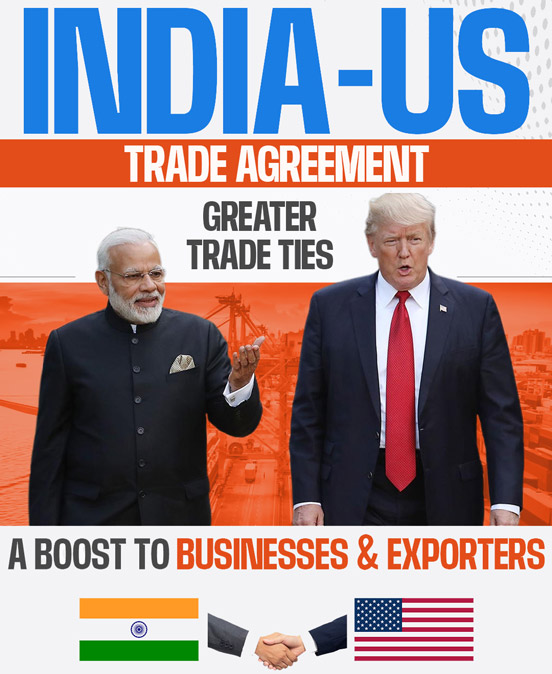
The India–US trade deal of 2026 marks a significant reset after months of tension.
When major powers negotiate, they rarely do so quietly. They posture, threaten, test resolve, and measure patience. For nearly twelve uneasy months, India–United States trade negotiations unfolded under the long shadow of tariff threats from President Donald Trump’s administration. Deadlines were announced and deferred, pressures applied and recalibrated. What appeared as brinkmanship on the surface was, in reality, a prolonged test of temperament — of who would blink first and who would endure longer.
India chose restraint over reaction. Rather than matching rhetoric with rhetoric, New Delhi adopted a calibrated approach, allowing dialogue and strategic patience to guide the process. The agreement reached in early February 2026 is therefore not merely a tariff settlement. It is the outcome of a diplomatic endurance test in which steady engagement outlasted political pressure.
Officials on both sides describe the pact as the first phase of a broader trade framework designed to restore confidence, lower barriers and expand the scope of strategic commerce between the two democracies.
Trade pact as a strategic counterweight to China
The emerging trade alignment between India and the United States is not merely an economic arrangement but a calculated geopolitical instrument to balance China’s manufacturing dominance and supply-chain leverage. By deepening tariff concessions, technology cooperation, and market access, both nations reduce dependence on Chinese production ecosystems while creating alternative industrial corridors across the Indo-Pacific.
For the United States, India offers scale, democratic stability, and a trusted destination for supply-chain diversification amid rising security concerns over Beijing. For India, preferential access to the American market accelerates exports, attracts investment, and upgrades domestic manufacturing capacity under strategic sectors like electronics, defense, and semiconductors. The pact thus serves dual purposes: insulating both economies from Chinese coercive trade practices and jointly shaping a rules-based economic order in Asia that rewards transparency, resilience, and democratic partnerships over authoritarian trade influence.
Strategic transition and enduring partnership with Russia may remain unaffected
One of the underlying tensions during negotiations related to India’s oil imports from Russia. Any reduction in these imports is expected to be gradual rather than abrupt. Industry discussions indicate that purchases could decline from earlier levels of 1.7–2.0 million barrels per day to roughly 500,000–600,000 bpd over time, with alternative supplies sourced from the United States, the Middle East, and potentially Venezuela.
A sudden halt would raise the import bill, pressure fuel prices, create inflationary stress, and require costly refinery adjustments. More importantly, oil is only one dimension of India–Russia relations. The partnership rests on decades of defense cooperation, nuclear energy collaboration, and diplomatic coordination. A calibrated shift in oil sourcing, if handled carefully, is unlikely to rupture these ties. The transition is therefore technical and economic rather than political. It is a fact that Trump is not averse to having ties with Vladimir Putin, which may be a long-term strategy to keep Russia away from China.
The EU agreement changed the negotiating geometry
The conclusion of the long-pending India–European Union trade agreement in early 2026 quietly altered the strategic backdrop of India–US talks. Preferential access to a 27-nation market demonstrated that India had viable alternatives to offset American tariff pressure. It signalled diversification of export destinations and reduced dependence on any single market.
This did not go unnoticed in Washington. The EU pact sharpened the commercial and geopolitical logic for the United States to conclude its own arrangement with India, ensuring American firms did not lose ground in one of the world’s fastest-growing large economies.
Sectoral gains across employment, agriculture, technology and defense
The most immediate beneficiaries of tariff normalization are India’s labour-intensive sectors — textiles, garments, leather, gems and jewellery — which employ millions and had suffered under elevated US duties. Restored tariff parity now allows these industries to compete again with regional rivals such as Vietnam and Bangladesh and reintegrate into American value chains.
Agriculture remains a sensitive frontier. India has protected critical segments such as dairy while allowing calibrated access to selected items. For the United States, expanded agricultural entry helps narrow its trade deficit; for India, the approach balances farmer sensitivities with trade pragmatism.
In services, particularly information technology and professional services, where tariffs do not apply, improved trade stability boosts business confidence. It also opens space for future discussions on professional mobility and digital trade frameworks.
A significant parallel development is in defence and aerospace cooperation. India is expected to step up purchases of US aircraft, drones, helicopters, and advanced systems. This links trade with strategic industrial cooperation and signals that economic engagement is increasingly intertwined with security collaboration.
Energy realignment, market confidence and the road to an FTA
The trade reset intersects with India’s evolving energy strategy. Diversification of crude supplies is being pursued in a phased manner to avoid inflationary shocks and refinery disruptions. The emphasis is on gradual realignment rather than dramatic shifts.
Financial markets reacted positively to the breakthrough. Equity indices firmed and the rupee strengthened as investor sentiment improved. Reduced tariff uncertainty supports export planning, capital flows and broader economic confidence at a time when India seeks a larger share of global trade by 2030.
Both governments now frame this pact as an opening chapter. Momentum is building toward a broader trade architecture that could eventually evolve into a comprehensive Free Trade Agreement covering goods, services, digital trade and movement of professionals.
Tariff reset and market access
The centrepiece of the agreement is the rollback of tariff pressures that had clouded bilateral trade. US duties on a wide range of Indian goods have reportedly been reduced to a standard band of around 18 per cent, a sharp drop from earlier punitive levels. For Indian exporters, this restores competitive parity with Asian peers.
In return, India is reducing or eliminating selected tariffs and non-tariff barriers on US products, in some cases bringing duties close to zero to fast-track American access. While full tariff schedules are still being negotiated, both sides describe this as the first tranche of a wider liberalisation process.
What comes next: A broader trade framework
Negotiations will now move toward detailed tariff schedules, sector lists, and services commitments. Discussions are expected to extend into digital trade, investment flows and professional mobility arrangements. The direction is clearly toward a deeper, rules-based economic partnership rather than ad-hoc tariff management.
Conclusion: A pivotal reset in bilateral trade
The India–US trade deal of 2026 marks a significant reset after months of tension. It lowers tariff barriers, restores confidence in key employment sectors, aligns energy considerations with trade policy and deepens cooperation in high-value areas such as defence and technology.
While not yet a full Free Trade Agreement, it lays a durable foundation for a more integrated economic relationship between the world’s two largest democracies — moving the partnership from tariff disputes toward long-term trust and strategic alignment.
--------------------------------------

(K S Tomar is a strategic affairs columnist and senior political analyst based in Shimla)
The views expressed are not necessarily those of The South Asian Times