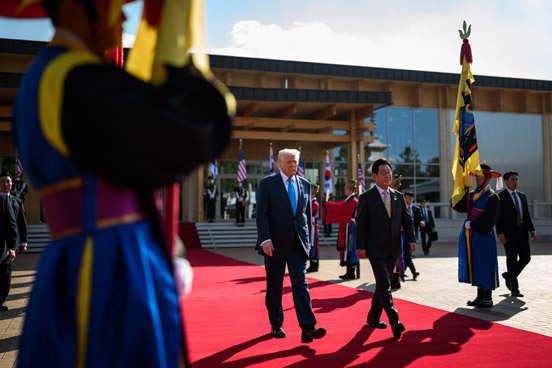
New Delhi: The United States and India will sign a long-delayed trade deal, Donald Trump said in South Korea, on the last leg of his Asia tour.
The US President's remark indicates a deal between two of the world's largest economies is only a question of time. Talks over the deal have dragged on for months now, punctuated by squabbles over Russia's war on Ukraine and India buying oil from Russia, and a row over tariffs.
"If you look at India and Pakistan, I'm doing a trade deal with India and have great respect and love for Prime Minister Narendra Modi… we have a great relationship," he said. Trump's positive remarks follow reports last week of progress over two of three major sticking points – India's continued import of discounted Russian oil and the US' 50 per cent 'reciprocal' tariff on import of Indian goods, which included a 25 per cent 'penalty' for buying that oil.
Talks had also stalled over India refusing the US access to its price-sensitive dairy and agriculture goods market, which constitutes a vital voter base for any Indian government.
Last week, though, reports said the US had agreed to reduce tariffs to 16 per cent after India agreed to scale back purchases of Russian oil. This was after Trump and Modi spoke on the phone, though neither side offered details or confirmed the trade-off between tariffs and oil.
The compromise could also see increased imports of non-genetically modified American corn and soymeal – goods at the centre of this particular trade stand-off between Washington and New Delhi – and include a mechanism to periodically review tariffs and market access.
India has increasingly turned to corn to boost ethanol output, but its rules bar ethanol made from imported grains and prohibit genetically modified (GM) food crops. The US mostly grows GM corn, though some farmers also produce non-GM varieties.
The US is pressing India to allow corn imports, arguing that ethanol made from American corn would be used only for blending with petrol and not enter the agriculture markets.
The push on soybeans, meanwhile, is a fallout of the US' tariff war with China, as a result of which, American soybeans are too expensive for the Chinese. The US, therefore, wants to sell its soybean surplus to India as protein-rich feed for the country with the most cattle in the world.
The Indian government has maintained a firm position throughout these protracted talks, that it will not accept any deal that could negatively impact the livelihoods of crores of small farmers.
Earlier this month, External Affairs Minister S Jaishankar said any deal with the US would have to respect India's 'red flags', referring to the "unfair" 25 per cent 'penalty' for buying Russian oil.