By Bhuvan Lall
There is a particular quality of light on the Côte d’Azur that does not exist anywhere else on Earth. It arrives before dawn, tentative and golden, pressing itself against the terracotta rooftops and the drowsing harbor. Then, with the unhurried confidence it floods the hillsides, the lavender fields, the ancient stone of the citadel, and the endless variations of blue that the Mediterranean performs each morning as though for the first time.
It is here that the former fishing village Saint-Tropez, situated on the western shores of the French Riviera, wears its fame with easy nonchalance. The Italianate baroque church presides over the old town with gentle authority. Sycamore trees, those great, dappled patriarchs, line the Place des Lices, where old men in linen still bend over their pétanque with the solemn concentration of chess grandmasters.
Narrow medieval alleyways, fragrant with wisteria and steeped in afternoon shadow, open unexpectedly into galleries where painting and sculpture compete for one’s attention. Luxury boutiques, their windows impeccable as theatre sets, appear at the end of cobbled labyrinths. And in the open-air Provençal market, the long shadows of high summer fall across stalls of olive oil, cut flowers, honey, and those curious Tropézian boxes. Along the old port, legendary restaurants with their constellations of Michelin stars cast golden light onto the water. For nearly two centuries, this small corner of Provence has exercised an almost supernatural power over the imagination of the world.
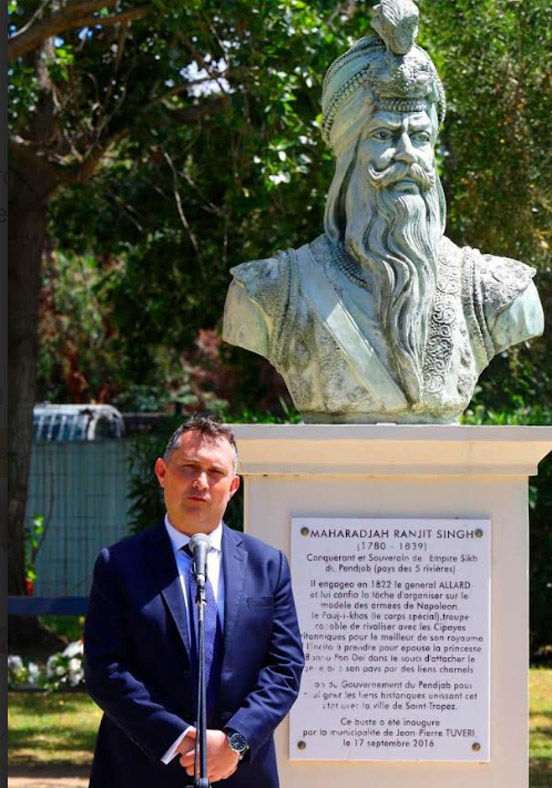
Frederic Allard in front of Maharaja Ranjit Singh's statue in Saint-Tropez.
The artists arrived first, drawn by that incomparable light. Paul Signac sailed into the harbor in 1892 and never quite left. He wrote to his friend Claude Monet of skies he could not believe, of a sea that shifted through fifty shades between noon and dusk. In his wake came Matisse, Bonnard, Hockney, Picasso, and the Belgian pointillist Théo Van Rysselberghe, each attempting, in his own fashion, to arrest the luminous, evanescent quality of this place on canvas. Writers followed: Colette, who understood sensuality as few ever have; Hemingway, who understood courage; Scott Fitzgerald, who understood beauty and its costs; and Françoise Sagan, who understood the particular recklessness of the young and the privileged. These were not casual visitors. They were pilgrims.
Then, in 1956, a young Brigitte Bardot stepped before Roger Vadim's camera in the film, 'And God Created Woman', and the world turned its gaze permanently, irreversibly, toward Saint-Tropez. What followed was one of the most spectacular transformations in the history of leisure: this small Provençal harbor town became the defining theater of mid-century glamor. The glitterati of the world arrived, with their heavy, monogrammed trunks and their magnificent, complicated lives.
The tradition held. It has never ceased. Today, paparazzi still patrol the harbor at golden hour, their lenses trained on the world’s most extravagant yachts where iconic fashion designers, legendary musicians, and Hollywood’s superstars are known to appear. It is said, with some justice, that no one in the world is recognized as a billionaire unless their super luxury yachts and floating palaces are anchored in Saint Tropez.
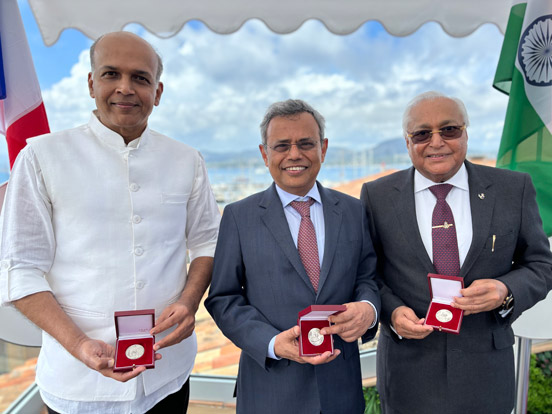
Filmmaker Ashutosh Gowariker, Ambassador to France and Monaco, Jawed Ashraf, and the UK's Lord Rami Ranger, were honored with the Medal of Saint-Tropez in 2024.
Yet behind the glittering facade of celebrity, Saint-Tropez guards a story of a more intimate and astonishing kind: a love that crossed continents and centuries, and which quietly, intractably, refuses to be forgotten.
On March 16, 1822, a 37-year-old Frenchman named Jean François Allard, born in Saint-Tropez, veteran of the Napoleonic campaigns in Naples, Spain, and Portugal, and former aide to the Emperor at Waterloo, presented himself at the Lahore Durbar before Maharaja Ranjit Singh, the Lion of Punjab.
The Maharaja, who wore the Kohinoor diamond upon his arm, presided over one of the richest kingdoms on Earth. But he faced a threat that no amount of treasure could deflect: the relentless northward advance of the British East India Company and its formidably trained army. He needed a military genius. In Allard, charming, Persian-speaking, steeled by the greatest military education the age could offer, he found one.
General Allard created the Fauj-i-Khas, the Royal Brigade: elite infantry drilled in the French manner, uniformed in the blue and red of Napoleon’s Grande Armée, commanded in French terminology, marching beneath tricolor standards inscribed with the Sikh invocation “Waheguru Ji Ki Fateh” (Victory belongs to God).
It was an extraordinary hybrid, a unit born of two civilizations, forged into something new and formidable. Allard’s cavalry won its honors at Naushehra, Multan, Peshawar, and across the campaigns of the northwest frontier, reaching its zenith in the First Sikh War of 1845–46. The Maharaja honored his general with the Kaukab-e-Iqbal-e-Punjab (the Bright Star of Punjab), the kingdom's highest distinction.
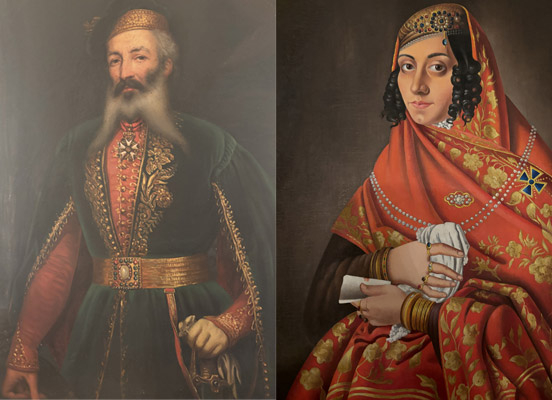
But it is the love story that endures with the deepest resonance. Allard encountered Princess Bannou Pan Dei and was mesmerized by her beauty. The Tropézian General began writing poetry and composing romantic verses in Urdu and Persian. They were married in March 1826 and moved to the opulent Kapurthala house in the Anarkali residential district of Lahore.
In 1834, the family traveled to Saint-Tropez: Allard, the Princess, their four children, two attendants, and the accumulated richness of a life built between two worlds. Allard settled them in a grand mansion, returned to Lahore bearing gifts and a letter from King Louis Philippe to the Maharaja, and was appointed France’s Political Agent at the Lahore court. He received the Commandeur de la Légion d'Honneur. He had, it seemed, achieved everything.
On January 23, 1839, Jean François Allard died of heart failure in Peshawar, 53 years old. His cortege was honored with gun salutes at every station on the long road back to Lahore. In Saint-Tropez, Princess Bannou Pan Dei waited. She stood at the harbor, that harbor of golden light and returning boats, and looked out to sea for a husband who would not come. She waited, in her way, for forty-five years. On January 13, 1884, she was laid to rest in the Cimetière Marin, the sea cemetery of Saint-Tropez, where the Mediterranean wind moves perpetually through the cypress trees.
Today, marble busts of General Jean Francois Allard, Princess Bannou Pan Dei, and Maharaja Ranjit Singh stand together in a garden at a prominent crossroads in the town, three figures from an improbable, magnificent story, presiding quietly over a place more accustomed to celebrityhood than to history.
The town of Saint-Tropez, along with the descendants of the Allard family, honors this Franco-Indian legacy with Nirvana, its festival of Indian cinema, music, dance, fashion, gastronomy, and yoga, organized in partnership with the Indian Embassy in France. Saint-Tropez bestowed Jawed Ashraf, Indian Ambassador to France and Monaco, Lord Rami Ranger of the United Kingdom, and Ashutosh Gowariker, the Academy Award-nominated Indian filmmaker, with the Medal of Saint-Tropez at Nirvana 2024.
Here, then, is the full portrait: a town of sunflowers and superyachts, of medieval alleyways and Michelin-starred terraces, of peacocks on car bonnets and lavender on the hillsides. A town where artists came to understand light, where the rich and famous come to be seen, and where, in a quiet corner, the story of the Indian Princess and a French General is immortalized, two hundred years of history unfolding like it was yesterday.
This is the old-school magnificence that the French do so enduringly, so achingly well.
----------------------------------------

(Bhuvan Lall is a creative entrepreneur, biographer, author, and filmmaker. He can be reached at [email protected])
(All photos courtesy of the author)