By Bhuvan Lall
On February 25, 2026, Prime Minister Narendra Modi landed in Tel Aviv and was accorded a warm and enthusiastic reception. An Israeli band welcomed him with the song “I Love My India” from the Subhash Ghai film 'Pardes', starring Shah Rukh Khan. Perhaps no moment better illustrates filmmaker Ghai’s place in India’s cultural universe than that day. In that extraordinary scene, the song born of Ghai’s patriotic vision transcended cinema entirely, becoming the sound of Indian identity on foreign soil.
Born in a family torn by partition, Ghai grew up absorbing the complex symphony of a civilization simultaneously ancient and reborn. He later carried that duality into every story he ever conceived. The young, fire-eyed dreamer graduated from Pune’s Film and Television Institute of India, went on to marry his soulmate Rehana, and stepped onto the vast, churning stage of Hindi cinema.
In his nearly sixty-year-old career, Ghai made several blockbuster hit films touching the cultural pulse of his motherland. His cinema was never just escapist fantasy; it was rooted in the soil of India, drawing from its ancient traditions, its grandeur, its home-grown poetry, and its soaring democratic idealism.
For millions of his fans, to watch a Subhash Ghai film was to be reminded, viscerally and beautifully, of what it means to be Indian. Through his films, he also carried the ideas of India, its spirituality, its drama, and its vibrant plurality to global audiences.
The arc of Ghai’s incredibly successful filmography reads like a mirror held up to India’s evolving aspirations and emotions. With his directorial debut, 'Kalicharan', he announced a voice of bold, unapologetic storytelling. With 'Karz', he wove reincarnation mythology into a modern thriller with such deftness that the cult film’s haunting music still echoes across decades.
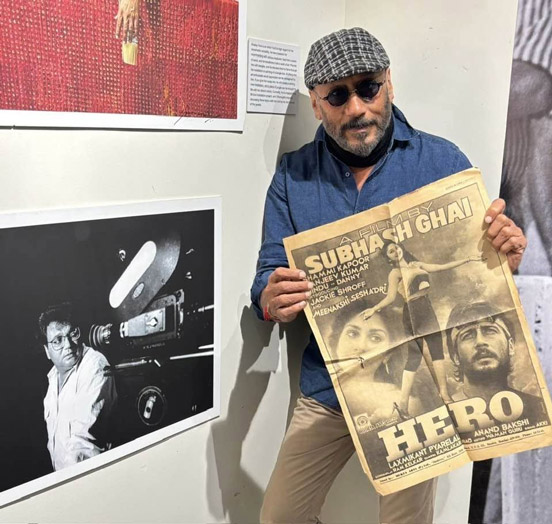
Actor Jackie Shroff holding a poster of 'Hero', which was directed by Ghai. (Photo courtesy: Subhash Ghai/Facebook)
With 'Hero', he invented archetypes of young rebellion and romance that generations adopted as their own. With 'Karma', he dealt with patriotism and national unity as a principled jailer united convicts to defeat terrorism. With 'Ram Lakhan', he painted brotherhood, duty, and justice on the broadest possible canvas, making dharma feel urgent and alive.
With 'Pardes', he explored the enduring power of Indian family values against Western modernity. And long before Indian filmdom’s intersecting with Hollywood became fashionable, Ghai was already dreaming across continents. The script of 'Khalnayak', was originally written by him in Los Angeles and drew the attention of Hollywood’s top stars.
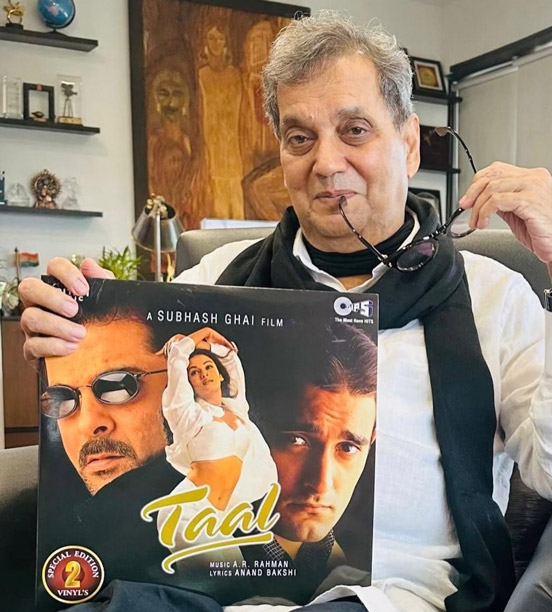
The film remains a testament to Ghai’s ability to craft narratives of universal moral complexity. Yet perhaps no film better encapsulates the creative genius of Ghai than 'Taal', a work of such cinematic splendour that it crossed every border India’s cinema had previously known. Featuring the transcendent music of A R Rahman, 'Taal' was not merely a hit globally (becoming the first Indian film to reach the Top 10 in the US Box Office); it was a cultural event, a proof of concept that Indian storytelling possessed a universality capable of touching hearts far beyond the subcontinent.
Famous film critic Roger Ebert was moved by the innocence and noted that 'Taal' captured a joyful classic Hollywood-style music spirit that had largely disappeared from American cinema. The music of Ghai’s films sets them apart from the ordinary. His soundtracks do not merely accompany his narratives; they outlive them, seeping into the daily fabric of Indian life. It is a telling detail of cinematic history that Rahman’s Oscar-winning composition “Jai Ho” was originally crafted for Ghai’s 'Yuvvraaj,' underscoring how profoundly his project’s creative orbits have nurtured India’s finest artistic voices.
One of Ghai’s most enduring contributions to Indian cinema is something that no award statuette can fully capture: the shaping of its greatest human capital. He directed Indian cinema’s most remarkable actors, Dilip Kumar, Raaj Kumar, and Sanjeev Kumar and is, by any measure, one of the most formidable star-makers the industry has ever known.
Actors ranging from Jackie Shroff, Anil Kapoor, Manisha Koirala, and many others who entered his studios as talented individuals got transformed into megastars who would go on to dominate Indian cinema. Even famous villain Gulshan Grover credits Ghai for characterizing him as the ‘Bad Man’. When Anil Kapoor found himself in Los Angeles as 'Slumdog Millionaire' swept the awards in 2009, his first instinct after the Oscars ceremony was to reach for a phone and call Ghai. Seven films together had forged not just a creative partnership but a lifelong fraternity. This bond speaks to the rare humanity Ghai brings to every professional relationship in his extraordinary life.
If Ghai’s films and his production company Mukta Arts are his most visible legacy, Whistling Woods International is perhaps his most visionary. Founded with the mission of nurturing young creative talent, Whistling Woods, managed proficiently by Ghai’s elder daughter Meghna, has grown into one of Asia’s finest film and media schools.
It is now ranks among the world’s top twenty in its field. In conceiving Whistling Woods, Ghai did something that separates the merely celebrated from the truly great: he chose to invest not in his own immortality, but in the immortality of others. Every student who walks out of Whistling Woods carrying a camera, a script, an actor’s poise, or a director’s vision is in some measure a product of Ghai’s belief, his faith that Indian storytelling will continue to evolve, surprise, and illuminate the human condition and win global awards and audiences. It is an act of institutional patriotism, a gift to India whose dividends will compound across generations yet unborn.
Today, Subhash Ghai stands as one of the foremost architects of India’s soft power. In an era where Indian cinema is increasingly asserting its rightful place on the world stage, filmmakers like Ghai remind us that this ascent was never sudden. It was the result of decades of patient, passionate, brilliant effort by filmmakers who believed in India.
Ghai's ambition was never merely to conquer the Indian box office but to position Indian storytelling on the global stage, carrying India’s soul to audiences who had never before heard its voice. His body of work is knitted into the memories and dreams of his countless global fans. He styled actors who are emulated.
He wrote dialogues that are the vocabulary of a people. He created characters that are archetypes. Families wake up to his melodies. Weddings are adorned with his songs. Young lovers whisper lines from his films. Elders hum his refrains at twilight. Even the next generation of filmmakers employ his soundtracks as creative quotations in their films. His younger daughter Muskaan is now entering the creative world with the same focus and passion as him.
Subhash Ghai’s contribution to India is unparalleled. It is fitting that Bharat Sarkar should honor Ghai with the prestigious Dadasaheb Phalke Award and Padma Vibhushan, as a recognition of a lifetime wholly consecrated to the service of India’s culture, and a life spent carrying the nation’s stories across the world. Subhash Ghai is a legendary icon of Indian filmdom, a man whose work has so thoroughly entered the bloodstream of the nation that it is impossible to imagine the nation’s cinematic identity without him.
---------------------------------------------
(Bhuvan Lall is the biographer of Subhas Chandra Bose, Har Dayal, and Vallabhbhai Patel. He is also the author of Namaste Cannes, India on the World Stage, and Delhi in the Era of Revolutionaries. He can be reached at [email protected].)