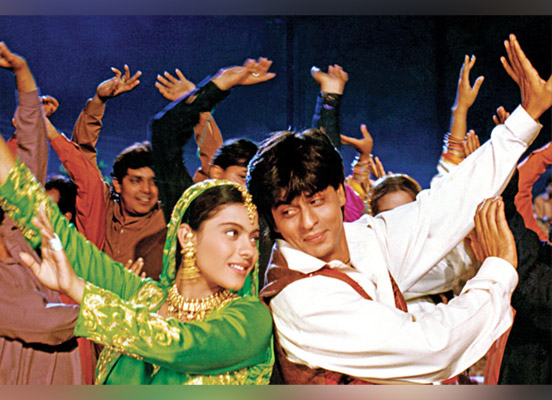
By Bhuvan Lall
The Badshah of Bollywood, with his transnational prominence, has been India’s most effective cultural diplomat.
It was the middle of the monsoons in 1988. New Delhi was wet, humid, and indifferent to the dreams of its inhabitants. There was an unusual buzz at the Mass Communication Research Centre on the campus of Jamia University. The staff and students spoke in excited tones about a new student who had enrolled in the very exclusive MA program.
That was where I took notice of him for the first time. There he was, standing in the foyer. Ruffled hair, the top two buttons of the shirt undone, a thick military-style belt on his waist, stylishly holding a cigarette in his hand, and a determined, confident look on his handsome face.
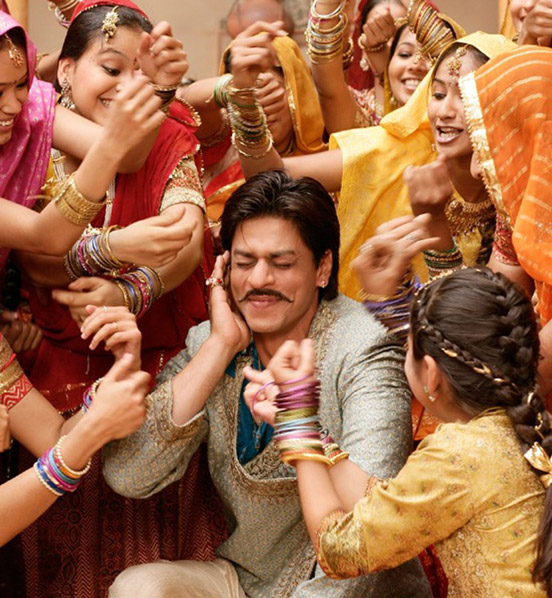
Shah Rukh's 'Paheli' was India’s official entry for the 78th Academy Award in the category of Best Foreign Film. (Photo courtesy: Red Chillies Entertainment)
He was at Jamia, he said, to study making films and was already getting offers to act in television serials for the State Broadcaster Doordarshan. Then he sped off in his White Maruti Van. Some people know early where life’s heading. He seemed one of them. Inside him, there burned something that the city around him had no language for. And back then, no one knew this 21-year-old was going to be a superstar. Today, the world knows him as SRK.
Born in Delhi into a middle-class family with a strong sense of values, young Shah Rukh grew up in rented flats, surrounded by cricket lanes, daily dramas, and the peculiar ambition that only India’s small neighborhoods seem to trigger. His father, Meer Taj Muhammad Khan, was a supporter of Subhas Chandra Bose and an Indian independence activist originally from the North West Frontier Province.
At the same time, his mother, Lateef Fatima Khan, worked as a magistrate. Meer Taj Muhammad Khan had stayed in Delhi when the great severance came in 1947. He believed in the idea of India. He wanted to raise his family in this land. His son, Shah Rukh, first gained national fame for his role in the TV series 'Fauji'. He soon dropped out of Jamia to pursue acting. At twenty-five, tragedy struck. He was entirely alone after losing his parents. He worked through grief with determination and a nearly supernatural charisma to build a full-time career in Mumbai’s impenetrable film industry.
.jpg)
Author Bhuvan Lall with Shah Rukh at Nirvana, Beverly Hills, CA, in December 2005. (Photo courtesy of the author)
Shah Rukh chose an unorthodox path for an actor by picking films that resisted casting him in the traditional mould of a romantic hero. He played the villain so convincingly that the audience fell in love with him. The success of 'Dilwale Dulhania Le Jayenge' in 1995 changed everything. Overnight, he became the nation’s favorite romantic hero, the man waiting on the railway platform for his beloved with his open arms.
Throughout the nineties and 2000s, his star power seemed unstoppable. His films not only dominated the domestic market but also across the Indian diaspora. With his arms flung wide, head tilted back, a smile that swallowed the screen, Shah Rukh Khan came to be symbolized as the Badshah (King) of Indian cinema. And yet he worked on expanding the global footprint of Indian films.
Some twenty years ago, in late December 2005, a white Bentley Arnage drew up before the Nirvana restaurant in Beverly Hills, California. From the car stepped Shah Rukh Khan, dressed as always in black, moving with the particular ease of a man who had spent his life being looked at. He had come to advance the claims of his film, 'Paheli', India’s official entry for the 78th Academy Award in the category of Best Foreign Film. He had acted in it and produced it.
Among the Hollywood people that evening, he spoke with a careful modesty. “I have been told,” he said, “that 'Paheli' is rather entertaining here. Which is strange. In India, it was not thought entertaining enough. It failed.” There was some understanding of global sensibilities in the admission, and he knew the odds for an Oscar nomination. “It is a long shot,” he said. “But perhaps some recognition will come to Indian cinema.”
He spoke with greater feeling about the possibility that lay beyond the prize itself, that India might be seen, at last, as a serious participant in the world’s idea of itself. Ranked as one of the highest taxpayers in India, he stated his mission, “I want people to look at India as a window of opportunity.”
Shah Rukh Khan’s films, with their songs, dances, and unabashed sentiment, were not an easy sell overseas. Yet over time, his cinema crossed cultural and linguistic barriers. What sets him apart from nearly every other Indian star is the sheer geography of his devotion. His fan base does not merely cross oceans; it saturates them.
For audiences as far as Peru, Saudi Arabia, China, Malaysia, Sweden, Kenya, and Morocco, he reminded them of what they had half forgotten, that the emotions which bind people together are more durable than the borders that keep them apart. He walked the red carpet at the Cannes film festival with 'Devdas', the lush and operatic tragedy, and joined his hands in a graceful namaste for the paparazzi.
The French government honored him with both the Ordre des Arts et des Lettres and the Légion d’honneur. The French acknowledged his talent for transcending cultural and historical differences and bringing people together through his films. In Germany, his following among non-Indian audiences is truly intense and most documented.
Among his fans are women who have learnt fragments of Hindustani and followed his filmography with methodical attention. He has spoken at Davos in 2018 and received a lifetime achievement award at the Locarno Film Festival in Switzerland in 2024.
In the Middle East, audiences have grown up watching his films, singing his songs in a language they do not speak, and finding in his characters something of their own emotional landscape. His cultural footprint is no longer that of a visiting celebrity in the Middle East; he has become an institution.
Time magazine listed him among the 100 most influential people in the world; he presented an award at the Golden Globes and was invited to join the Academy that votes for the Oscars. He appeared at the Met Gala in New York City in 2025, regal, unhurried, and beaming, representing a nation arriving at a table it had long deserved a seat at.
Today, Shah Rukh Khan’s significance truly transcends stardom. He is the most recognized human being on the planet, as well as India’s most famous actor overseas. While nations compete for soft power as fiercely as they do, Shah Rukh Khan, with his transnational prominence, has also been India’s most effective cultural diplomat.
Over three decades, his films have presented the world’s largest democracy as plural, passionate, emotionally intelligent, and irresistibly human. He has made India legible to audiences who may never have visited, and made it lovable to those who have. He appears on screens of every size in every continent, spreading his arms expansively and smiling like he owns the world. For his global fans, in a very real sense, he does.
As India takes its place on the world stage, economically, diplomatically, and culturally, Shah Rukh Khan at sixty is not merely a superstar; he is India’s most compelling export, a living, breathing ambassador of a nation’s dreams.
(Bhuvan Lall is the biographer of Subash Chandra Bose, Har Dayal, and Vallabhbhai Patel. He is the author of Namaste Cannes and India on the World Stage. He can be reached at [email protected])