Our house sits beside a fairly busy road, which means that I occasionally have to pick up litter from our yard. It’s one of my jobs at home. My wife and I split household duties: she does the cooking, shopping, and decorating, while I do the cleaning, yard work, and football watching.
Picking up litter comes under ‘yard work,’ but unlike colorful leaves falling from trees in autumn, there’s little beauty to be found in fast-food wrappers falling from passing cars. I wish I could identify the litterbugs, go to their homes, and return their trash to them.
Me: “Hello. I have something for you: your Starbucks coffee cup. I found it in my yard.”
Litterbug: “That’s not mine.”
Me: “Are you sure? Because it’s got your name on it. Vivek.”
Litterbug: “Vivek is a very common name. There are six Viveks working for my company, and another four on the Board of Directors. There’s also a Vivek who ran for president, a Vivek who served as the Surgeon General, and a Vivek who owns the Sacramento Kings basketball team.”
Me: “This cup is definitely yours. I sent it to a DNA lab, and using DNA and genealogy databases, they determined that there’s a 99.999 percent chance that this coffee cup is yours, and a 0.001 percent chance that it belongs to Vivek Ramaswamy.”
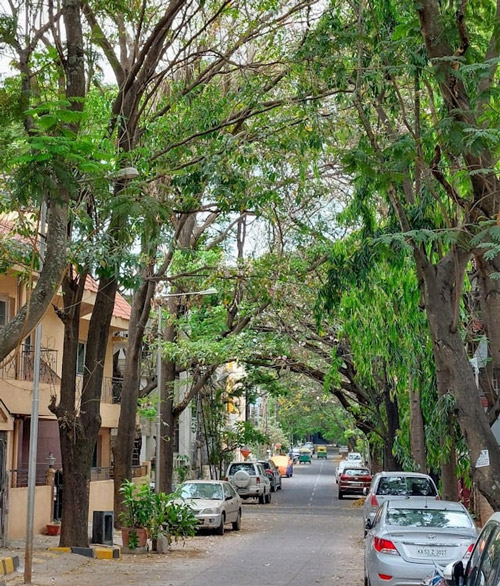
Of course, no one goes to that much trouble to identify litterbugs. Littering is certainly not a serious crime, but it can be a major problem in some cities. That’s why I was happy to read about an initiative undertaken in Bengaluru, India. According to an NDTV report, the Greater Bengaluru Authority (CGA) has launched a “Garbage Dumping Festival,” warning residents that if they dump garbage into the streets, the garbage will be dumped right back onto their doorsteps.
“To create awareness, this is a sort of a return gift,” said Kari Gowda, CEO of the Bengaluru Solid Waste Management Limited (BSWML).
Just picture a BSWML worker knocking on a door after dumping a pile of garbage on a doorstep.
Worker: “It is my pleasure to bring this return gift to you.”
Resident: “Return gift?”
Worker: “Yes, we are returning the gift that you gave to the city. We appreciate your generosity, but we just can’t accept it. It would be unethical to receive it, as it might be construed as a bribe.”
Resident: “What will I do with it?”
Worker: “Give it to your in-laws.”
Resident: “But I like them.”
Worker: “And you don’t like the city?”
In addition to returning garbage to people who dump, the city is imposing a ₹2,000 fine, even for first offenses. You may be wondering how the GBA is going to catch offenders. Well, the GBA will rely on video recordings, including videos taken by ordinary citizens. As an incentive, the GBA is offering ₹250 to anyone who records and shares videos of people dumping garbage.
If you live in Bengaluru and happen to record a friend throwing garbage in the street, you may wonder if it’s worth snitching on your friend for ₹250.
No, it’s not. But you may want to assume the role of a BSWML worker and give your friend a return gift.