Parul Somani, an MIT- and Harvard-trained author and speaker, shares what inspired her book and how her Path of Least Regret framework helps people navigate uncertainty and hard choices.
Parul Somani did not write The Path of Least Regret: Decide with Clarity. Move Forward with Confidence from the safe distance of theory. She wrote it out of lived experience—through burnout, an aggressive cancer diagnosis as a young mother, and the reinvention that followed.
Her debut book argues that when certainty is impossible, the important decisions are not about finding a perfect answer, but about choosing the path that best aligns with what matters most.
That message grew out of a life that, on paper, looked successful. A graduate of MIT and Harvard Business School, Somani built her career in management consulting before taking on leadership roles in Silicon Valley startups.
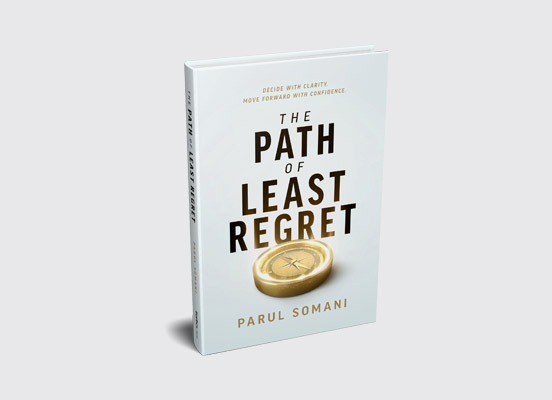
The book asks a simple but searching question: when there is no easy answer, what choice can a person live with most peacefully over time? (Photo courtesy of the author)
Like many high-achievers, she had been trained to approach decisions analytically: gather the facts, weigh the options, and identify the smartest choice. But some of the decisions that shape a life do not arrive with complete information, clean tradeoffs, or guaranteed outcomes. They arrive in seasons of uncertainty, grief, fear, and competing responsibilities. In those moments, even the most capable people can feel stuck.
That was the gap Somani wanted to address. She saw how often people were being told to “trust themselves” or “follow their gut” without being given a practical way to think through hard choices. At the same time, she knew from experience that logic alone was not enough when the stakes were deeply personal.
Over time, she began to articulate a different way forward: a values-based approach to decision-making grounded not in prediction, but in alignment. That idea became the foundation of The Path of Least Regret.
At its core, the book asks a simple but searching question: when there is no easy answer, what choice can a person live with most peacefully over time? Somani’s answer is the “path of least regret.” It is not the easiest path, the safest one, or the one that wins the most approval from others. It is the path most aligned with a person’s values, priorities, and aspirations—the path that allows them to move forward with greater clarity, integrity, and peace of mind, even without guarantees.
The book is written for readers in transition: professionals considering a career pivot, leaders navigating uncertainty, parents balancing competing demands, caregivers making difficult family decisions, and individuals wrestling with burnout, reinvention, or what comes next. Its appeal is especially strong for people who may appear accomplished from the outside but feel internally conflicted, overextended, or disconnected from what matters most.
Part of what gives the book its reach is the way Somani combines personal narrative with practical guidance. She writes from lived experience, but also draws on behavioral science, leadership insight, and coaching principles. The result is reflective without becoming abstract and useful without becoming formulaic. It does not promise a life free from fear, grief, or ambiguity. Instead, it offers a grounded way to make decisions in the presence of those realities.
Somani’s background also gives the book credibility across both personal growth and professional leadership audiences. Today, she is known as a keynote speaker, decision strategist, mindset coach, and author whose work sits at the intersection of those worlds. She speaks to individuals and organizations about how to navigate uncertainty, change, and hard choices with greater resilience and intention.
That positioning makes sense: the dilemmas people face at work and at home are rarely as separate as they appear. Career choices affect family life. Health crises reshape identity. Caregiving changes ambition. Burnout raises questions about purpose.
For South Asian readers in particular, Somani’s work may strike a familiar chord. Her story reflects themes that resonate across many South Asian families and communities: ambition, responsibility, resilience, family expectations, and the pressure to keep moving forward no matter what life brings. But her message also pushes against a narrow definition of success rooted only in achievement, stability, or appearances. Instead, she asks a more inward question: not just what looks right from the outside, but what feels right to live with over time.
That shift is a large part of what makes The Path of Least Regret timely. Readers are rethinking inherited ideas about success, sacrifice, and fulfillment. Younger adults are questioning conventional career scripts. Mid-career professionals are reexamining burnout and purpose. Parents and caregivers are navigating competing loyalties. Across those experiences, Somani’s central idea remains relevant: clarity does not come from controlling the future. It comes from getting honest about what matters most in the present.
For Somani, writing the book was not the end of the work. It was the beginning of a broader effort to bring its ideas into public conversation. Her focus now is on helping the framework reach wider audiences through speaking engagements, fireside chats, workshops, leadership forums, and community conversations. She sees The Path of Least Regret not only as something to be read privately, but as something to be discussed and applied in real time. The questions at the center of the book—how to move forward when every option carries tradeoffs, how to make peace with imperfect choices, how to stay connected to one’s values when life becomes unpredictable—are the same questions people bring into workplaces, families, and communities every day.
Readers interested in learning more can visit parulsomani.com, where they can find information about the book, Somani’s speaking work, and resources, including a free guide designed to help them begin applying the Path of Least Regret approach in their own lives. She shares insights on LinkedIn and Instagram at @pdsomani, where her content explores decision-making, resilience, mindset, and intentional living.
With The Path of Least Regret, Parul Somani has written more than a book about decision-making. She has offered a vocabulary for navigating the crossroads that define a life. In a moment when people are searching for clarity while living without guarantees, that message may be what gives the book its widest resonance.
The Path of Least Regret, launched on March 31, 2026, is available now on Amazon and other major booksellers in hardcover, ebook, and audiobook. Learn more at parulsomani.com/book