By Aashna Shah
For years, we were told to shrink.
Neutral palettes. Capsule wardrobes. Clean girl aesthetics. The quiet pressure to look effortless, polished, and most importantly, minimal. Somewhere along the way, “less is more” stopped being a design principle and started feeling like a personality requirement.
Now, maximalism is pushing back.
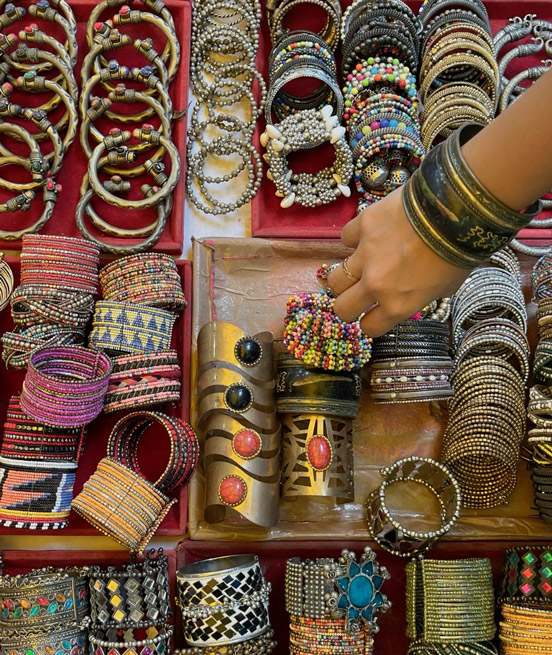
Maximalism is color that refuses to be toned down. It is stacked bangles that jingle when you move. It is mixing prints that technically should not work but somehow do. It is walking into a room and not apologizing for being seen. Where minimalism edits, maximalism amplifies.
For South Asians, this “revival” feels almost ironic. We never really left.
Our culture has always understood the power of more. Bridal lehengas are not meant to blend in. Temple jewelry is not designed to be delicate. Festivals are not quiet. From mirror work in Gujarat to Kanjeevaram silks in the South, South Asian style has always embraced richness, craftsmanship, and storytelling. Every thread, every embellishment, every layer carries meaning.
So when maximalism shows up on global runways and Pinterest boards, it is not just a trend. It is a recognition, even if overdue, of an aesthetic that has existed far beyond Western fashion cycles.
But what makes this moment different is who is reclaiming it.
Young South Asians are not just inheriting maximalism; they are remixing it. A vintage dupatta becomes a statement top. Sneakers meet embroidered skirts. Gold jewelry is layered over streetwear. It is not about tradition versus modernity anymore. It is about coexistence. Identity is no longer something to simplify. It is something to build on.
Social media has only accelerated this shift. In a sea of sameness, maximalism cuts through. It demands attention in a way that feels intentional, not performative. It allows people to be multidimensional in a space that often rewards uniformity.
For a generation that has grown up balancing identities, expectations, and definitions of belonging, “more” is not overwhelming.
It is honest.
(Aashna Shah is an Indian American sophomore at Syosset High School interested in business and storytelling. She hopes to use the Kaleidoscope as a pathway to uplift underserved communities. She serves as the Submission Coordinator for Kaleidoscope, where she helps curate and elevate youth voices through storytelling. )