By Basab Dasgupta
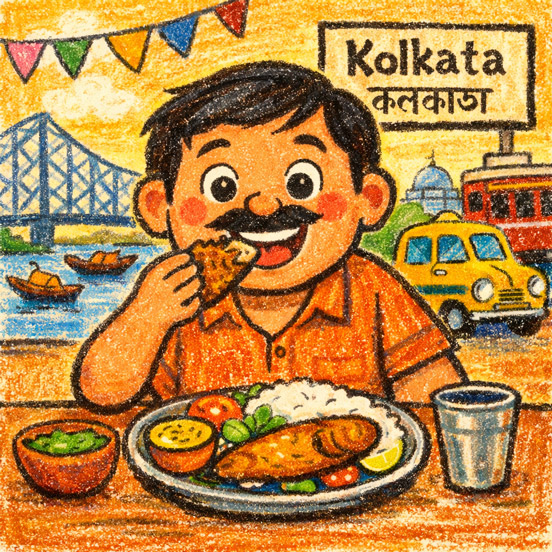
A news item about making “Desi Magur” (a smaller version of catfish) the state fish in Jharkhand to promote its conservation efforts made me very happy. I was born and brought up in the greater Kolkata area in houses on the river Ganges, where my main source of protein was fish. Occasionally, we had chicken and goat meat, but on very few days without fish.
I probably ate every species of fish available and cooked using every known recipe, even dried, dehydrated fish. The two most common fish in our home menu were “Ruhi” and “Hilsa”. Ruhi fish was good for making an everyday curry, and the staple of our home menu. Hilsa was saved for more exotic preparations. I still lick my chops thinking about Hilsa cooked in a mustard sauce with green peppers. Then there were side dishes like fish chop and fish cutlet.
I remember names of most types of fish, including “Magur”, “Pabda”, “Koi”, “Punti”, “Katla”, “Vetki”, “Tilapiya”, “Pomplet”, etc. One of my fond childhood memories is my father inquiring from our rooftop with the fishermen on their boats on the river: “Chief, do you have any?” It was a bad omen to ask more directly, like “Did you catch any Hilsa fish today?”
It was a shock when I came to the US because none of the fish I knew were available here except shrimp. Popular American fish such as Cod, Halibut, Salmon, Bass, Marlin, Trout, Flounder, Haddock, Pollock, Mackerel, Whitefish, Mahi Mahi, etc, were rather expensive and/or tasted bland to my taste buds; probably because most were ocean fish, unlike river fish I grew up with. Canned Sardines were affordable but good only for a snack or lunch.
With the help of local Bengalis already here, my wife and I learned that there are close equivalents of both Ruhi and Hilsa, known as “Carp” and “Shad", respectively, but they are generally considered lower-grade fish (“bottom feeder”), available only in inner city neighborhoods. We hunted down one such fish store, and much to our pleasant surprise, prices were reasonable; furthermore, they offered heads of carp for free if we wanted.
Of course, the Bengalis love moong dal and cabbage prepared by mixing them with bones taken from the head of a Ruhi fish. However, the place was far from our home; we ended up relying on chicken and red meat for our protein needs, only occasionally cooking trout or salmon.
I lived in Louisiana for several months when I first came to the US. The state and especially the city of New Orleans is famous for Southern cuisine. I fell in love with catfish cooked Cajun style; for some reason, it is popular only in the Southern part of the US. I have tried “Chilean Sea Bass” (made famous by the movie “Jurassic Park”) a few times and loved it; however, it is one of the most expensive varieties.
When I lived in Wisconsin, we visited the Wisconsin Dells in Door County one summer. One alluring attraction of Door County is the so-called “Fish Boil” - a tradition brought along by Scandinavian settlers. Freshly caught Lake Superior whitefish is literally boiled in water with butter, onion, and potato over an outdoor open flame, giving it a unique, delicious taste. Lake Superior is also home to millions of tiny smelt fish, which can be fried or prepared in many Indian styles.
Many restaurants in this country offer “all you can eat” fish buffets on Fridays – supposedly a tradition in the Christian religion. Typically, the serving consisted of fried breaded pieces of fish and/or baked or grilled portions.
After I moved to California with a job at a Japanese company, a new item was added to my repertoire of favorite food: raw fish. I have been to Japan dozens of times and often visit Japanese restaurants in California; there is one in almost every town. Although it is an acquired taste, I am obsessed with sashimi. I like sashimi better than sushi because the rice in sushi makes eating it awkward and adds a blandness to the taste.
I like making “top ten” lists of my favorite things. The item that tops my top ten most favorite foods of all time is salmon sashimi. I cannot imagine anything better than putting a piece of raw salmon dipped in soy sauce mixed with wasabi in my mouth and letting it just melt away.
Interest in raw fish drew my attention to other raw sea creatures such as shark, eel, tuna, squid, clam, and octopus. However, I had to draw the line somewhere. Once, during a business dinner in Korea, my host ordered a delicacy, especially for me, which consisted of living baby octopi that were not only raw but squiggling on the dinner plate. The host explained that when one puts these in one’s mouth, they grab on to taste buds, and it is a sensation to die for. I politely declined, “I do not eat anything that is still alive”.
Roe of Sturgeon (and similar fish) or “Caviar” is a Western and Russian delicacy. Since it is expensive, I never bought it for a personal meal but tasted it during some business dinners. All I can say is, “You get what you pay for”.
The Southern California population is dominated by people of Mexican origin who have contributed to the fish culture with fish tacos.
Fish in a taco can be fried or grilled. One time in Tijuana, a friend of mine and I went to a fish restaurant and ordered a whole fish. It was marinated with lime and chili and baked over a charcoal grill. I do not know why the Bengalis have not tried similar preparations.
I applaud the entrepreneurial people from Bangladesh who are opening restaurants all over the world and bringing with them the taste of fish. Most of the restaurants serve preparations of Hilsa fish caught from the river Padma and flown out of Bangladesh every day. I will never forget the taste of a fish dish at a Bangladeshi restaurant in London. When the owner found out that I am also a Bengali, he asked his chef to prepare this dish, not on the menu: tandoori fish cooked in a tandoor oven with Indian spices.
As I am getting older, I am losing interest in red meat. It has nothing to do with religion or cholesterol level, but because of meat getting stuck between teeth and difficulty in chewing. Although I eat chicken, mostly legs and thighs, chicken breasts taste like rubber to me. I have come a full circle; like my childhood days, I am now dependent on fish for protein. Fortunately, there is no end to the variety of fish available; it reminds me of the metaphor we used during our younger years in a different context, "There are plenty more fish in the sea”.
It is unfortunate that the adjective “fishy” in the English language implies suspicious or dishonest. Even “fish story” means an exaggerated, improbable tale. The truth is that there is nothing more wholesome and delicious than fish, and that is my fish story.
--------------------------------------

(California-based Basab Dasgupta has a doctorate in Physics from the University of Wisconsin and has worked with Sony as Vice President of an operating division.)
The views expressed are personal and not necessarily those of The South Asian Times