By Sanga Mitra & Anirban Som
Call it Tharangambadi—the name whispered by the locals—or Tranquebar, as the Danes once named it for ease of tongue—this quaint coastal town, whose name translates to “land of the singing waves,” is a hidden gem in Tamil Nadu. It is a place where the sea hums gently and the time seems to stand still, preserving history in its purest form.
Just 120 kilometers away, the French outpost of Pondicherry hums with life- vibrant and bustling with cafés, wandering tourists, and lively streets. In contrast, Tranquebar, the Danish enclave, feels like a pause in time—unhurried, untouched, and intimate. There are no crowds to follow, no rush to keep up with. You walk its narrow lanes at your own rhythm, letting the stories of the past reveal themselves, one weathered wall at a time.
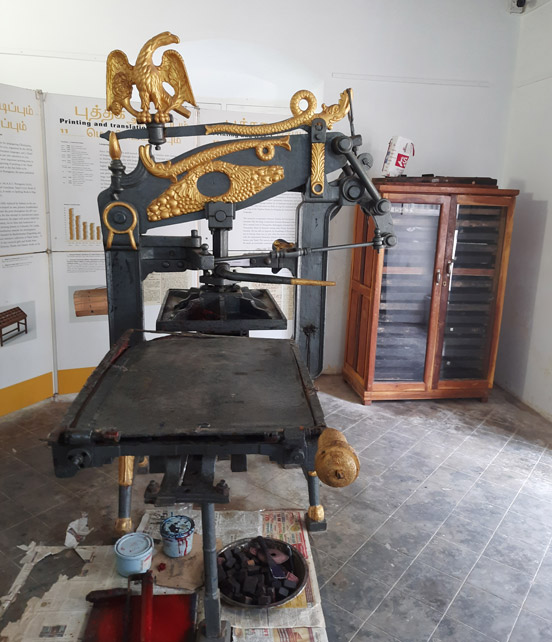
The first printing press in South India at the Ziegenbalg Museum.
We reached Tranquebar by road from Trichy, a drive of about 165 kilometres. Chennai is about 270 kilometres away by road along the scenic East Coast. The nearest major rail and bus access point is at Nagapattinam, roughly 33 kilometers away.
Few realize that this town is home to India’s only Danish fort, standing proudly along the Coromandel Coast in the Nagapattinam district. The entrance to Tranquebar, marked by the modest Town Gate on King’s Street, opens into a world of fading facades and colonial echoes. The streets are lined with buildings that seem to remember centuries gone by, each carrying fragments of forgotten conversations.
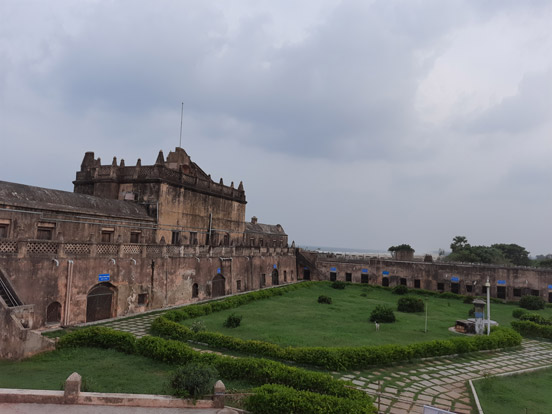
At the heart of it all stands the Dansborg Fort, facing the restless Bay of Bengal. The origins of this settlement date back to 1620, when a Danish expedition led by Governor Roland Crappé and Admiral Ove Giedde arrived here. A treaty between King Christian IV of Denmark and Ragunatha Nayak of Tanjore granted the Danes permission to build a fort—Dansborg.
For over two centuries, Tranquebar remained a Danish outpost, until it quietly passed into British hands in 1845. The Dansborg Fort, a two-storied structure facing the Bay of Bengal, is built in Scandinavian military style with thick stone walls and mounted cannons. This fort with a central garden is considered the second most important Danish castle after Kronborg- Denmark’s iconic coastal fortress, and a symbol of Danish maritime power.
Today, it houses a small museum displaying old maps, historical documents, treaties, and artifacts from the Danish era. Though not as grand as the forts of northern India, its seaside location and rich history make it a must-visit. The fort has been protected as a heritage monument since 1977.
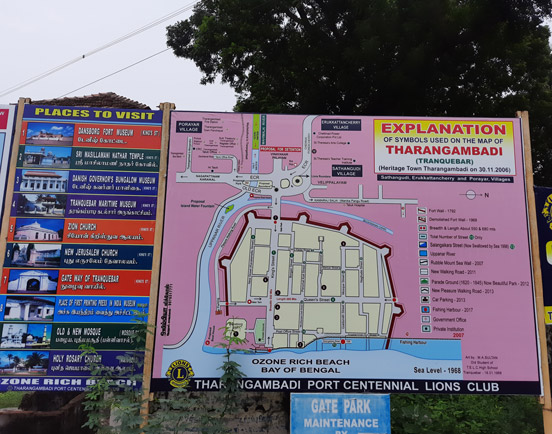
The Map of Tranquebar: The quaint coastal town holds immense potential as a heritage tourism destination.
From the upper floor, the eye drifts toward the “Bungalow on the Beach", originally a Danish courthouse, later a British residence, and now a restored luxury boutique hotel managed by the Neemrana group. With its high ceilings, wraparound balcony, and vintage furniture, it exudes colonial nostalgia. The dining experience here, especially on the patio overlooking the Bay of Bengal, is both serene and memorable.
We stayed at another Neemrana property, Coconut Alley, tucked along Queen’s Street. Like the town itself, it retains a rustic charm. Accommodation options are limited, and these heritage properties are among the few places offering both stay and meals, as the town lacks standalone restaurants. Tranquebar does not overwhelm—it invites.
Walking further along King’s Street, past the post office, one encounters the Governor’s Bungalow, a striking colonial structure built between 1776 and 1784. Though currently closed for restoration, it is expected to open to the public soon. Nearby stands the Commander’s House, also known as Halkier’s House, an elegant white building from the 18th century. It now houses the Danish-Indian Cultural Centre, featuring a maritime museum and library.
The exhibits include coins from the Danish period, fishing artifacts, glassware, Chinese tea jars and weapons—though the display could benefit from better organization. Across the road stands the Zion Church, built in 1701, one of the oldest churches in the region. Though we couldn’t enter, its exterior appeared well-preserved.
Tranquebar’s story is not only one of trade and empire, but also of ideas and faith. It played a significant role in India’s printing and missionary history. In 1706, German Protestant missionaries Bartholomäus Ziegenbalg and Heinrich Plütschau arrived here, carrying with them not just religion, but knowledge. Ziegenbalg not only oversaw the construction of the New Jerusalem Church in 1718—the first Protestant Lutheran church in India—but also introduced the first printing press in South India. In 1714, he printed the New Testament in Tamil, making it the first Indian language to have a translated Bible.
Today, the Ziegenbalg Museum, housed in his former residence, displays this historic press along with manuscripts, letters, and printing tools. While parts of the complex are well-maintained, others remain in need of restoration. Ziegenbalg, who passed away in 1719, is buried at the New Jerusalem Church, and a statue erected in 2006 commemorates his contributions. Plans are also underway to build a memorial hall in his honor.
Though Christianity has left a deep imprint here, the town speaks in many voices. Tranquebar is home to multiple Hindu temples and mosques. The Masilamani Nathar Temple, built in 1306 during the Pandya dynasty, stands right on the beach. The coexistence of temples, churches, and mosques in this small town beautifully reflects India’s spirit of harmony.
In every sense, Tranquebar is a hidden treasure—a place where history, culture, and tranquility converge. These shores have not always been gentle; the 2004 Indian Ocean tsunami once swept through, leaving behind loss and silence. Yet, like the returning tide, Tranquebar has found its way back—restored with care, resilient in spirit.
With thoughtful planning and preservation, it holds immense potential as a heritage tourism destination. For history enthusiasts, it offers a rare chance to wander through a richly layered past at a leisurely pace—on foot, unhurried, and undisturbed.
----------------------------------------

(Sanga Mitra is a bioinformatics researcher and Anirban Som is an Associate Professor of Marketing at the Indian Institute of Management Tiruchirappalli. Both are avid travel enthusiasts who enjoy exploring new places and cultures.)
(All photos courtesy of the authors)