By M A Hossain
Myanmar’s ongoing civil war has reached a critical point, with the rise of ethnic armed organizations (EAOs) significantly altering the balance of power in the country. Among these groups, the Arakan Army (AA) has gained substantial control over Rakhine State, capturing key border areas near Bangladesh. This shift in power has further complicated the already dire situation of the Rohingya, who remain stateless, persecuted, and caught between conflicting forces. As Myanmar’s political and military landscape continues to evolve, the crisis has transformed into a regional security concern, extending beyond its borders to impact neighboring countries, particularly Bangladesh.
For years, Bangladesh has struggled to find a sustainable resolution to the Rohingya crisis, relying primarily on diplomatic efforts that have yielded little success. Myanmar’s junta has consistently stalled negotiations, using misinformation and leveraging its relationships with China, Russia, and India to avoid accountability. Given these challenges, it is now essential for Bangladesh to move beyond its traditional reactive approach and adopt a proactive strategy that secures diplomatic, economic, and military leverage. A well-coordinated plan will enable Bangladesh to pressure Myanmar’s actors into meaningful negotiations while ensuring regional stability and safeguarding its national interests.
Myanmar's internal conflict and the Rohingya dilemma
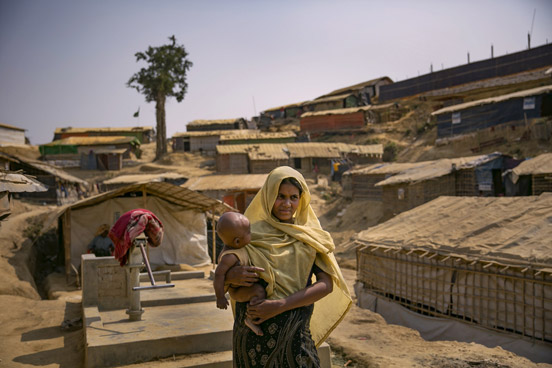
Myanmar’s political turmoil since the 2021 coup has reshaped the country’s power dynamics, with ethnic armed organizations (EAOs) like the Arakan Army (AA) gaining significant ground. The AA’s control over key areas in Rakhine State — including border towns like Maungdaw and Taungup, as well as the strategic military hub of Ann — has weakened the junta’s authority. However, despite these shifts, the Rohingya remain trapped in uncertainty. Persecuted by Myanmar’s military and still labeled with discriminatory terms like "Bengali Muslims," they face continued hostility, even as the AA’s ambiguous stance offers little hope for their rights or safe return.
The Rohingya's situation has grown even more precarious amid forced conscription by the junta, accusations of ties to armed groups like ARSA, and rising tensions with the AA. Without a clear path to repatriation or international protection, their future remains in limbo. As power struggles intensify in Myanmar, the urgency for a durable solution — one that ensures their safety and rights — has never been greater.
Bangladesh’s strategic approach
Bangladesh has long sought a peaceful resolution to the Rohingya crisis, but its efforts have been repeatedly undermined by Myanmar’s unwillingness to engage in meaningful negotiations. Myanmar has successfully used diplomatic cover from China, Russia, and India to delay repatriation efforts while continuing to receive political and economic support. Given these circumstances, it is imperative for Bangladesh to shift its strategy from passive diplomacy to one that establishes firm leverage over Myanmar.
The new approach should be built on three key pillars: diplomatic engagement with ASEAN, policy-driven advocacy, and strategic military preparedness. By strengthening regional alliances, utilizing research-based arguments, and reinforcing its defense capabilities, Bangladesh can create a position of strength that forces Myanmar to take repatriation efforts seriously.
Building regional alliances with ASEAN
Bangladesh can strengthen its leverage over Myanmar by rallying ASEAN around the Rohingya crisis as a regional security threat — not just a humanitarian issue. By highlighting risks like cross-border crime, arms trafficking, and extremism, Bangladesh can push ASEAN toward a unified stance, increasing pressure on Myanmar’s junta and the AA. A cohesive ASEAN position could also challenge China and Russia’s support for Myanmar, as Beijing’s economic interests in the region may force it to reconsider backing Naypyidaw’s obstructionism.
Policy advocacy and data-driven diplomacy
To solidify its diplomatic stance, Bangladesh must complement engagement with data-driven advocacy, partnering with ASEAN-aligned think tanks to highlight the Rohingya crisis’s security and economic repercussions. Research should expose human rights abuses by Myanmar’s junta and AA, quantify Rakhine’s instability on regional trade, and assess security risks like radicalization — shifting the narrative from a humanitarian appeal to a strategic imperative. This evidence-based approach will galvanize international support, counter Myanmar’s disinformation, and pressure ASEAN to act.
Military readiness and strategic defense cooperation
While prioritizing diplomacy, Bangladesh must also bolster its border security amid rising volatility in Rakhine State and the AA's growing influence. Strengthening defense cooperation through joint military exercises with ASEAN partners like Malaysia, Indonesia, and Thailand can signal regional resolve while deterring aggression. Additionally, Bangladesh should leverage tools like the US BURMA Act for intelligence-sharing and border security enhancements — maintaining a robust defensive posture without direct intervention. A visible military presence would both prevent cross-border instability and reinforce Bangladesh's strategic position in negotiations.
Alongside diplomacy, Bangladesh must secure its border through ASEAN military cooperation, US BURMA Act resources, and a visible defensive presence — deterring spillover while strengthening its negotiating hand.
Global implications and the role of major powers
The Rohingya crisis is not just a bilateral issue between Bangladesh and Myanmar — it has far-reaching geopolitical implications. China, Russia, and India have played significant roles in shaping Myanmar’s political landscape, often prioritizing strategic interests over human rights concerns. But, one crucial aspect overlooked by all stakeholders is that these Rohingya refugee camps could become breeding grounds for transnational terrorist organizations. These vulnerable populations are under the hawkish eyes of international terrorist organizations seeking to exploit them.
China, in particular, has deep economic stakes in Myanmar, including infrastructure projects linked to the BRI. While Beijing has traditionally backed the junta, a unified ASEAN stance could force it to reassess its position. Similarly, Russia’s military support to Myanmar may become increasingly difficult to justify if international pressure mounts. India, balancing its interests between countering China’s influence and maintaining regional stability, may also reconsider its approach.
For Bangladesh, the challenge lies in navigating these complex geopolitical dynamics while securing commitments for Rohingya repatriation. Strengthening alliances with Western nations, particularly the United States and the European Union, could provide additional diplomatic leverage. Furthermore, advocating for a UN-monitored safe zone in Rakhine may be a viable solution to ensure that returning Rohingya populations are protected from further persecution.
The Trump administration's firm stance on illegal immigration set a precedent for strict border control and repatriation policies. Similarly, Bangladesh, facing a prolonged Rohingya refugee crisis, can explore diplomatic strategies to ensure the safe and dignified repatriation of Rohingyas to Myanmar. By leveraging international support, engaging in multilateral negotiations, and maintaining strategic pressure on Myanmar, Bangladesh can push for a sustainable solution. Just as the US prioritized national interest in immigration policies, Bangladesh must assert its sovereignty while upholding humanitarian principles, ensuring that Myanmar fulfills its responsibility to reintegrate the Rohingyas into their homeland.
Conclusion
The crisis in Myanmar has evolved with the Arakan Army's (AA) rising influence in Rakhine State, presenting Bangladesh with both challenges and an opportunity to reshape its diplomatic strategy. By adopting a proactive approach — strengthening regional alliances, leveraging research-backed policies, and enhancing military readiness — Bangladesh can reframe the Rohingya crisis as a regional security issue, compelling Myanmar to engage in meaningful negotiations. Additionally, empowering Rohingya refugees with leadership skills and rights advocacy will aid repatriation efforts, ensuring long-term stability and solidifying Bangladesh’s role as a key diplomatic player in South Asia.
----------------------------------
.jpg)
(The writer is a political and defense analyst based in Bangladesh. He can be reached at: [email protected])
The views expressed are personal and not necessarily those of The South Asian Times.