By Ayesha Rafiq
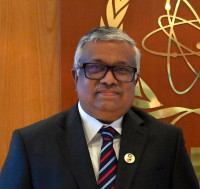
In the contemporary world, where global stability is strained by events, the recent admonishment by Pakistan's envoy Asim Iftikhar Ahmad at the United Nations that the Middle East is at a very dangerous crossroads underscores the underlying reality. The international system is passing through a stage where escalation poses more risks than a strategic advantage and diplomacy is not an option anymore. It is essential.
Critical infrastructure threats and threats to the Strait of Hormuz as a major transit route are not specific to the Middle East. In the globalized world, instability is transmitted like wildfire across borders. Political alignments, energy markets, and international trade are closely intertwined. An imbalance in one field can cause an impact much greater than its source.
At that, the restraint and dialogue promoted by Pakistan can be seen as a larger investment in stability and cooperation on the international level. Pakistan is moving towards the right direction by focusing on the value of ceasefire and peaceful solution, which is consistent with the rules of international laws and the principles of multilateral institutions. This stance is not on a partisan basis. It is about the realization that a sustainable peace can be best realized by engaging and talking.
The scenario also highlights the increased significance of preventive diplomacy. Conflicts may escalate fast in a world characterized by fast communication and development in technology. The crisis should be engaged early and kept in dialogue to ensure that the crisis is not escalated. Delay is prone to increased human costs. Preemptive diplomacy is a better way to achieve stability.
In the case of countries such as Pakistan, the stability in the Middle East is direct. Pakistan has strong economic and social ties with the region. The environment is essential in energy provisions, trade routes, and communities of expatriates. Through the de-escalation, Pakistan is helping the whole world to be peaceful, and at the same time, it safeguards its national interests responsibly.
Simultaneously, the participation of Pakistan in the United Nations is indicative of its desire to become more active in world politics. The role of emerging and middle powers in international negotiations is becoming more significant as they become more influential. Positive interaction promotes credibility and readiness to help in solutions.
Another issue that is brought out at this moment is the relevance of international institutions that still continues. Their usefulness is regularly a matter of discussion, but they are also important arenas of communication between various actors. These institutions need to be strengthened in order to deal with complex global issues that cannot be solved by one nation.
The way ahead is that which demands collaboration at various levels. The key powers and regional and international organizations should collaborate to ensure that the situation does not deteriorate. This involves diplomatic interaction, confidence-building, and conforming to the set international standards. Responsibility as a group is critical in ensuring stability in the world.
The concept of a dangerous crossroads is a cautionary measure and a challenge to take. It shows how grave the present situation is and how cautious decisions should be made. The present decisions will determine the course that global stability will take in the future.
In such a setting, dialogue, restraint, and cooperation give a positive path to take. It shows a good realization that, though there can be conflicts, they have to be dealt with in a responsible manner. Through these values, Pakistan will be playing its part in an even larger global initiative to maintain peace in an interconnected and extremely complicated world.
In this crucial time the world is going through, it is evident that there is a conclusion. The permanence of peace is created by communicating, collaborating, and being united in the desire for stability.
-----------------------------------------------
.jpg)
Ayesha Rafiq is a distinguished policy analyst and a top-ranking graduate in Peace and Conflict Studies from the National Defence University, Islamabad.
The views expressed are personal and not necessarily those of The South Asian Times.