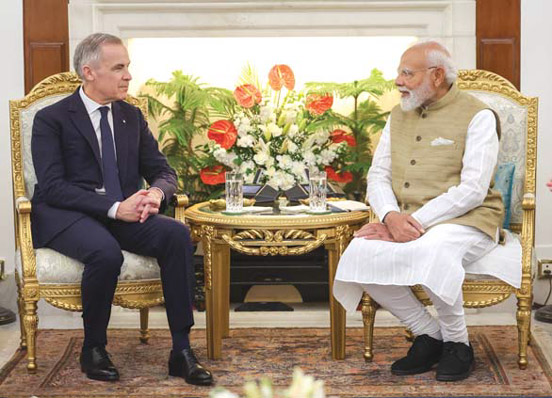
New Delhi: While trade negotiations between India and Canada have in the past been derailed due to political tensions between the two countries, the relaunch of talks during the visit of Canadian Prime Minister Mark Carney in March this year has provided a second chance to build a durable bilateral economic relationship amid the changed geopolitical landscape, according to India’s former envoy to the North American country.
“Canada faces its own structural dilemma. Its overwhelming economic dependence on the United States has become a strategic constraint, particularly in an era of geopolitical uncertainty. Diversification is no longer optional. In that context, India represents not just another market, but a long-term strategic partner,” former High Commissioner to Canada, Sanjay Kumar Verma, highlighted in an article in India Narrative.
He was of the view that the shift in 2022 towards an Early Progress Trade Agreement (EPTA) reflected a degree of realism that had been missing earlier, and can be used to gradually build a lasting comprehensive economic partnership agreement (CEPA).
The CEPA should not be conceived as a single, all-encompassing outcome, but as a process that unfolds in stages. The first stage can consolidate what has already been negotiated under the EPTA framework. Subsequent stages can progressively incorporate more complex elements, including investment protection, digital trade, and regulatory cooperation.
The most sensitive areas — those involving agriculture, intellectual property, or public procurement — can be addressed later, when the political and economic environment is more conducive, Verma wrote in the article.