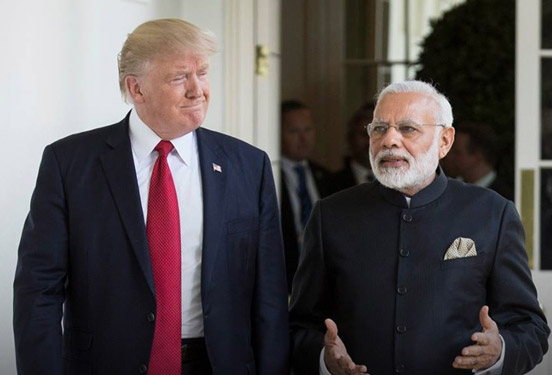
PM Modi and President Trump discuss the West Asia situation over a phone call, supporting de-escalation and restoration of peace at the earliest.
New Delhi: Prime Minister Narendra Modi spoke to US President Donald Trump, reiterating India's support for immediate de-escalation and restoration of peace amid the ongoing West Asia conflict.
During the call, PM Modi emphasized that keeping the strategic Strait of Hormuz open, secure, and accessible is essential for the whole world. Both leaders also agreed to stay in touch regarding efforts towards peace and stability.
"Received a call from President Trump and had a useful exchange of views on the situation in West Asia. India supports de-escalation and restoration of peace at the earliest. Ensuring that the Strait of Hormuz remains open, secure and accessible is essential for the whole world. We agreed to stay in touch regarding efforts towards peace and stability," PM Modi posted on X.
According to experts, the Trump-Modi call signals the US wants to keep India closely involved and consulted in ongoing developments.
The conversation between both leaders comes amid the ongoing conflict in West Asia which began following the February 28 strikes carried out by the United States and Israel on Iran, which resulted in the killing of Iran's Supreme Leader Ayatollah Ali Khamenei. In response, Iran launched drone and missile attacks targeting the US and Israeli facilities, regional capitals, and allied forces in West Asia.
The conflict has added pressure on global markets and energy prices remain sensitive to developments in the region. President Trump and PM Modi have shared a high-profile political partnership over the years, highlighted by large public events and diplomatic engagements.
The two leaders have frequently praised each other publicly, emphasizing cooperation in areas such as trade, defence, and strategic partnerships between the United States and India.
Jaishankar, Rubio speak on Middle East tensions
Earlier this week, India’s External Affairs Minister S Jaishankar and US Secretary of State Marco Rubio spoke over the phone. They reviewed its impact on the global economy and energy supplies. Both agreed to continue working together.
This was the first call between the two leaders after the war in Iran. Jaishankar said the talks “focused on the West Asia conflict and its impact on the international economy.” He added that both sides “particularly spoke about energy security concerns.”
In Washington, in a readout of the call, the State Department said they agreed on the importance of continuing to work together to advance mutual priorities.
Principal Deputy Spokesperson Tommy Pigott said that Rubio and Jaishankar agreed on the importance of continuing to work together to advance mutual priorities.
Jaishankar and visiting US Under Secretary of War for Policy, Elbridge Colby, also held a meeting in New Delhi, discussing the current geopolitical scenario. Colby said the US views India with deep respect, and New Delhi's decisions will profoundly shape the future of the Indo-Pacific.
Get serious about a deal: US President
Meanwhile, with the world in the throes of an energy crisis from the partial closure of the Strait of Hormuz, President Donald Trump has warned that time was running out for Tehran to “get serious” about a deal.
Iran responded to the United States' 15-point peace proposal with a five-point plan, according to the Iranian news agency Tasnim. Trump said on Truth Social that Iran “better get serious soon, before it is too late, because once that happens, there is no turning back, and it will not be pretty”.
He described the Iranian negotiators as “very different and strange”, claiming they were “begging” for a deal while publicly saying they were considering the United States proposals. Later, at an open cabinet meeting, he remarked, “We will see if we can make the right deal, and they make the right deal, and then the strait will open up.”
Keeping the Strait open, a chokehold on 20 per cent of fossil fuel flows to the world, has emerged as a top priority for the United States and many countries affected by the blockage. Trump added, “Even now, we do not know if there are any mines.”