By K S Tomar
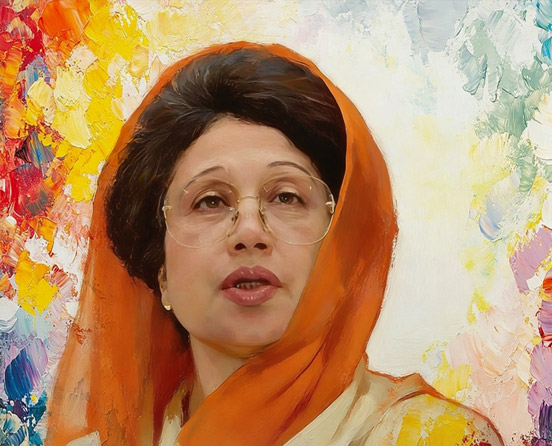
The passing of Khaleda Zia has coincided with one of the most delicate transitions in Bangladesh’s recent history — a moment when Washington, New Delhi, Beijing, and Islamabad are quietly recalculating their strategies. With an unsettled political climate at home, a banned ruling party, an opposition driven by grief and momentum, and an electorate uncertain about what comes next, Bangladesh has entered a phase where every external power has stakes. For the United States, the issue is democratic credibility. For India, it is security and stability along a sensitive frontier. For Pakistan, it is a cautious opportunity to reset atmospherics. For China, it is continuity of strategic footprints. And at the center of all this stands one question: if Tarique Rahman — Khaleda Zia’s son — emerges as the next prime minister, how will the world engage with Dhaka’s new leadership?
Washington’s calculus: Democracy first — but not at the cost of stability
The United States is likely to frame its Bangladesh policy around a familiar dual priority: visible commitment to democratic processes, tempered by an insistence on regional stability. Washington has watched Bangladesh’s political cycles with unease — alternating phases of dominance, repression, protest and disputed mandates. The demise of Khaleda Zia, a figure symbolically linked to resistance and democratic aspiration for many supporters, has intensified Western scrutiny of how power will now be transferred.
If elections appear uneven, exclusionary, or vengeful, Washington may opt for recognition with reservations — engaging a new government while maintaining pressure through public statements, civil-society support, and targeted diplomatic messaging. Sanctions are unlikely unless violence escalates or political freedoms are visibly crushed, but conditional cooperation — particularly on governance, human rights and transparent institutions — would remain central.
At the same time, the US will avoid pushing Bangladesh into China’s arms. Expect diplomacy that mixes criticism with incentives: economic cooperation, climate partnerships and security dialogue — but only if Dhaka signals readiness to open political space and reassure minorities, the media and opposition voices.
End of an era — and the vacuum it creates
Khaleda Zia’s death represents more than the loss of a former prime minister; it closes a chapter dominated by two towering and adversarial personalities — Zia and Sheikh Hasina. Their contest shaped institutions, political culture and public expectations. It built authority but also entrenched bitterness. Zia embodied resilience and electoral legitimacy even when sidelined, yet her legacy remains clouded by corruption charges and the habit of winner-takes-all politics.
Her departure leaves not merely nostalgia — but a genuine vacuum. Into that vacuum now steps a new generation, one that carries her party’s memory yet faces challenges of credibility, discipline and governance.
Elections without equilibrium
Bangladesh moves toward elections under unusual and unsettling conditions. Sheikh Hasina’s prolonged dominance collapsed amid popular anger, institutional fatigue and political backlash. Her party’s subsequent ban has altered the contest beyond recognition. A political landscape without its most dominant player raises questions not only about fairness, but also about the durability of any government formed under such circumstances.
Democracies function not by removing rivals, but by defeating them in credible contests. Bangladesh today risks repeating a dangerous cycle — exclusion followed by retaliation, followed again by exclusion.
The son steps forward
Within this turbulent environment, Tarique Rahman has emerged as the focal point of expectation. For many in the BNP, he represents continuity, emotional inheritance and the possibility of converting sympathy into electoral strength. His return after years in exile just before his mother’s death added poignancy and political intensity — projecting him as a natural successor.
Yet leadership is a test that begins the day victory is secured. Tarique will confront skepticism over past controversies, questions about administrative capacity and the heavy responsibility of governing a polarized nation. Sympathy brings votes; it does not automatically produce trust.
India’s strategic dilemma
For India, the stakes could not be clearer. Over the past decade and a half, New Delhi and Dhaka worked together on cross-border security, connectivity corridors, energy linkages and trade flows. Much of this cooperation was built on personal equations and institutional comfort. A new government, led potentially by Tarique Rahman, will inherit both opportunity and suspicion.
New Delhi will neither openly interfere nor rush into embrace. Its priority will be quiet continuity — ensuring border stability, curbing extremist networks, preserving transit arrangements and avoiding political missteps that appear partisan. India will engage whoever governs Dhaka, but expectations will be pragmatic: respect sensitivities, avoid rhetoric that reopens old wounds, and keep channels transparent.
Pakistan: Curiosity without illusion
Islamabad views developments in Bangladesh through a historical prism still marked by 1971. A BNP-led return might appear more conversational and less emotionally charged than Awami League rule. Yet Pakistan understands that Bangladesh’s foreign policy has matured beyond nostalgia or alignment. Any opening will be slow, symbolic and limited — perhaps cultural, perhaps diplomatic — but not transformational. Tarique, if he leads, will prioritise domestic legitimacy over external experimentation.
China: Strategic patience and economic leverage
Beijing will watch Bangladesh’s transition with professional calm. Over the years, it has woven infrastructure, port, energy, and defense ties with successive governments. Whether BNP or Awami League leads, China’s objective remains: maintain leverage through loans, projects and technology. Tarique Rahman, if pragmatic, may avoid sudden reversals — seeking diversification rather than rupture. China, in return, will emphasize predictability, financing and political non-interference — projecting itself as the partner that stays while others debate.
The legitimacy question
Ultimately, legitimacy will be the foundation or fragility of the next government. An election that sidelines major players may produce order on paper but instability in practice. The United States will question, India will caution, China will hedge and Pakistan will wait — all reacting to how inclusive Bangladesh chooses to be. Fairness is not merely a Western demand; it is the basis for durable governance at home.
A test of statesmanship
Bangladesh now confronts a defining question: can it finally break from cycles of exclusion and revenge? Khaleda Zia’s passing might have invited reconciliation and restraint. Instead, it has sharpened competition wrapped in memory and emotion. Tarique Rahman, should he assume power, has the chance to rewrite this script — to move from grievance to governance, from symbolism to institution-building.
For America, India, Pakistan and China alike, stability in Dhaka is not an abstract concern — it is tied to trade routes, maritime corridors, counter-terror efforts and regional peace. What Bangladesh does in the months ahead will echo beyond its borders.
If the transition honors openness and legitimacy, Khaleda Zia’s departure may become a turning point toward renewal. If not, the country risks yet another chapter of political strain and contested authority — watched closely by great powers who prefer calm, even if imperfect, to turbulence in a critical neighborhood.
-------------------------------------------
.jpg)
(K S Tomar is a strategic affairs columnist and senior political analyst based in Shimla)
The views expressed are not necessarily those of The South Asian Times