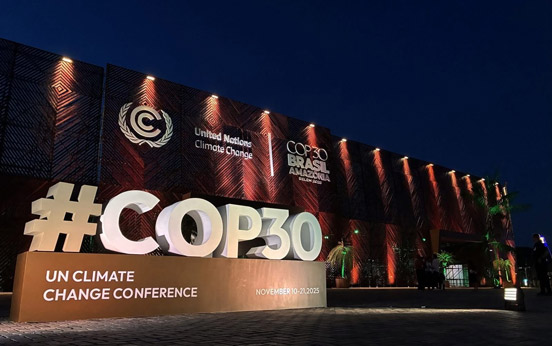
One of the key takeaways from COP30 is that climate and trade are inseparable in today’s global economy.
By K S Tomar
COP30, which recently concluded in Brazil, was never about identifying what needs to be done to address the climate threat — that is already well known. The real challenge has always been implementation: how to turn promises into measurable progress amid wars, trade chaos, and the rising self-interest of nations. In a world distracted by geopolitics and economic uncertainty, COP30 underscored that while the climate fight continues, translating commitments into action remains a complex, uneven process. The summit highlighted both the resilience of global momentum and the gaps that still threaten meaningful progress.
Momentum survives political shifts
Even after the United States, under President Donald Trump, exited the Paris Agreement, global climate action did not collapse. Leaders showed up, commitments were maintained, and Brazil’s presidency ensured that negotiations continued on course. Momentum matters: it drives investment, signals resilience, and keeps the global conversation alive despite political disruptions.
The fact that 190 countries remained engaged, despite conflicts and competing national interests, demonstrates that climate action is no longer optional — it is now embedded in the political and economic calculus of the 21st century. Momentum, however, is fragile. A few high-profile withdrawals or lukewarm commitments can stall progress, making sustained global engagement essential.
Clean energy transition and natural solutions
Progress on clean energy continues, but at a slower pace than required. A total of 115 nations have filed Nationally Determined Contributions (NDCs), and commitments are gradually increasing. Renewables are projected to double by 2030 — short of the tripling target set at COP28 — yet this modest acceleration is nonetheless a critical achievement given the economic headwinds and geopolitical instability.
Beyond energy, COP30 highlighted investments in nature-based solutions. The $6 billion pledged for conserving forests and oceans underscores the importance of protecting carbon sinks that absorb nearly half of global emissions, while oceans take in 90% of excess heat. These commitments show that climate action is no longer just about technology; it is also about safeguarding ecosystems that form the planet’s natural defense against warming.
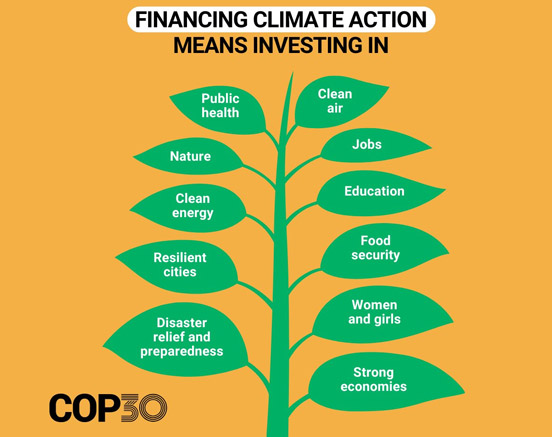
(Infographic courtesy: X@GlobalGoalsUN)
Fossil fuel phase-out remains stalled
After nearly three decades of discussions, achieving consensus on phasing out fossil fuels remains elusive. Despite the COP30 presidency putting the issue on the table, no roadmap was agreed. Transitioning away from fossil fuels requires balancing reductions with scaling alternatives and coordinating production cuts across nations, a task demanding unprecedented global cooperation.
Future COPs, or even alternative platforms, must confront this head-on. Delaying action risks deepening climate instability and locking in infrastructure that will emit carbon for decades. The complexity lies not just in energy transition but also in economic equity: fossil fuels remain a lifeline for many developing economies, and phasing them out without alternatives risks widening global inequalities.
Adaptation gains recognition, but slowly
Developed countries pledged to triple finance by 2035 to support infrastructure and early-warning systems in vulnerable communities. While this is a positive signal, it is both late and insufficient. For countries grappling with floods, droughts, and extreme weather, adaptation is a matter of survival, not charity. The timeline for delivering these funds is far too long for nations already bearing the brunt of climate change. COP30 made it clear that adaptation must no longer be treated as a secondary priority. Wealthy nations need to move from rhetoric to tangible support, with clear benchmarks and timelines, or risk catastrophic humanitarian consequences.
India’s rising role and emerging risks
India leveraged its strong track record in renewable deployment to assert influence at COP30. The country highlighted weak ambitions from developed nations and pushed for increased financing for developing countries. This proactive stance is crucial: the next five years will determine whether global emissions and climate finance targets are met or continue to lag. India’s insistence on accountability and financial support underscores its dual role as a climate leader and a developing economy navigating the risks of global trade policies. One immediate challenge is the EU’s carbon tariffs, expected to hit Indian exporters in 2026. While COP30 agreed on a two-year discussion on trade, the real battleground for balancing climate action with economic competitiveness lies in ongoing trade negotiations, particularly the EU-India framework.
Geopolitics and business engagement
With the United States largely absent, COP30 reflected broader geopolitical realignments. Emerging alliances, critical mineral access, and climate finance discussions were all influenced by shifting power dynamics. While negotiations between developed and developing countries appeared more balanced, governments alone cannot deliver the solutions needed. Business — the engine for green hydrogen, carbon capture, and resilient infrastructure — must have a formal seat at the negotiating table. The private sector’s absence at COP30 highlights a significant gap: climate action requires accountability-driven collaboration between governments and industry. Corporations can no longer be limited to financing; they must help design, implement, and scale climate solutions with measurable outcomes.
Finance, trade, and the global climate economy
One of the key takeaways from COP30 is that climate and trade are inseparable in today’s global economy. Carbon tariffs, renewable technology markets, and access to critical minerals are now central to international climate negotiations. While COP30 deferred many trade-related discussions, the pressure on governments to coordinate climate policy with trade agreements is intensifying. Without clear alignment, countries risk creating fragmented approaches that undermine both emission targets and economic growth. For developing nations like India, leveraging climate leadership to secure finance, technology, and fair market access will be critical in the coming years.
Keeping the climate conversation alive
COP30 succeeded in keeping the climate conversation alive in a fractured world. While the summit did not deliver on every target, it brought neglected strategies and stakeholders to the forefront and maintained momentum toward more difficult discussions ahead. Agreements reached after intense negotiations may seem modest, but they are preferable to inaction. The summit reinforced a vital lesson: climate action is a marathon, not a sprint. Global leaders may not yet be winning the battle against emissions, but their sustained engagement ensures that the fight continues.
The bottom line is that COP30 demonstrated both the resilience and the limitations of the current global climate framework. Political shifts, geopolitical tensions, and economic uncertainties complicate implementation, yet the commitment of 190 countries signals that the world is not giving up. Judging the summit solely by headline numbers — in terms of emission reductions or climate finance — would miss the larger narrative of perseverance, negotiation, and incremental progress. The summit also underscored that meaningful action requires integrating governments, business, and civil society in ways that ensure accountability, efficiency, and equity. In these uncertain times, that continued dialogue is a win in itself.
COP30 may not have resolved every thorny issue, but it reaffirmed that the climate fight is far from over. Momentum persists, innovations in renewables are growing, and nature-based solutions are finally gaining recognition. The next challenge is translating these commitments into tangible results, scaling adaptation and mitigation efforts, and ensuring that the global climate agenda is not held hostage to short-term political and economic interests. For the world, the message is clear: the climate fight continues, and surrender is not an option.
------------------------------------------------------------

(K S Tomar is a strategic affairs columnist and senior political analyst based in Shimla)