By Sujay S Phatak & Payal Seth
India is not short of data. States generate numbers through administrative systems, surveys, dashboards and routine reporting. Yet one basic question often remains unanswered: are these statistics reliable enough to inform policy decisions with confidence? In a country aspiring to Viksit Bharat by 2047 through decisively data-driven governance, data quality is the first bottleneck.
When the evidence is shaky, policy becomes guesswork
The Indian data ecosystem often suffers from a "trust gap": users may see numbers, but cannot always see the rules, methods and documentation that make those numbers interpretable and comparable. The costs of this gap are high, for example, when revised estimates are released without clear revision notes, debates shift from what to do to whether the numbers can be trusted, and programs may get delayed or contested.
Over time, the greatest loss is institutional: public confidence in official statistics. For any government, quality statistical products are to be treasured in the way a compass and a map are to a sailor. Just as no ship can reach its destination without correct coordinates, no country will be able to realize its hopes for development without precise, detailed, and accurate data to guide the way.
A framework that treats quality as a system, not a slogan
To address this issue, the Ministry of Statistics and Programme Implementation (MoSPI) has introduced the Statistical Quality Assessment Framework (SQAF). Rooted in the UN Fundamental Principles of Official Statistics (FPOS) and adapted from the National Quality Assurance Framework (NQAF), the international quality-assurance framework, SQAF, offers a simple idea: implement a structured quality check of official statistics before they are used to make decisions.
SQAF is a self-assessment framework for statistical products and the processes that produce them. It prompts statistical agencies to examine whether their methods are sound, procedures are documented, revisions are transparent, confidentiality is protected, and outputs are timely, comparable, and usable. In short, it converts "quality" to a common checklist applicable across the National Statistical System.
SQAF in one glance: What it asks of official statistics
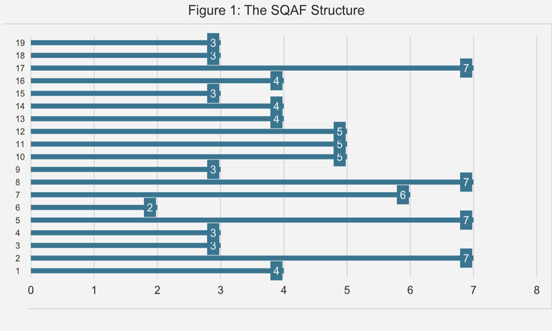
SQAF groups quality into four levels related to the management of (a) statistical systems, (b) institutional environment, (c) statistical processes, and (d) statistical outputs. Each level contains a set of quality principles specific to that level, totalling 19.
Furthermore, several quality requirements specify the measures necessary to ensure quality with respect to that principle. There are 85 requirements in total (see Figure 1 for a detailed structure of SQAF). Its core question is deceptively simple: Are our statistics fit for use — and can we demonstrate that with evidence?
(Graph courtesy of the authors)
The toolkit helps — but the hardest part is interpretation
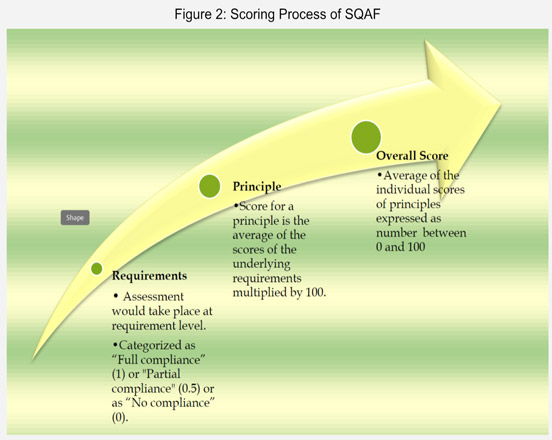
MoSPI has also issued an Excel-based toolkit that translates assessments into a simple scoring logic: full, partial, or no compliance, allowing agencies to establish a baseline (see figure 2 for detailed scoring process). The real value of the toolkit lies in the discipline it imposes: agreeing on definitions, documenting workflows, identifying evidence, and making limitations explicit. That is how quality becomes discussable and improvable — without waiting for a public controversy to expose gaps.
(Infographic courtesy of the authors)
Although MoSPI has mandated that all departments and directorates in the state government must implement this framework in their statistical processes and products, a mandate is practically not enough to ensure proper implementation. In practice, some requirements can be conceptually dense, and different divisions can interpret the same requirement differently.
Documentation is often scattered, even where good work is being done. And because it is self-assessment, the process can drift into box-ticking unless teams have clarity and incentives to be honest.
A reality check from Madhya Pradesh
The early experience of applying SQAF in Madhya Pradesh reveals the gap between framework and practice. When the pilot began with three processes in the directorate of economics and statistics, officers quickly hit roadblocks as they worked through the 85 requirements. A requirement like "divergences from international standards are documented and explained to stakeholders" prompted confusion: which standards? Documented where? Explained to whom? Another asked whether "statistical confidentiality is guaranteed by law".
Officers knew confidentiality mattered, but couldn't cite the specific legal provision. This is where Pahlé India Foundation (PIF), New Delhi, added value. Through repeated, product-by-product discussions, we helped the teams to (i) break requirements into simpler prompts aligned to actual steps, (ii) distinguish what is system-wide vs product-specific, and what is not applicable vs non-compliant, and (iii) build an evidence-linked response—connecting each score to a verifiable document or practice.
For example, to understand the legal mandates, PIF guided the teams to the Collection of Statistics Act, 2008, and associated rules. We also helped the officers translate process knowledge into structured responses. For example, when asked if "data providers receive support and guidance," officers knew they answered queries and conducted site visits — but hadn't documented this as evidence.
The exercise revealed a pattern: officers who mastered their statistical processes could still struggle with SQAF if they lacked three things. First, deep knowledge of applicable laws, government orders, and administrative rules, such as documents scattered across departments and gazettes, and decades.
Second, clarity on what counts as "evidence" in SQAF's language: a document that proves the response. Third, the ability to articulate tacit practices explicitly, such as moving from a response like "we follow guidelines" to something more structured, like "MoSPI provides survey manuals with detailed instructions; the division follows these without deviation."
The key lesson is straightforward: quality assessment is as much an archaeological dig through institutional memory as it is a statistical audit.
A practical way forward: baseline first, perfection later
The way ahead does not require grand institutional redesign. It requires disciplined execution. Start with high-impact products like the surveys, state income, and price statistics.
Conduct guided walkthroughs so each requirement is understood in context. Map evidence while scoring what practice supports the answer, and what document is missing. Run a brief internal consistency check to ensure scoring remains comparable across divisions. Submit the baseline, then repeat periodically.
The objective of the first cycle is not to achieve perfect scores. It is to build a credible baseline and a repeatable quality habit. India does not lack data; it lacks confidence in its data. SQAF is a quiet but necessary step toward rebuilding that confidence— systematically and in a way that makes data-driven governance real.
-----------------------------------------
Sujay Phatak is a Senior Research Associate and Payal Seth is a Fellow & Lead of the Centre of Data for Economic Decision-making at Pahlé India Foundation.
The views expressed are not necessarily those of The South Asian Times