By Urvashi Prasad & Umesh Raj
Guwahati today is straining under the weight of its own growth. The Gateway to Northeast India houses nearly 1.4 million residents, with thousands of vehicles added every month, while the city’s total road length remains stagnant.
This mirrors Mumbai’s experience, where over 1.5 million private cars (about 753 cars per km) crowd a fixed road network. Likewise, Guwahati has about 1.3 million vehicles for 1.325 million people - almost one per resident, including approximately 600,000 two-wheelers as of 2023. Average speeds have plunged to around 20 km/h, worsening congestion as nearly half of commuters rely on private vehicles for daily travel.
Public buses and vans barely meet demand, forcing many into costly private taxis or bike-taxis. With the population projected to reach 2-3 million by 2045, the city will require roughly 750,000 new homes. In short, the southern bank is reaching gridlock with little room for expansion.
A strategic shift across the Brahmaputra
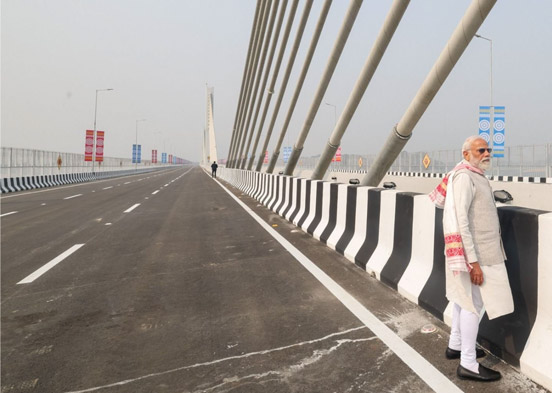
In such a fast-growing city, the solution lies not in building more flyovers but in reimagining Guwahati’s growth across the Brahmaputra. The new six-lane Kumar Bhaskar Varma Setu, linking Fancy Bazar to North Guwahati, reduces the cross-river commute from 90 minutes to just 15 - a six-fold improvement. This reshapes where people live and work. North Guwahati is now effectively 10-15 minutes from the city core, making institutions like IIT Guwahati and the upcoming IIM far more accessible. The bridge transforms the Brahmaputra from a barrier into a unifier.
Decongesting the core
Opening access to the north bank relieves pressure on Guwahati’s streets. New housing, including affordable units, can shift northward. Guwahati Metropolitan Development Authority’s (GMDA) “New Town” plans envision the north bank as an extension of the city rather than distant suburbs. Residents will bypass downtown congestion, cutting commute times and emissions.
Building water and climate resilience
Floods are a perennial challenge, but the twin-city plan strengthens resilience. Critical infrastructure - power grids, water-treatment plants, and communications - can be duplicated or hardened on higher ground. A major project funded by the Japan International Cooperation Agency (JICA) already provides 24×7 water supply to the south, central, and north zones. With the bridge, this network gains redundancy: if one side floods, a backup supply can flow from the other. Yet coverage remains patchy, with only one-third of households enjoying reliable piped water. Heavy reliance on borewells and tankers has depleted groundwater to critical levels, prompting warnings from the Central Groundwater Board.
Smart infrastructure and digital corridors
The north bank is being groomed as Assam’s tech hub. Amtron’s “Tech City” hosts data centers and 5G labs, while the National Informatics Centre (NIC) has opened a new e-governance data center. Linking this hub to the metro bus and road network enables Guwahati to evolve into a genuine smart city, with digital infrastructure spanning both banks. Innovators can leverage planned highways and power lines to create a “digital corridor” of fiber, cloud, and electric mobility.
Health and education corridors
The north bank hosts landmark institutions: AIIMS Guwahati, IIT Guwahati, and soon AAHII Guwahati. These will attract thousands of students, faculty, and medical staff requiring housing, transit, and services.
In a twin-city model, southern residents can reach these institutions in minutes, while north-bank communities gain quick access to the city’s hospitals and colleges. Education and healthcare will flow both ways, accelerating growth.
This shift is already visible. Projects such as the Assam Advanced Healthcare Innovation Institute (AAHII) at IIT and the city’s new Integrated Freight Complex signal expansion. The foundation stone of the ₹1,705 crore Integrated Judicial Complex, laid by Chief Justice of India Surya Kant, underscores that civic offices too are migrating across the river. Expansion into North Guwahati is no longer optional - it is a structural necessity.
Safeguards for sustainable growth
Challenges remain. Both banks face ad-hoc sprawl and sensitive wetlands. Rushed development is not the answer; sustainable planning is. Green belts and Brahmaputra floodplains must be preserved as buffers, and informal settlements integrated into planning. A dual-city approach can distribute growth more sustainably across both banks.
Looking ahead
The Kumar Bhaskar Varma Setu is more than a bridge - it is a catalyst for transformation. Guwahati must pair its twin-city strategy with smart safeguards. Transportation policy should prioritise mass transit, smart traffic management, and demand-control measures to avoid gridlock like Mumbai’s. Water use must be managed sustainably, with accelerated piped coverage and strict limits on groundwater pumping.
By embedding these safeguards - preserving green buffers, ensuring water resilience, and deploying smart mobility - Guwahati can grow sustainably without sacrificing liveability.
[Dr Urvashi Prasad and Umesh Raj are associated with the New Delhi-based Pahle India Foundation. The views expressed are their own.]