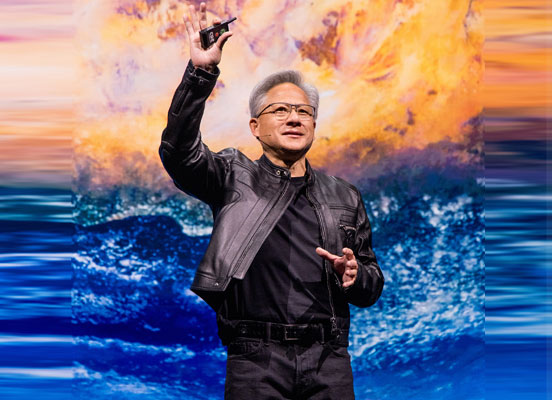
The new Cold War is not about nukes or carriers. Instead, it is a battle for superior technology powered by silicon chips and artificial intelligence. Nvidia founder Jensen Huang, who is often seen wearing a leather jacket, epitomizes this war.
Since the end of the original Cold War, pundits have been forecasting the return of another one. However, the new one is very different from what they had predicted. It is not about the number of nuclear weapons or submarines. The main leverage of the superpower confrontation has moved to computing power, and that is mainly due to the advanced chips that enable artificial intelligence. There is nothing in this world that does not rely on technology, and technology cannot do anything without chips.
The United States is still the leader in manufacturing the most advanced processors, but China is making every effort to close the gap. For more than ten years, the US has considered these chips as sensitive technology and has been imposing export controls in different waves. In 2015, the Obama administration put Chinese supercomputing centers on the blacklist. In 2019, Trump banned certain companies like surveillance giant Hikvision. When the Chinese tried to find loopholes through intermediaries, Biden decided to impose broad restrictions affecting the whole country in 2022. The Americans have been attempting to defeat a game of whack-a-mole, which seems to have no end. However, now the stakes have become extremely high.
Nvidia's new chip, the Blackwell, is a step beyond the technological arms race. It is the most in-demand processor worldwide, as the real competition is not only about chips but also about which one will control artificial intelligence. The US is currently leading, but China shocked the world with DeepSeek, an AI equivalent to ChatGPT, which they say was developed with significantly fewer resources and less computing power. The Chinese have been extremely anxious to get their hands on Blackwell chips, and this is the point where Jensen Huang is facing the dilemma of being in the middle of two superpowers.
After growing up, Huang, the son of Taiwanese immigrants in a small town in Kentucky, went to a juvenile reform school, which was basically an academy, and later he proved his genius at the University of Oregon. He left the technology industry after 10 years, and in the early 1990s, he co-founded Nvidia with two other guys. They initially planned to call it "Envision," but when they found out the name was already taken by a toilet paper company, they opted for "Nvidia". At that time, they humorously said that "NV" would turn their company into a source of envy. It has now, thirty years later, become exactly that.
Huang's pivotal idea came from thinking in a new way about how computers handle graphics. Rather than having one processor perform on the whole image step by step, he developed methods whereby several processors could work on different segments concurrently, parallel processing along with neural networks that simulate the way the human brain puts together information. This innovation made Nvidia the perfect company for the AI revolution.
One of the major moves by President Donald Trump in the ongoing geopolitical game was to elevate Huang to a central figure. Huang was not at Trump's inauguration, and according to rumors, he had some difficult meetings with the president. Nevertheless, Huang managed to be part of the president's close circle by committing to investing $500 billion in US manufacturing. In fact, it was in Arizona that he decided to open a factory to produce the very first Blackwell chips. In October, it was one of the chips he took to the President personally.
However, Huang needs a favor from the president in return: the clearance to do so to sell these chips to China. It would be a huge market, and thus, profitability would be tremendous. Trump's position on the issue has been up and down, and once in a while, he hints at allowing sales in Korea, which, in turn, Nvidia's stock goes up by three per cent, a notable increment for a company that has a five trillion dollar market cap. The stock got back to where it was when Trump, compelled by his cabinet members who are against China, and also by Congress, disassociated himself from the statement.
Now, Trump is employing these chips as leverage to barter deals all over the world, from Armenia to Kazakhstan. As a matter of fact, he even went so far as to talk about whether Nvidia's China sales were to be cut by fifteen per cent, Huang did the math, and that amount would cover nearly fifteen percent of the US trade deficit with China. At the same time, the Chinese are countering with a power game of their own. They have made it clear that they will not be buying any Nvidia chips, whether they are advanced or not, and they will not be purchasing those that they are allowed to buy.
Hardly an irony could be more glaring. Trump shows Huang off like a trophy at the global stage, a story of the American dream made by an immigrant kid who did several jobs, went to night classes at Stanford, and built one of the most valuable companies in the world. Yet the regime has mounted an aggressive war against immigration that is unparalleled in history altogether.
In any case, Huang advocates openly for a different policy. To him, the competition in tech is beneficial, and the US should win it by being the fastest, not by preventing others from competing. He was interested in China partly because of its enormous developer and engineer workforce, the largest gaming community in the world, and, until not very long ago, crypto mining operations. But the Chinese increasingly pose that question to themselves: why should we provide our labor to an American entrepreneur, when we can make our own chips?
Last quarter, Nvidia reported revenues of 57 billion dollars with profits of over 31 billion, up by 65 per cent year-on-year. The company's market capitalization has increased ten times from three hundred thirty billion to three point three trillion dollars in just nineteen months. Microsoft took nine years to accomplish the same growth; Apple took thirteen. Nvidia is now roughly eight per cent of the entire S&P 500.
Some experts warn that AI is a bubble that is bound to burst. Large investors have sold off Nvidia stock, and even a few voices in the industry express doubts. Still, the company keeps going against the grain of such forecasts. One of the biographer's words was that whether AI eventually rescues or annihilates humanity, it will be done on Jensen's chips.
That's the cold and uncomfortable reality of Cold War 2.0. Our technological tomorrow depends on a superpower game of rivalry between a man and the rest of the world, with an immigrant's story being at the very center of the collision.
----------------------------------------------------------
.jpg)
(Vipul Tamhane is a counter-terrorism expert and governance consultant)
The views expressed are not necessarily those of The South Asian Times