By Amrutvijaydas Swami
BAPS Swaminarayan Sanstha
In previous articles, we have explored how a mandir stabilizes the mind, inspires noble living, and fosters mutual respect. Now, let us delve into another significant aspect of the mandir: its role in preserving and protecting culture and tradition.
In our increasingly secular and materialistic world, it's easy for respect and reverence towards one's own culture and traditions to be overshadowed. Mandirs, or Hindu temples, however, stand as a bastion against this onslaught, preserving and reviving the richness of our cultural heritage.
Many Hindus living in the USA, UK, Australia, New Zealand, and other countries have become reattached to Indian culture and traditions as a result of their involvement in the mandirs built there. Mandirs built many decades ago by Hindus living in Guyana, Fiji and Mauritius have helped to preserve traditional values in their descendants.
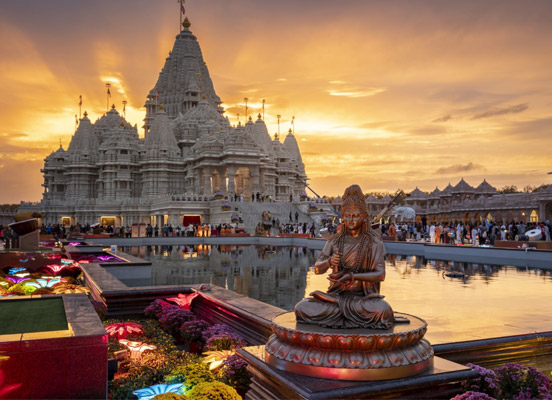
For thousands of years, up to the present day, Vedic architectural science has guided the layout, design and construction of thousands of magnificent mandirs, both in India and outside: the Surya Rath Mandir of Konark on the Wheels of Time, the soaring Shikhar of Tirupati, the charming robustness of Kedarnath, the delicate forms of Belur-Somnathpuri, the stupendous pradakshina of Rameshwar, the stunning gateway of the Madurai Meenakshi Mandir, the romantic Dwarka Mandir, the intricately and artistically sculpted BAPS Swaminarayan Mandirs in the USA and the hi-tech Akshardham Complexes in Gandhinagar and New Delhi - all represent the millennia-old culture and traditions of India enshrined in stone. As marvels of art and architecture, mandirs enhance the local landscape.
As wonders of art and architecture, these mandirs do more than just enhance the local landscape. They serve as vibrant hubs for the performing arts, with BAPS mandirs, in particular, providing avenues for skill development in dance, drama, vocal and instrumental music. These cultural centers also foster traditional arts, crafts, and cuisine, thereby nurturing a living link with our heritage.
The resurgence of the haveli style of wood architecture, a tradition lost for over a century, is a commendable outcome of the construction of BAPS mandirs in places like London, Nairobi, Chicago, and Los Angeles in recent years. The extensive use of intricately sculpted wood in these structures preserves the centuries-old skills of our artisans.
Mandirs represent the tangible bridges that connect us with the richness of India's age-old traditions, regardless of where we are in the world. They serve as perpetual reminders for every generation of Indians—past, present, and future—of their eternal bond with God.
More than that, they call upon us to carry forth the responsibility of preserving and nourishing the unique cultural and spiritual legacy of India.
Let us, as Indian Americans, celebrate and take pride in these splendid edifices, which not only anchor us to our roots but also inspire us to strive towards nobler living. Through mandirs, we can foster mutual respect, propagate our cultural heritage, and ensure its vibrant continuity for the generations to come.