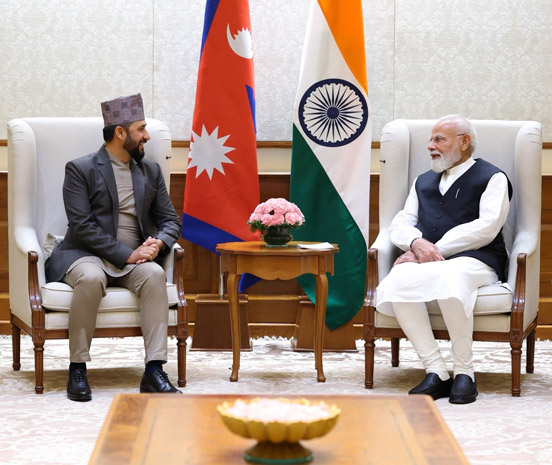
New Delhi/Kathmandu: While Kathmandu acknowledges India's emergence as a rising global power, New Delhi has continued to respect Nepal's sovereignty and strategic autonomy. There are no objective reasons why the relationship between the two countries should not continue to progress smoothly, a report has stated.
“Concerns driven by subjective anxieties and political posturing are often short-lived and unproductive. Moving beyond perceptions of power asymmetry and small-state vulnerability is essential to building a pragmatic partnership that advances the well-being of the people of both countries," Bishwadeep Pandey, a Central Committee member of the Nepali Communist Party (NCP), wrote in an opinion piece.
“It has not been long since contemporary global dynamics began to be described as a 'field of exploding realities' within an 'era of uncertain fluidity'. Amid constant shifts in the balance of power, alliances, and international relations, nations must remain hyper-vigilant and entirely prepared to safeguard their national aspirations and core interests. The relationship between Nepal and India is no exception to this reality," Pandey stated.
“Geography, civilization, deep people-to-people ties, and a shared commitment to democratic ideals provide a stable foundation for the relationship between these two neighbours. However, geopolitical dynamics are constantly evolving. The drivers of this fluidity are multidimensional; no single nation or government is solely responsible for these shifts,” he added.
Pandey highlighted the recent five-day visit to India by Nepal's ruling Rastriya Swatantra Party (RSP) Chairman Rabi Lamichhane, saying the visit undertaken at the invitation of the Bharatiya Janata Party (BJP) is widely seen as a strategic effort to elevate bilateral ties amid Nepal’s evolving political landscape.
"High-level engagements of this nature are rarely confined to mere state formalities; they are driven by a strong sense of purpose and underlying missions. It is precisely this shared sense of purpose that makes such high-level dialogues possible,” he added.