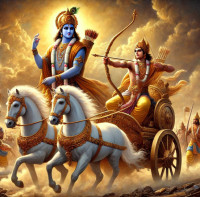
Vijayadashmi, more commonly known as Dashera, is celebrated by millions of Hindus across the world as a festival that marks the victory of good over evil. Rooted in the Ramayana, it commemorates Shri Rama’s triumph over the asura king Ravan, who had kidnapped Sitaji from the forest.
Ravan was a learned scholar, a great devotee of Shiva, and a powerful ruler. Yet, his downfall came not from ignorance but from arrogance and uncontrolled desires. He knew what was right but chose pride over humility and indulgence over restraint. When he kidnapped Sitaji, he crossed the line between righteousness and selfish passion. At that moment, his knowledge and devotion lost their sanctity.
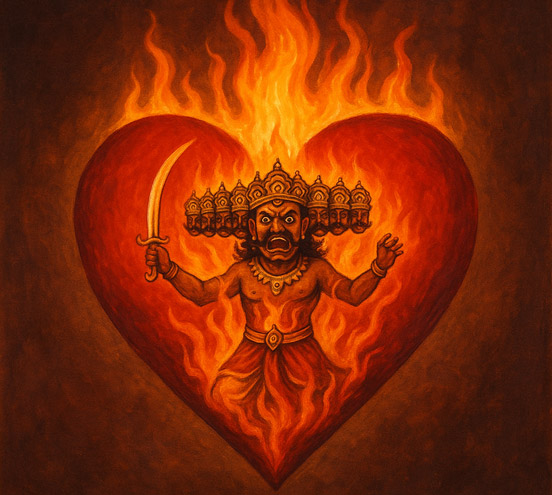
The burning of Ravan’s effigies each year symbolizes the destruction of arrogance, lust, greed, and ego—qualities that continue to dwell within human hearts. But Vijayadashmi is not just about a victory long ago. It calls each of us to reflect: Who is Ravan today?
Today’s Ravan may not appear with ten heads, but his vices remain very much alive—in our anger, jealousy, greed, and ego. Every time we let our impulses rule over our conscience, Ravan rises again within us. The effigy that burns in the town square each year is merely a symbol; the true battle is the one within.
Vijayadashmi invites us not just to celebrate an ancient victory, but to undertake a deeply personal conquest—the eradication of inner demons. The real effigy is made of ego, jealousy, attachment, and lust. These can only be conquered through the light of wisdom, the discipline of devotion, and the strength that comes from spiritual company.
Associating with the good - satsang, listening to spiritual discourses, and associating with a realized saint—fuels that inner fire which consumes base instincts. Bhagwan Swaminarayan explained in Vachanamrut Kariyani 12 (a compilation of the teachings of Bhagwan Swaminarayan is called the Vachanamrut):
Regardless of how lustful, angry, greedy, or lewd a person may be, if he listens to discourses with faith and love, all of his flaws would be eradicated. For example, if a man with teeth strong enough to chew raw chickpeas were to eat a great many sour mangoes, then he would not be able to chew even boiled rice. In the same way, if a person who is strongly overpowered by lust, anger, etc., were to listen to discourses with faith and persistence, then that person would no longer be capable of indulging in the panchvishays (Sensual pleasures). Thus, one should listen to the discourses with faith and love. There is no better method to stabilize the mind and free it from desires for vishayas.
Hence, burning the Ravan inside is not a one-day ritual; it is a lifelong discipline. Each day, through prayer, reflection, and the remembrance of God, we weaken Ravan’s grip. When anger flares, we can recall Shri Rama’s calm composure; when temptation arises, we can remember Sitaji’s unwavering virtue; and when pride swells, we can bow in humility before the divine.
As we celebrate Vijayadashmi, let the flames that consume Ravan’s effigy remind us to ignite our own inner transformation. For the true victory of good over evil is not won in Lanka—but within the human heart.
Lenin Joshi
BAPS Swaminarayan Sanstha