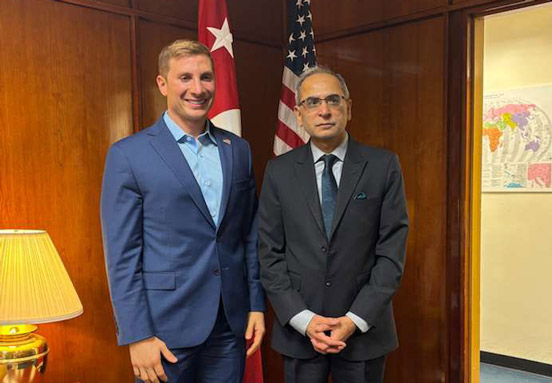
Washington: As the world awaits the results of India-US trade deal negotiations, India’s Ambassador to the United States, Vinay Mohan Kwatra, met US Under Secretary of State Jacob S Helberg here to discuss a mutually advantageous trade arrangement and enhanced cooperation in emerging technologies.
Kwatra congratulated Helberg on taking charge as Under Secretary for Economic Growth, Energy, and Environment. Sharing details of the interaction, he wrote on X: “Had a wide-ranging conversation on our bilateral economic engagement agenda, including a mutually beneficial trade deal, strategic trade dialogue, and technology cooperation, including AI.”
Helberg, who now serves as the 22nd Under Secretary of State for Economic Affairs, earlier worked as an Advisor to the Council of Economic Advisors at the White House. His meeting with Kwatra adds to a series of engagements the Indian envoy has recently held with senior US officials and lawmakers.
Officials indicate that the first phase of the proposed India-US bilateral trade agreement (BTA) is “nearing closure”, with expectations that it will tackle the steep tariffs on Indian exports while also addressing US market access concerns.
The US remains India’s largest trading partner for the fourth consecutive year in 2024–25, with bilateral trade reaching USD 131.84 billion — including USD 86.5 billion in exports. The country accounts for about 18 per cent of India’s total goods exports, 6.22 per cent of imports, and 10.73 per cent of total merchandise trade.
Earlier this month, Indian Commerce Secretary Rajesh Agrawal had indicated that both sides were “nearing closure” on the initial stage of talks. He said that negotiations have been progressing swiftly through regular virtual rounds, although no fixed timeline has been set for the agreement.
Positive signals from Washington have further boosted expectations. US President Donald Trump recently reiterated his intent to strengthen ties with India, noting that his discussions with Prime Minister Narendra Modi were “going great”. He also hinted at lowering tariffs on India “at some point”, suggesting that a breakthrough in the talks may not be far away.
|
India rejects IMF’s assumptions on US tariffs The Indian government has pushed back against the International Monetary Fund’s (IMF) latest assessment that assumes the recently imposed 50 per cent US tariffs on Indian exports will remain in place indefinitely. The IMF used this “baseline” scenario to trim India’s GDP forecast for 2024-25 to 6.6 per cent and cut its 2026-27 projection by 20 basis points to 6.2 per cent, warning that persistent tariffs would weaken external demand and dampen investment. Indian authorities, while acknowledging that some sectors would feel the strain in the near term, argued that the IMF was overstating the long-term drag on growth. They said India had already front-loaded much of its adjustment to the tariff shock and was working to expand access to alternative export markets. New and upcoming free trade agreements, they added, could help offset any losses from the US market. |