By Kuntala Karkun
A recalibration of India’s demographic dividend strategy is overdue, and integrating women through digital skilling is central to it.
As India stands at the cusp of a historic opportunity with the world’s largest youth population, the term “demographic dividend” has become a familiar refrain in policy and development circles. This dividend, however, is not a guaranteed payout; rather, it’s a potential that must be harnessed deliberately and inclusively. And two crucial, yet underutilized, levers in this process are female labor force participation and the strategic use of technology.
With over 68% of its population in the working-age bracket (15–64 years) and more than 50% under the age of 30, India is home to one of the largest youth populations in the world. This demographic structure presents a unique and powerful opportunity, commonly referred to as a demographic dividend. If strategically leveraged, this could propel the country toward sustained economic growth, higher productivity, and enhanced global competitiveness. Yet, there’s a glaring gap that threatens this opportunity: the persistent under-representation
of women in the labor force.
The missing half of the workforce
A striking paradox of India’s growth story is the precipitous fall in female labor force participation (FLFP), even as education levels among women have improved. India’s female labor force participation rate (FLFPR) has long trailed behind global benchmarks. In 2023-24, India’s FLFPR stood at 33%, far below countries like China (61%), USA (57%), UK (58%), and Germany (55%), and less than half of India’s male LFPR rate (79%).
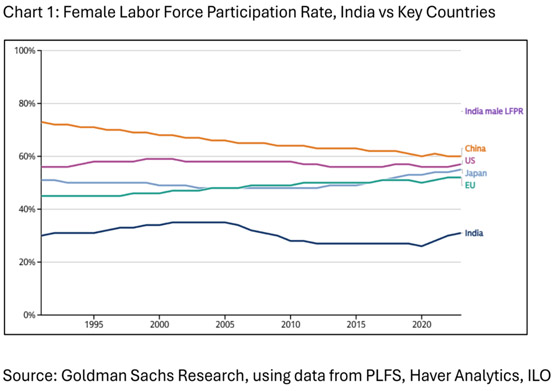
(Courtesy: www.goldmansachs.com)
This lag in female labor force participation is more than a reflection of entrenched social norms and structural barriers—it is a profound economic inefficiency that undermines India’s long-term growth trajectory. Despite
significant strides in education and healthcare, the persistent exclusion of women from the labor market highlights a critical disconnect between potential and performance.
At a time when global economies are doubling down on human capital as the engine of sustainable development, India’s failure to productively engage nearly half of its population stands out as both a social and economic paradox. The World Bank estimates that India could raise its GDP growth by an additional 1.5 percentage points if just half of its women participated in the workforce. Even more strikingly, the International Monetary Fund (IMF) projects that achieving gender parity in labour force participation could expand India’s GDP by a staggering 27%.
These are not marginal gains; they represent the kind of leap that could redefine India’s economic trajectory and propel it toward its goal of Viksit Bharat. Every woman kept out of the workforce is not only a missed opportunity for individual advancement but also a loss to the country’s collective productivity, innovation, and competitiveness. In other words, the empowerment and inclusion of women in the labor force is no longer just a matter of social justice or gender equality; it is a national economic imperative.
The tech dividend: A parallel opportunity
Just as India’s demographic window opens, a technological revolution is unfolding. Technology, when accessible and inclusive, has the power to leapfrog traditional barriers to women’s economic participation. Digital platforms, mobile connectivity, and AI-driven tools are creating new pathways for work, learning, and entrepreneurship.
Remote work platforms like Upwork and Freelancer provide flexible employment opportunities without the need for relocation. Mobile-based skilling apps such as Hunar, Coursera, and NSDC Digital allow women to acquire industry-relevant skills from home. FinTech innovations, including UPI, Jan Dhan accounts, and SHG-linked apps, are increasing women's access to formal financial services. Additionally, digital health and childcare solutions free up time for women to engage in paid work. The gig and platform economy—through platforms like Urban Company and Meesho—lowers entry barriers for women to pursue entrepreneurship and service-based work, opening up new avenues for economic empowerment.
Technology amplifies what demographics and equity alone cannot achieve. It can be a force multiplier that unlocks productivity, spurs innovation, and builds inclusive growth. What’s needed now is a second wave: not just training for basic digital literacy, but support for women in STEM fields, AI development, and e-commerce leadership.
Policy needs to connect the dots
For technology to truly empower women and help unlock India’s demographic dividend, a multi-pronged policy approach is essential. First, expanding digital infrastructure—such as access to smartphones, affordable broadband, and regional-language digital content—in rural and semi-urban areas is crucial to bridge the digital divide. Second, skilling programs must be gender-sensitive, tailored to local job markets, and aligned with social realities, enabling more women to participate meaningfully in the workforce.
Third, regulatory frameworks should evolve to protect women in the gig economy and recognize emerging work models. This includes formalizing flexible work, extending childcare benefits, and ensuring social security coverage. Finally, public-private partnerships can accelerate inclusion by incentivizing tech companies to onboard more women through tax incentives, mentorship schemes, and targeted digital literacy initiatives.
Now is the time to act
India’s demographic dividend will peak around 2040. Whether it becomes a growth windfall or a squandered opportunity depends on how well we can integrate women and tech into our development narrative. As India marches toward its goal of Viksit Bharat@2047, the dual engines of demography and digital innovation can either become our greatest growth story or a missed opportunity.
If half the population remains underemployed, the dividend becomes a liability. But if we unlock the potential of Indian women through smart, inclusive technology, India won’t just reap a demographic dividend; it will lead a global transformation.
(The writer is a Senior Fellow at Pahle India Foundation, a policy think-tank based in New Delhi.)