By Aniket Kshirsagar
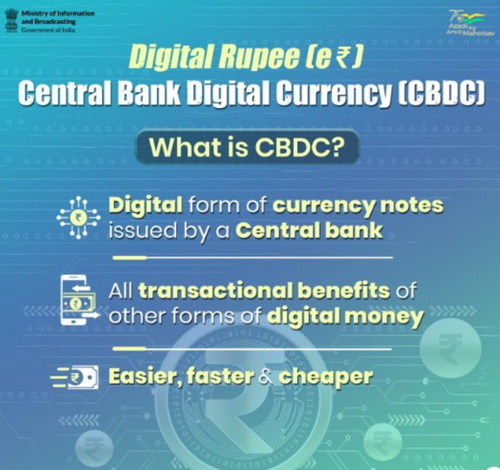
Despite being underway for more than two years, India’s Central Bank Digital Currency (CBDC) pilot program of the e-rupee (e₹) has largely remained in the shadows. Even though digital currency has seen a significant jump in volume compared to previous years, adoption has been underwhelming, with ₹1,016 crore in volume in circulation as of March 2025.
This is a sign of retail unpopularity. The reasons can be assessed from multiple arguments. One of them can be presented as being more structural and fundamental than the rest.
India has built the world's second-largest CBDC pilot in a country that already has the world's most successful digital payments system. UPI processed 20 billion transactions worth ₹25 trillion in a single month and accounts for nearly 85% of digital transactions in India. Yet the RBI has spent three years, 17 banks, and enormous institutional capital building a parallel digital currency.
The current article aims to explore the hidden inefficiencies, theoretical and practical, in the structural framework of India’s CBDC undertaking. The question we try to work with is not whether India should have a CBDC; it's whether India built the right one first. We further examine the inefficiency costs associated with these structural inefficiencies.
Section 1: The theoretical cost
The RBI, in its concept note explaining its stance on the e-rupee, has made it amply clear that, at least for now, its vision for its digital currency is to complement cash rather than replace it.
Many theoretical studies around the world (most prominently, the argument presented in the working paper series on CBDC by the Bank of Canada) mathematically prove that, in theory, having both cash and a CBDC available to agents sometimes results in lower welfare than having only one, suggesting that removing cash may actually be a welfare-enhancing policy if the goal is monetary policy effectiveness.
The RBI has explicitly said it is not replacing cash. So, India is in a permanent coexistence. The inefficiency costs are not a temporary fee paid for future gains. Again, they turn out to be structural.
While the reasoning for such a structure may be sound and dynamic, the central bank’s constraints do not take away from the welfare loss. The RBI should be a case study in itself, as the constraints of all the central banks around the globe are unique, resulting in unique motivations and challenges in developing a fully operational CBDC.
India does not face a dual system problem (cash + CBDC), as is theorized in most other economies. Rather, it faces an even more complex triple-layer systemic problem (cash + CBDC + UPI). Every agent who has to decide between three payment modes, every bank that has to maintain three parallel rails, every merchant that has to accept two forms of legal tender, and a system of digital payments that is already deeply integrated at a retail level. These are friction costs that tend to compound.
Section 2: Obstacles to retail CBDC
As the RBI does not grant any rate of interest on CBDC holdings for the possibility of disintermediation of banks, it can be argued that retail e-rupee has no significant defensible advantage over UPI. There do exist unique features like offline operability, anonymity (which has been subject to a significant amount of policy debate), and programmability.
The minuscule adoption of the CBDC so far in India is proof that these features are not enough to pull retail agents away from UPI. The RBI does not mean the e-rupee to be a competitor to either cash or UPI, and is simply introducing a CBDC to provide a unique and standalone form of legal tender.
Unfortunately, the argument of the present article posits that it may actually be cumulatively more inefficient for the central bank to roll out a standalone legal tender, while promoting full operability of pre-existing, traditional means of economic transactions, wiz. cash and UPI.
The inefficiency costs of introducing a retail CBDC in such an environment include monitoring costs, settlement costs, and infrastructure costs, among others. Simply put, in an economy like that of India, which operates at extremes, reliant on cash, and with UPI being the largest digital payment interface of its kind globally, it is as yet difficult to point out a retail agent who would find CBDC more efficient or convenient than the plethora of payment modes already at their disposal. Systemic costs are high, and adoption is quite unenthusiastic, even when given the concession of the current system being a pilot.
Section 3: Argument for an efficient wholesale CBDC
We have established that retail CBDC leads to inefficiency costs. But that does not entail that India should not invest in the Research and Development of the e-rupee. The wholesale CBDC, which the RBI has developed and is less frequently discussed, may actually be the most efficient and cost-saving use case of a digital currency.
In India's current government securities market, all secondary market transactions flow through the Clearing Corporation of India Limited (CCIL) as a central counterparty. The explicit goal of the wholesale CBDC pilot was to reduce transaction costs by removing the need for centralized intermediaries to guarantee settlement and to reduce the need for collateral to address settlement risk.
This matters in a way the retail case doesn't. The CCIL intermediary is not redundant, the way a bank in a UPI transaction is. It exists because a settlement between institutions requires a guarantee mechanism that prevents cascading defaults. Wholesale CBDC with atomic, programmable settlement can eliminate that counterparty risk structurally, not just economically.
Wholesale CBDC allows for new forms of conditionality of payments, requiring that a payment only settles on condition of delivery of another payment or delivery of an asset. This conditional payment instruction enhances delivery-versus-payment mechanisms in RTGS systems.
Here, the dual-system cost argument (in the case of India, triple-system cost) also fades, because wholesale CBDC is not competing with an equally good incumbent. It is competing with a legacy infrastructure that still requires collateral pre-posting and central counterparty guarantees, which is a genuine efficiency gap.
Section 4: The inversion problem
Herein, we will try to diagnose why this priority inversion happened. The RBI chose retail CBDC as its public face because that's what central banks are expected to do. Their mandate is to serve citizens, not bond markets. Additionally, an Indian CBDC must be accepted by retail economic agents for it to gain popular legitimacy.
The consequence is that the product that most requires public trust and network effects (retail) is being judged by adoption metrics, which have inefficiencies. In contrast, the product that could provide actual institutional and procedural benefits (wholesale) is being piloted quietly without the urgency it deserves.
[Aniket Kshirsagar is a graduate of Economics and Psychology from CHRIST (Deemed to be University), Bangalore.]
The views expressed are not necessarily those of The South Asian Times