New Delhi: Finance Minister Nirmala Sitharaman announced an allocation of Rs 7.8 lakh crore for the country’s defense sector in the Union Budget for 2026-27, representing a 15 per cent increase over the corresponding figure of Rs 6.81 lakh crore for the previous financial year.
The defense forces have been allocated Rs 2.19 lakh crore for the purchase of military hardware as part of the capital outlay in the Budget, which constitutes a 21.8 per cent increase compared with the Rs 1.80 lakh crore allocated in FY 2025-26.
The increased outlay comes against the backdrop of Operation Sindoor and the changing geopolitical landscape. The approach is also in line with the government's push for an 'Aatmanirbhar Bharat', or self-reliant India, by encouraging indigenous research and manufacturing.
Finance Minister Sitharaman also proposed the waiving of basic customs duty on raw materials imported for the manufacture of parts of aircraft to be used in maintenance, repair, or overhaul requirements, which will benefit units in the defence sector.
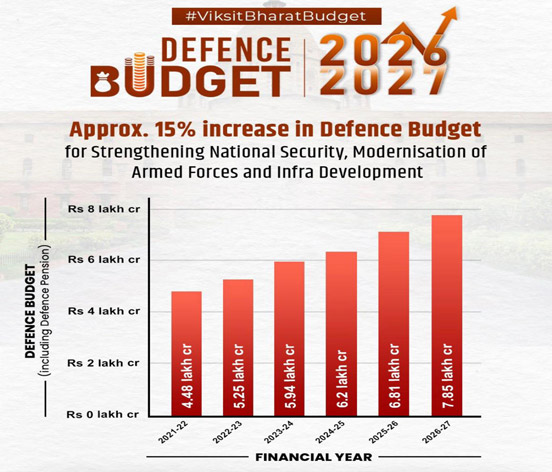
(Graphic courtesy: Ministry of Defence, GoI)
The government announced a capital expenditure of Rs 12.2 lakh crore in the Budget for 2026-27, to boost big-ticket infrastructure projects for growth and jobs in the economy.
The increase in capex has been driven by higher allocations for fighter jets, warships, missiles, artillery guns and other state-of-the-art defence equipment. The higher allocation of the purchase of defence equipment is expected to benefit both defence public sector undertakings and their private-sector suppliers, especially as order books across the sector have expanded sharply.
The public sector companies expected to benefit include Hindustan Aeronautics Ltd, which has an order book mainly from the Indian Air Force, Mazagon Dock Shipbuilders, which produces warships for the Indian Navy, and Bharat Electronics Ltd, which produces electronics equipment for the forces.
Smaller private sector companies such as MIDHANI, BEML, Bharat Dynamics and various startups in the drones sector are expected to benefit, too, as part of India’s indigenous procurement push.
The government has maintained fiscal prudence and monetary stability whilst maintaining a strong thrust on public investments, she said, stressing that India must deeply integrate with global markets, exporting more and attracting foreign investment as well.
The Finance Minister said that the government has undertaken comprehensive reforms towards creating employment, boosting productivity and accelerating growth.