New Delhi: India and China projected a stabilizing tone in their ties, with Beijing stating that the two countries should view each other as “cooperative partners instead of rivals" and as development opportunities rather than threats.
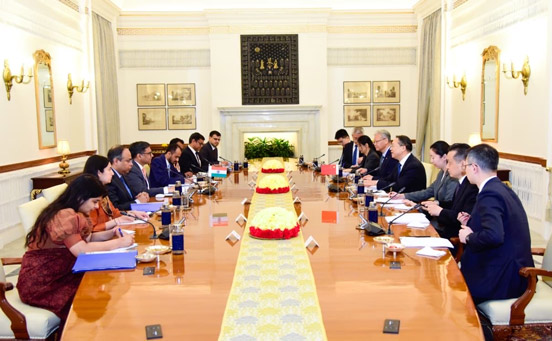
The remarks came after a fresh round of the India-China Strategic Dialogue held in New Delhi this week between Foreign Secretary Vikram Misri and China’s Executive Vice Foreign Minister Ma Zhaoxu, who is in India for BRICS-related meetings.
In its statement, Beijing said the two sides had held “friendly, candid and in-depth" talks on the international and regional situation, domestic and foreign policies, and the state of China-India relations.
“Both sides should view and handle China-India relations from a strategic and long-term perspective, and uphold the strategic perception that China and India are cooperative partners instead of rivals, and the two countries are each other’s development opportunity instead of a threat," it mentioned.
The Chinese statement also noted that the two sides agreed to back each other’s stints as BRICS chair in 2026 and 2027, strengthen coordination among countries of the Global South, and work towards a multipolar world.
India's Ministry of External Affairs said the dialogue covered a “wide gamut" of bilateral, regional and global issues, with particular focus on stabilising and rebuilding ties and identifying ways to move engagement forward. Misri highlighted the successful resumption of the Kailash Mansarovar Yatra and expressed hope that its scale would expand further.
|
‘Understand and respect' India's UNSC aspirations: China China expressed support for a successful BRICS Summit in India and conveyed that it “understands and respects” India’s aspirations for United Nations Security Council (UNSC) membership, a significant turnaround from its prior opposition to India's bid for a permanent seat. The UNSC comprises five permanent members and 10 non-permanent members, elected for two-year terms by the UN General Assembly. The five permanent members — China, France, Russia, the United Kingdom, and the United States — have veto power over all resolutions. |