[The opinions expressed in this article are those of the author. They do not purport to reflect the opinions or views of The South Asian Times.]
By Dr Nitish Dogra
The world marks International Lead Poisoning Prevention Week (ILPPW) from 19-25 October 2025. As India progresses to an aspirational Viksit Bharat by 2047, this is also the time when the nation must unlock its true demographic dividend, with a bold, time-bound national goal to eliminate childhood lead exposure by 2040 in keeping with the global agenda. Lead poisoning is, unfortunately, a relatively under-recognized environmental threat.
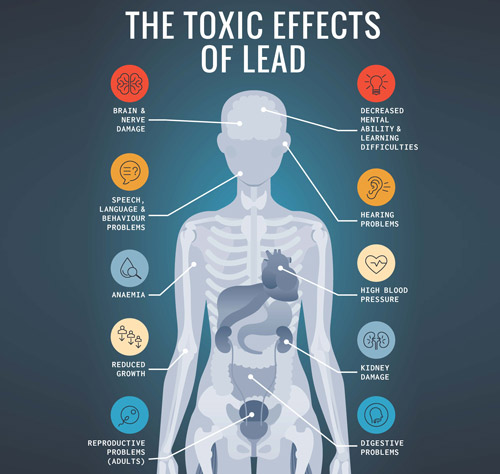
Unlike air pollution or climate change, say, it does not show up in the same way in media headlines. However, in terms of the impact on society, what we witness is comparable. It leaves a profound adverse impact on the way children learn and think. In adults, it can lead to kidney damage, reproductive issues, and cardiovascular problems, to name just a few of the issues.
Lead poisoning is undeniably a public health emergency. In 2020, a UNICEF–Pure Earth report brought to light a startling figure. Nearly 275 million Indian children have blood lead levels above the safe limit of 5 micrograms per deciliter. That amounts to about one in two Indian children, the highest burden anywhere in the world.
Although lead, a toxic heavy metal, has been banned from petrol and paint for many years now, it still persists through spices, cosmetics, ceramics, paints, used batteries, and industrial waste in the daily lives of so many in our country. And so, through air, soil, water and direct contact, lead finds its way to an unsuspecting population. Lead exposure hits the poor hardest, such as families living near waste dumps or smelters. Workers in the informal sector often handle toxic materials without protection, while their children play nearby, breathing the same contaminated air.
The economic cost is staggering. A well-designed global study estimates that lead exposure sets back the economy of the country by nearly 5 per cent of the country’s GDP annually through lost productivity, medical expenses, and premature deaths. It is undeniably a setback on human potential, a toxin that slowly but surely impinges on the foundations of national progress.
India has been able to ensure public health transformations. These include the elimination of polio, the Swachh Bharat campaign, and the COVID vaccination initiative, to name just a few. All of these demonstrate what is possible when political will, public awareness, and the plausibility of resources align. Setting 2040 as the target year for childhood lead elimination offers a clear, long-term vision, one that allows regulation, systems to evolve, and a clear communication strategy emanating from science to society.
In order to ensure this, the following is a suggested three step forward. First, map and monitor. India must set up a systematic National Lead Surveillance Program with blood lead surveys across the country, identify hot-spots and trace sources of exposure. The focus should be on evidence-based policy.
Second, the country must strengthen enforcement and eliminate contamination. Existing standards for lead in paints, food, and consumer goods need to be enforced. Informal battery recycling, a major contributor, should be formalized, with regulation, training, and safe recycling technologies.
Third, India must educate and empower communities. Public campaigns should teach parents, teachers, children and local leaders how to identify and reduce exposure. Lead screening can be integrated into India’s maternal and child health programs as well as Anganwadi programs.
Removing lead from our environment would not only save lives but also boost education and increase productivity. Every rupee spent on prevention would yield many times more in long-term gains. Protecting children’s brains is, in essence, protecting the country’s future workforce and its social stability.
Eliminating lead exposure is within reach. The technologies exist. The regulations exist. The knowledge exists. What’s missing is the sense of urgency, the political and moral commitment to act decisively. India can demonstrate to the Global South that economic growth and environmental health are not opposing forces but complementary ones. A national mission for a Childhood Lead- Free India by 2040 would not only safeguard millions of young minds but also inspire similar action across other developing nations still grappling with legacy toxins.
Imagine a child born in 2025. By the time that child turns 15, they should live in a country where safe food, clean water, and toxin-free homes are the norm, not the exception. That vision is entirely possible. India has already proven it can tackle the impossible. The next frontier is invisible, a fight against a toxin we can’t see but can surely stop. The question is not whether we can do it, but whether we choose. By making 2040 the year India becomes lead-free, we send a powerful message to the world that the health of our children is not negotiable. Development means more than GDP. Ultimately, it means giving every child the right not just to a healthy body but a healthy brain, after all the next generation needs not only to survive but thrive in a planet with more challenges than opportunities.
-----------------------------------
(Dr Nitish Dogra is a Fulbright Fellow and Scientific and Technology Lead for the India Lead Elimination Action Partnership (i-LEAP), Pahle India Foundation)