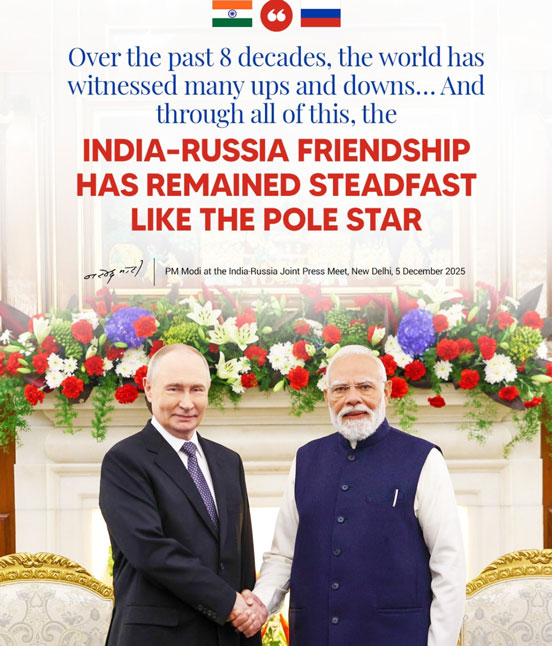
Fuel security, next-gen defense, nuclear expansion, and a trade architecture beyond sanctions mark a turning point — India signals to Washington and Beijing that its foreign policy will not follow prescribed alignments.
By K S Tomar
It was as though an old strategic partner returned in the middle of a storm with renewed strength rather than nostalgia. Vladimir Putin’s touchdown in New Delhi — amid the continuing violence in Ukraine and Donald Trump’s intensifying insistence on a negotiated settlement — did not merely add another chapter to a long diplomatic partnership; it reopened the debate on how global power is distributed, who writes the rules of war and peace, and how India positions itself in an increasingly fractured world.
Where the 1971 Indo-Soviet Treaty once secured India against diplomatic isolation, the latest summit projects something deeper: a shared confidence that India and Russia are not relics of the past but players redesigning the strategic future.
The extensive agreements sealed in New Delhi have transformed warm sentiment into a practical road map that will drive India’s technological rise and Russia’s economic durability. From nuclear power and satellite programs to defense platforms and high-tech industrial ventures, the summit indicated that the friendship has moved beyond reminiscence and decisively into capability-building.
The S-400’s remarkable performance during Operation Sindoor has left both sides convinced that Indo-Russian defence cooperation is no longer just about legacy platforms but about future-ready military muscle that reinforces India’s strategic autonomy at a time of global realignment.
A friendship that defies volatility and reinforces vision
The 23rd Annual Summit solidified the perception that Indo-Russian ties continue to shine like a constant star in a sky of shifting loyalties. In an era when alliances flip as quickly as headlines, the imagery of Modi receiving Putin at the airport, the unscripted embrace, and the personal drive to the Prime Minister’s residence reflected trust that survives leadership transitions, sanctions pressure, and geopolitical headwinds. This symbolism was not allowed to stand alone; it culminated in an Economic Cooperation Programme that charts the partnership’s evolution until 2030, signalling that the relationship is not dependent on sentiment but anchored in deliverables.
A new architecture of trade immune to coercion
The core of the summit was a strategic reconstruction of bilateral commerce designed to withstand external pressure. Agreements span energy supply, logistics, fertiliser production, maritime cooperation, migration, and medical research. India’s flagship deal with URALCHEM to set up a urea plant in Russia guarantees stable fertilizer access and shields domestic agriculture from price shocks and supply disruptions.
Simultaneously, Russia’s assurance of uninterrupted oil shipments secures a critical buffer against market volatility and sanctions-driven manipulation. A push toward settlements in national currencies and fast-tracking a Free Trade Agreement with the Eurasian Economic Union signal a clear departure from Western-centred financial circuits. The two nations are not building alternate systems out of rebellion, but as insurance against a world where the dollar is increasingly used as a geopolitical weapon.
A defense-energy matrix at the core of national security
While trade expansion provides width, energy and defence continue to provide depth. India and Russia are now looking beyond conventional nuclear power to small modular reactors and floating nuclear stations — a potential game-changer for energy-hungry coastal states. India’s widening engagement in the Arctic, including the training of Indian seafarers for polar routes, plugs New Delhi into emerging maritime corridors that could shape the next era of global logistics. The targeted ambition to raise bilateral trade to $100 billion and explore sovereign currency mechanisms does not merely reflect optimism — it represents a deliberate move to insulate critical sectors from external arm-twisting.
India won’t mortgage its choices
The subtext of the summit was impossible to miss. At a time when Washington is exerting intense pressure to squeeze Russia economically and force a peace settlement on Western terms, India has resisted becoming an instrument of American coercive diplomacy. The Delhi summit was not a rejection of the United States, but a reminder that New Delhi chooses partners based on national interest, not superpower prescriptions. India continues deep defence, technology and maritime cooperation with Washington, but the era of fearing displeasure in Western capitals is over. The strategic autonomy doctrine is no longer theoretical — it is operational.
A Washington lens on New Delhi
US policymakers will study the summit for signs of whether the Indo-Russian oil supply chain becomes semi-permanent; whether joint work on advanced air-defence technologies weakens American leverage built through CAATSA; and whether Russia gains diplomatic visibility during wartime. None of these questions will derail India-US engagement, but they will widen a gap in expectations. India has signalled that it will not play a subordinate role in an American-shaped world order — partnership yes, obedience no.
A global ripple that marks the arrival of multipolarity
What unfolded in Delhi is part of a larger disruption of the post-Cold War strategic map. The summit strengthens resistance to unilateral sanctions, promotes alternative energy-settlement networks and revitalises the India-Russia role inside BRICS+ and the Shanghai Cooperation Organisation. For the Global South, the symbolism is powerful: blocs are fading, choices are multiplying, and national interest — not ideological inheritance — will define alignment.
A Beijing-Islamabad equation left uncomfortable
China and Pakistan have reasons to read the summit with unease. A reinvigorated India-Russia partnership reduces Moscow’s reliance on Beijing, narrowing China’s diplomatic manoeuvring room. Islamabad, meanwhile, understands that deeper Indo-Russian defense and energy ties restrict China’s ability to use the Russia-Pakistan channel as a counterbalance to New Delhi. India’s growing Arctic footprint and nuclear-energy expansion reinforce a reality the Sino-Pak axis has long resisted: New Delhi cannot be boxed in regionally.
A windfall for both sides
India emerges with five hard benefits — energy assurance, fertilizer security through Russian production, next-generation defense and nuclear synergy, diversified logistics pathways beyond chokepoints, and heightened global influence through multipolar diplomacy. Russia gains access to a stable and enormous energy market, a resilient defence and technology partner, investment streams that soften wartime economic pressure, non-European logistics routes and political legitimacy independent of China.
A new operating manual for Indian foreign policy
This summit was not a sentimental salute to Cold War camaraderie but a sophisticated broadcast of strategic confidence. India refuses to exchange flexibility for alignment and will not subordinate global choices to the calculations of any single bloc. For Russia, India remains a bridge to the world. For India, Russia remains indispensable to defence depth and energy affordability. And for the international order, the summit will endure as a reminder that the age of dictated alliances is over. India is not bending — it is recalibrating the balance of power.
------------------------------------------------------------
.jpg)
(K S Tomar is a strategic affairs columnist and senior political analyst based in Shimla.)
The views expressed in op-eds are not necessarily those of The South Asian Times