
In recognition of Lung Cancer Awareness Month, NYC Health + Hospitals today announced the public health care system has performed nearly 17,000 lung cancer screenings since the launch of its Lung Cancer Screening Program in September 2022. Lung cancer is the leading cause of cancer death for both men and women, and more people die each year from lung cancer than breast, prostate, and colorectal cancers combined. Patients are screened for lung cancer with a low-dose computerized tomography (CT) scan, a diagnostic imaging tool that uses X-rays to create cross-sectional images of the lungs. The early detection of lung cancer, which is often asymptomatic in early stages, has proven to dramatically increase survival. NYC Health + Hospitals offers lung cancer screening for patients who are between the ages of 50 and 80, have a history of heavy smoking, are currently using tobacco, or stopped smoking within the past 15 years, and have no signs or symptoms of underlying lung cancer. Lung cancer screenings are now available to eligible patients at all NYC Health + Hospitals acute care facilities.
“Performing nearly 17,000 lung cancer screenings in just three years has undoubtedly saved New Yorkers’ lives, and shows what a public health care system can achieve when it prioritizes equity and outreach to its patients,” said Dr. Mitchell Katz, President and CEO of NYC Health + Hospitals. “Detecting lung cancer early with a quick, non-invasive lung cancer screening is critical for successful treatment. We’re committed to making sure every New Yorker in need has access to it.”
“Our commitment to expanding access to lung cancer screenings reflects our team’s commitment to addressing health disparities and providing equitable, high-quality care for every New Yorker at risk of developing lung cancer,” said Dr. Ashwin Basavaraj, Chief of Pulmonary Medicine at NYC Health + Hospitals. “We encourage all eligible patients to speak with their providers about screening — the earlier we screen, the faster we can connect you to effective, life-saving treatment options.”
Lung cancer screenings are covered by Medicare, Medicaid, and most commercial insurance plans without any out-of-pocket cost. Patients who meet the criteria and wish to be screened should speak with their primary care doctor for a referral. If you do not have a primary care doctor, please call 1-844-NYC-4NYC to schedule an appointment.
Patients who screen positive for lung cancer are paired with a clinical navigator who ensures they receive care specific to their needs, including follow-up appointments and connections to tobacco cessation resources. Patients can access the latest technologies in robotic and navigational bronchoscopy to help biopsy and diagnose lung cancer, as well as minimally invasive surgical lung resection for early stage lung cancer. Additionally, they have access to cutting-edge oncology treatments, including targeted therapy and eligibility for certain clinical trials to explore advanced treatment options.
NYC Health + Hospitals Lung Cancer Screening Program (LCSP) has expanded access to life-saving lung cancer screenings for New Yorkers across the city, advancing healthy equity and reducing preventable deaths by identifying cases of lung cancer at earlier, more treatable stages.
Since its launch, the LCSP has:
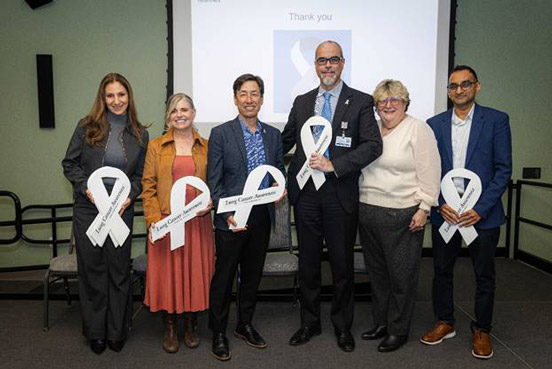
NYC Health + Hospitals Chief of Pulmonary Medicine Dr. Ashwin Basavaraj (right) joins White Ribbon Project Co-founders Heidi and Pierre Onda (second and third from left) to honor providers’ commitment to lung cancer screening. (Photo courtesy: NYC Health+Hospitals)
“We are honored to see NYC Health + Hospitals continue to embrace the White Ribbon as a symbol of unity, visibility, and hope for all people affected by lung cancer,” said Pierre and Heidi Onda, Co-Founders and Directors of the White Ribbon Project. “The way their Lung Cancer Screening Program has woven this symbol into care, from patients to navigators to clinical leaders shows what is possible when compassion and collaboration meet purpose. Together, we are changing the narrative, inspiring early detection, and bringing hope to every life touched by this disease.”