By Prakash Bhandari
The National Investigative Agency (NIA), which is investigating the cause of the massive fire in the Pachpadra refinery in Rajasthan, is focusing its investigation on whether there was any conspiracy, like sabotage, that caused the fire. The NIA, which has been entrusted with the job of primary investigation, is also aiming to investigate security lapses in the context of Prime Minister Narendra Modi’s security protocol.
The fire broke out 24 hours before PM Modi was scheduled to inaugurate the refinery - India's first greenfield integrated Refinery-cum-Petrochemical Complex, which is a joint venture between Hindustan Petroleum Corporation Limited (HPCL) and the government of Rajasthan.
Rajasthan’s former Chief Minister Ashok Gehlot, the visionary behind the refinery, got in touch with an Australia-based refinery chemical engineer to know his expert view on the reasons that caused the fire. Technically, refineries have been catching fire due to technical failure after 20-25 years, he said.
The Australian expert whose name was not disclosed by Gehlot in his report said that fire accidents are nothing new, and such fires occurred in old refineries. However, he was surprised that such a fire occurred in a newly installed refinery. The expert did not agree with the HPCL officials' version that the Fire was caused by the leakage of hydrocarbons through one of the valves or fringes in the heat exchanger circuit.
The NIA is also investigating a Twitter post on April 16 by Aravind@Aravind, who regularly posts issues on social media relating to oil, gas, and refineries, and six days before the fire.
“Indian oil refineries must take extra steps on security, and sabotage from the inside. India must step up surveillance and security. I got a bad hunch that the adversary (GLISCO_DS linked) can burn a refinery to increase oil price for geopolitics and derail India’s economy 2-in-1...
I think anyone could have predicted if they had followed the news on refinery fires in patterns around the world. There were refinery fires in Mexico, Canada, the US (two sites), Russia (two sites), Australia, Ecuador, etc., one after the other in just the last 20 days or so.”
GLISCO DEEPState (Globalist-Islamist-Communist) is a term used in political commentary to describe an alleged conspiracy network aiming to disrupt India’s economic stability. Critics claim this nexus links foreign firms, media, and anti-India actors to cause distress and damage India’s relationship with Western nations.
On March 30, 2026, Aravind had tweeted that the GLISCO Deep State is planning to hit the Indian economy hard. But all his warnings were not taken seriously by the nationally-owned oil companies or by the intelligence agencies.
The NIA is concentrating on the various aspects of technical failures and the aspect of negligence on the part of the refinery officers responsible for the machinery failures. It has come to the notice that there was no coordination between the various security agencies and the Hindustan Petroleum Corporation Ltd, the major stakeholders in this refinery, on the aspect of safeguards and fool-proof security at the plant site, where the Prime Minister was to inaugurate the Rs 80,000 crores refinery almost 24 hours after the massive explosion.
The Union Ministry of Home Affairs is treating the incident as a potential breach of established security protocols. Officials and experts from multiple agencies, including the National Investigation Agency (NIA), a team from the Union Ministry of Home Affairs, and technical experts from the Ministry of Petroleum, reached the site to begin a detailed investigation.
The NIA itself does not have any expertise in investigating the refinery explosion and is following the experts of the refinery officials who are guiding the investigations. Security agencies typically conduct extensive checks ahead of any Prime Minister’s visit, but in Pachpadra, which is located in the newly created Balotra district about 100 km from Jodhpur, the NIA has been tasked to investigate the cause of the fire.
A thorough investigation into the cause of the fire and the various safety issues could be completed only with the supervision of the expert refinery safety experts. Once the primary investigation was over, the Hindustan Petroleum Corporation Ltd and the Ministry of Oil and Petroleum would think of hiring foreign experts from the US and the Middle East to not only investigate the cause of the fire, but also all future safety aspects that have to be taken into consideration while installing the new Crude Distillation Unit (CDU) and other plant equipment. Thus, the future investigations will be tasked to suggest the various measures to be taken in the design aspects of the CDU, particularly relating to the Hydrocarbon.
CCTV footage from across the refinery is being closely analysed to identify any suspicious activity. Entry protocols have been tightened, and surveillance of personnel and outsiders has been significantly enhanced.
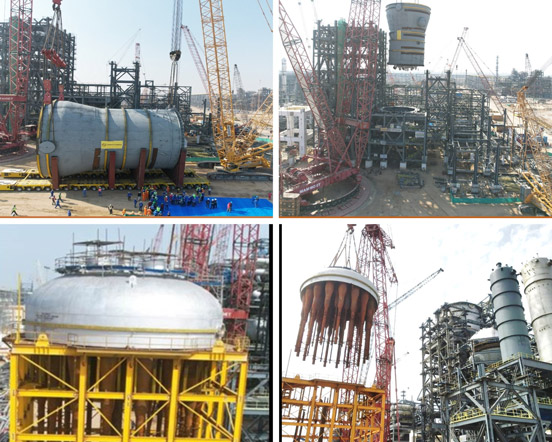
Spread over 4,500 acres and built for Rs 79,459 crore, the refinery employs over 20,000 workers and staff.
As of now, Hindustan Petroleum Corporation Limited (HPCL) has not released a detailed assessment of the damage. Preliminary indications suggest that if the Crude Distillation Unit (CDU) has not suffered major damage, commercial production could potentially resume soon.
According to preliminary information provided by HPCL officials, the damage is confined to a limited area. Preliminary indications suggest that if the Crude Distillation Unit (CDU) has not suffered major damage, commercial production could potentially resume by July 1.
The contract for the erection of the plant was given to Tatas and other engineering companies. The initial report of the investigation by the Hindustan Petroleum Corporation (HPCL) reveals that the fire was confined to the heat exchanger stack of the Crude Distillation unit (CDU), impacting six exchangers and associated equipment. The investigation also revealed the possible leak from a pressure gauge tapping point as the trigger behind the incident.
The HPCL is hopeful that a new CDU unit would be installed and production would begin sometime in May.
(The views expressed are personal and not necessarily those of The South Asian Times)