By Damini Yadav & Jyoti Yadav
The latest Periodic Labour Force Survey (PLFS) Annual Report, released on March 27, 2026, offers a cautiously optimistic snapshot of India’s employment landscape for the year 2025. The finding looks positive due to its sustained steadiness; however, there are some pressing questions seeking attention and answers.
At first glance, the numbers suggest stability - an encouraging sign in a volatile global economic environment. Yet beneath this veneer of steadiness lie deeper structural concerns that warrant closer scrutiny.
According to the report (2025), the Labour Force Participation Rate (LFPR), which is defined as the percentage of persons in the labour force (i.e., working or seeking or available to work) in India, is 44.9% for all ages, while the LFPR was 44.7% in 2024. The trend for Worker Population Ratio (WPR), which is defined as the percentage of employed persons, is 43.5% (2025), while it was 43.3% (2024).
The Unemployment Rate (UR), defined as the percentage of persons unemployed among the persons in the labour force, is 3.1% in the current report as compared to 3.2% in 2024. Though these are the broad data points depicting steadiness and advancement, the further differentiation between rural-urban and male-female has more to divulge.
.jpg)
(Source: Periodic Labour Force Survey (PLFS), Ministry of Statistics & Programme Implementation, Government of India)
The LFPR for rural male & female slightly increased to 58.8% in 2025 from 58.2% in 2024 and 34.6% from 34.2%, respectively. The urban picture also followed a similar orientation, marking steadiness with LFPR in male recorded at 59.7% (2025) as compared to 59.4% (2024), and for female, at 22.2% (2025) from 22 % (2024).
The WPR for rural male has also logged an increase to 57.2% (2025) from 56.6% (2024), with rural female showing slight growth to 33.8% (2025) from 33.5% (2023-24). Similarly, WPR for urban male went up at 57.2% (2025) from 56.7% (2024), and for urban female, again a slight improvement to 20.7% (2025) from 20.5 % (2024).
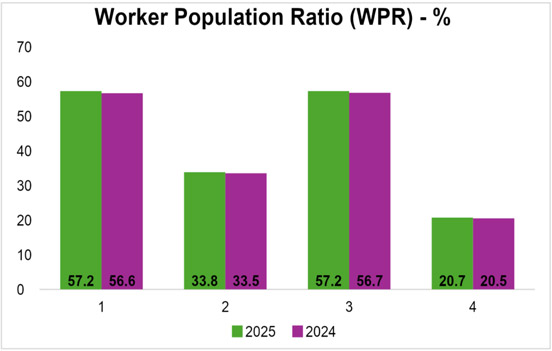
(Source: Periodic Labour Force Survey (PLFS), Ministry of Statistics & Programme Implementation, Government of India)
It is clear that the employment space is steady and quite consistent; however, the challenges of stagnant growth, gender gap, and inadequate job opportunities are hard to ignore. The concerning points remain the trends of female employment that probably suggest overburden (household work and outside), safety & health concerns, and failed translation of education into productive employment.
Unemployment in educated and youth
Unemployment Rate (UR) for educated (the highest level of education, secondary and above) persons of age 15 years and above, is recorded at 6.5% in the latest report (2025) as compared to 7.0% in 2024, indicating a positive mark. The Unemployment Rate for youth aged 15-29 years has also modestly declined from 10.3% (2024) to 9.9% (2025), exhibiting a mixed stance.
Although the trends portray improved capacity of the economy in absorbing educated workforce, it continues to struggle to provide the right prospects to the youth. A close look through a gender lens shows parallel tendencies in rural areas with UR for youth (15-29 years) at 8.2% among male and 8.6% among female, but in urban areas, the gap is wide with UR at 11.8% for male while 18.9% for female highlighting women's economic exclusion.
The rural trends point to a possibility of distress-induced employment, especially among women, due to the informal nature of work, lacking wage parity, and the absence of social security.
Yet, the incapacity of the urban space to provide jobs to educated women is disturbing, indicating discriminatory hiring practices, safety concerns, and the limited presence of creche/childcare facilities.
Persistent questions
It might appear instantaneous to judge the latest report based on the comparative analysis with the last report (2024), as the National Statistical Organisation (NSO) has brought fundamental changes addressing long-standing limitations of the survey’s frequency, coverage, and accuracy. It ought to be distinguished that there has been a dramatic increase in the sample size.
Structural revamping has improved the credibility and alignment with the ILO-recommended standards. Yet, some questions remained unanswered with regard to the gender gap in employment, joblessness in youth & educated, and absence of critical areas relevant to contemporary times, such as wage distribution data, work quality, migration & circular labour statistics.
It is imperative to focus more on employment scenarios, understand them well, and continue the quest in exploring pragmatic and sustainable solutions to cater to our favorable demographic dividend.
(Dr Jyoti Yadav is Assistant Director - Programs and Fellow, and Damini Yadav is Associate Fellow at New Delhi-based Pahlé India Foundation)
The views expressed are not necessarily those of The South Asian Times