Women are not auxiliaries in agriculture and food systems; they are its architects.
By Ishita Verma & Harpinder Sandhu
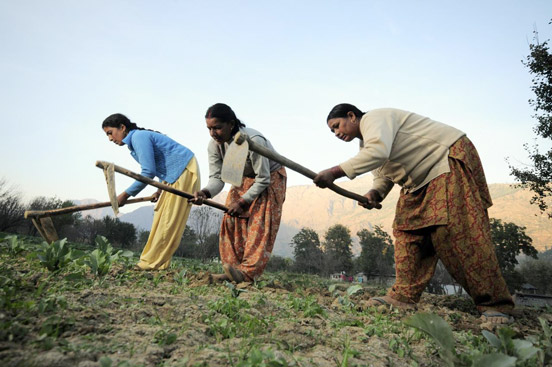
In the sun-scorched fields of India, women have long been the quiet architects of agriculture and food systems. They sow, weed, harvest, and feed the nation as they do for their households. Today, women constitute over 64.4% of India’s agricultural workforce, yet less than 15% of landholdings are in their names (Economic Survey 2024–25). This mismatch between contribution and recognition not only reflects the statistical oversight but also shows a deeper historical injustice that imperils India's food security and sovereignty.
Food sovereignty is the people’s right to healthy, culturally appropriate, and sustainably produced food. The first farmers, the last to be recognized: As agroecologist Dr Sandhu (2025) argues, it was women and not men who first domesticated crops and livestock over 12,000 years ago. This was not an accident of intuition, but it was the result of meticulous observation, experimentation, and knowledge passed through generations via songs, rituals, and storytelling. Yet, with the rise of plough-based agriculture and institutionalized land ownership, women were gradually excluded from the formal agricultural domains. British colonial revenue systems and the subsequent Green Revolution policies after independence reinforced this exclusion by tying access to credit, technology, and government assistance solely to male landowners.
Between 2017-18 and 2023-24, women’s share in rural agricultural work increased from 73.2% to 76.9%, while men’s fell below 50% (EPW, 2022), largely due to male out-migration. Despite this shift, women continue to face exclusion from decision-making processes and remain underrepresented in cooperatives, with a stark reality where only 3% of Farmer Producer Organizations (FPOs) are led by women. One key reason is the productivity gap, which is often used as a roadblock against women farmers. It is often quoted that the farms managed by women produce 11% lower yields than those managed by men (IFPRI, 2023).
But this is not a failure of effort or skill. It is a policy failure and a systemic denial of access to resources like credit, irrigation, manure inputs, markets, and mechanised tools, 80% of which are designed for male physiology. Without land titles, women lack collateral to access institutional finance or crop insurance, which adds to their vulnerability.
But India too has taken some steps in the right direction. The Mahila Kisan Sashaktikaran Pariyojana (MKSP) has reached over 3.5 million women farmers, enabling them to join self-help groups, adopt sustainable farming practices and engage in livelihood diversification. But the scale of MKSP remains modest compared to the vast scope of India’s food challenges. Even within these programs, women’s leadership remains underdeveloped. Even flagship employment schemes like MNREGA, where women’s participation in Uttar Pradesh reached 45.05% in FY 2025–26, fail to address structural constraints such as landlessness and lack of autonomy.
These inequities are further magnified by the climate crisis. Women farmers are among the most climate-vulnerable populations in India. Erratic rainfall, rising temperatures, and extreme weather events disproportionately affect subsistence crops, most of which are grown by women in rainfed and marginal regions. Yet gender is barely visible in most of India’s State Action Plans on Climate Change (SAPCCs). A 2021 review (Singh et al., 2021) found that less than one-third of SAPCCs mention gender at all, and even fewer have even proposed gender-responsive adaptation strategies. The Climate-Smart Agriculture (CSA) programs, wherever implemented, also tend to be technology-centric and top-down, with little regard for social or gendered access. As Rao (2025) argues, most CSA interventions ignore gender intersectionality, effectively excluding those who need them most.
Yet despite structural neglect, women continue to lead efforts that preserve local food systems and biodiversity. In Odisha’s Kandhamal district, the Millet Sisters Collective, composed largely of tribal women, revives heirloom millet varieties and their work has improved household nutrition, strengthened income security and promoted agroecological resilience. Across Uttarakhand, community seed banks managed by women preserve indigenous biodiversity. Similar international examples give proof of what is possible when women are empowered. In Rwanda, post-genocide land reforms ensured that over 94% of women now have access to land, and women’s participation in agricultural cooperatives has soared. In Nepal’s mountainous regions, women-led seed networks have proven vital to both biodiversity conservation and household nutrition. These cases underscore a clear message: when women control resources, food systems thrive.
India’s journey toward food security and sovereignty needs structural justice for the very hands that feed it. Sovereignty is not only about producing enough, but it is about having autonomy in making decisions about the production, resources and decisions. As India approaches its centenary in 2047, it must embrace a gender-transformative agricultural reform that can secure land titles for women, redesign tools to suit their needs, mandate gender-specific regulations in credit access and cooperatives, and also invest in agroecological initiatives led by women. Agricultural and climate data must be revisited to understand the disparities and work towards direct targeted interventions. The gains are measurable: closing the gender gap in agriculture could increase India’s total output and boost women’s farm yields (FAO, 2024). As aptly said, ‘Left to men, we would still be only hunting.’ Women are not auxiliaries in agriculture and food systems; they are its architects. Recognizing and empowering them is a national imperative for resilience, equity, and sustainability.
-------------------------------------------
SOURCES
(Ishita Verma is a Research Assistant with Pahle India Foundation. Dr Harpinder Sandhu is Director, AgTech Research Hub at Federation University, Australia, and Distinguished Fellow at Pahle India Foundation.)
The views expressed are not necessarily those of The South Asian Times