By Smriti Rekha Singha, Bishal Kalita & Bitupan Bora
Odisha has historically been one of India's most deprived states, with significant challenges in hunger, poverty, and other dimensions of standard of living. Over the past decade, Odisha has shed its image as an underperformer, once languishing near the bottom in human development rankings, to emerge today as a model of fiscal prudence and educational reform, topping the 2025 Fiscal Health Index and ranking 5th nationally in the 2023–24 Performance Grading Index for school education. Odisha has set a remarkable example of understanding how growth and development go hand in hand, yielding overall and inclusive progress.
Odisha in the millennial era
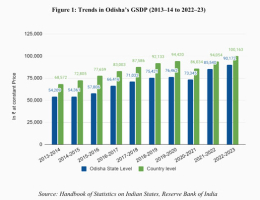
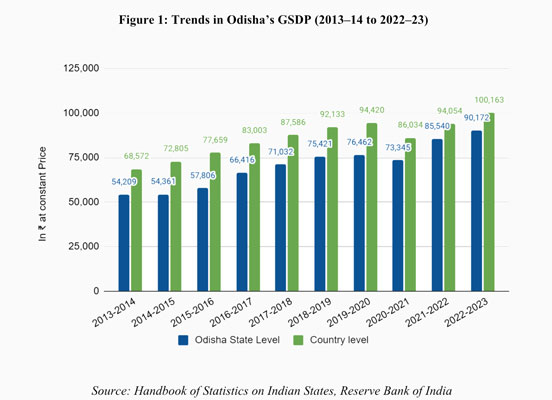
In the 2000s, Odisha had 57.2 per cent of its population living in poverty in 2004-05, ranking the state with the highest poverty population in the country. Following the next poverty estimation, Odisha improved, with 32.59 per cent of the population living in poverty in 2011-12 (Annual Report 2014-2015, NITI Aayog). Considering the last decadal Per Capita Net State Domestic Product at constant price, we observe Odisha has since made gradual improvements, achieving a thriving performance in its overall economy.
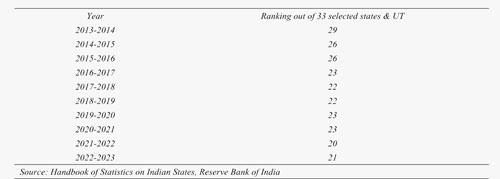
(Table courtesy of the authors)
Enduring growth and development
When we discuss growth and development, growth refers to an increase in production, national income, or the supply of goods and services within a country over a specific period. Whereas the term 'development' is often interpreted differently in various philosophies. As explained by Prof Amartya Sen, Development means freedom; for example, political freedom (the right to vote) and the expansion of people’s capabilities (for instance, people's ability to attain education).
Based on his ideas, the Human Development Index (HDI) was created, and it later evolved into the Sustainable Development Goals (SDGs). These indicators measure the expansion of freedom and capabilities.
In this context, to understand Odisha’s endurance for both growth and development, we examined two reports, both published by NITI Aayog: the Fiscal Health Index, 2025, and the SDG India Index-2023-24.
The Fiscal Health Index (FHI) measures a state's fiscal performance. A state's good fiscal performance boosts its economic growth. For example, controlled public debt can be a stable pillar for the economy. FHI is the arithmetic mean of five major sub-indices. These five sub-indices are quality of expenditure, revenue mobilization, fiscal prudence, debt index and debt sustainability.
FHI 2025 reported that for the year 2022-2023, Odisha secured the highest scores in fiscal performance among 18 major states of India. In detail, Odisha scored best in debt index, followed by revenue mobilization, then debt sustainability, then fiscal prudence and finally quality of expenditure. Odisha scored the highest in the debt index and debt sustainability among the 18 selected major states. This means Odisha spent a smaller portion of its revenue on interest payments, has smaller outstanding liabilities, and has a greater growth rate of GSDP than the growth rate of interest payments.
This indicates that Odisha has effective and sustainable fiscal management practices that surpass those of other larger economy states, such as Maharashtra and Andhra Pradesh. The quality of expenditure index of Odisha also reflects the inclusion of often-neglected sectors, such as sports, arts, and culture, along with increased spending on health and education.
Regarding fiscal management, Odisha received approximately 90 per cent of its non-tax revenue and 45 per cent of its revenue receipts from the mining sector. It is driven by premiums to market price over the lease period rather than by higher volume of extraction. Overall, from FHI, we understand that Odisha has been enduring sustainable economic growth.
Regarding the SDG India Index, it is a compilation of 113 indicators across 16 SDGs in the Indian context, aligning with the UN-SDGs. These 113 indicators originate from the National Indicator Framework of the Ministry of Statistics and Programme Implementation (MoSPI). This index includes the social, economic and environmental sectors. In the SDG India Index of 2023-24, Odisha is a front-runner state in terms of its overall SDG performance, with 9 SDG indicators achieving front-runner status. These 9 SDG indicators are no poverty, good health and well-being, clean water and sanitation, affordable and clean energy, decent work and economic growth, sustainable cities and communities, responsible production and consumption, life below water and life on land.
Here, Odisha’s increased capital and revenue expenditure allocations reflect a deliberate fiscal outlay strategy aligned with SDG targets. For instance, enhanced spending on education and health supports SDG 4 (Quality Education) and SDG 3 (Good Health & Well-Being), while capital investments in sanitation and urban infrastructure reinforce achievements in SDG 6 (Clean Water and Sanitation) and SDG 11 (Sustainable Cities and Communities). This pattern suggests that the state’s fiscal prudence and prioritization of high-impact sectors have had a multiplier effect on social outcomes, thereby contributing to Odisha’s commendable performance across nine SDGs. In essence, the refinement of fiscal policy has not only strengthened the state’s developmental capacity but also sustained the momentum of inclusive governance and SDG-linked outcomes. The staggering indices of the state can be attributed to the outcomes of the persistent efforts and endurance of policy implementations and strong and inclusive governance.
A model for the future
Odisha’s trajectory highlights how targeted investments in human capital, such as education, health and social welfare, can potentially reinforce inclusive and sustainable economic growth. The state’s progress demonstrates how people-centric policies not only improve quality of life but also strengthen long-term fiscal outcomes. For other Indian states, Odisha serves as a model for aligning social development goals with economic priorities, creating a virtuous cycle of human welfare that makes the pursuit of the SDGs both practical and achievable. However, in the conclusion, we reiterated the need to consider both the micro and macro perspectives of the state's economy for inclusive & sustainable development. Therefore, the nexus between growth and development requires better research in the Indian context for optimum and sustained progress of a state.
References
[Dr Smriti Rekha Singha is a Senior Research Associate, Bishal Kalita is a Research Assistant, and Dr Bitupan Bora is a Regional Director (Northeast), at the Pahle India Foundation.]
The views expressed are not necessarily those of The South Asian Times