By Agreima Tyagi, Sakshi Joshi & Aneesh K A
If led with vision and compassion, this can deliver a future of work that stands as a model, not only for India but for the world.
In a country where aspirations often get stuck in traffic jams, a silent revolution is already bringing dreams to life, powered by two-wheelers, digital platforms, and mobile applications. The time when a secure 9-to-5 job was the sole marker of professional success is giving way to a new reality. In today's India, millions are finding livelihood opportunities not within conventional office spaces, but across various platforms- delivering food, offering online tutoring, freelancing in designing and coding, and working in logistics, healthcare, and more.
The gig economy has shifted from a peripheral phenomenon to a major driver of India's economic growth in the future. But there is an important rider: This revolution is progressing without a well-defined strategy. If we wish it to take us to inclusive growth, careful mapping is required. According to a report by NITI Aayog, India already has over 7.7 million gig workers, and estimates indicate that this number is likely to swell to 23.5 million by 2030. In a labor market often marred by lackluster job generation, the gig economy provides flexibility, accessibility, and agency. It opens doors to a variety of skills that defy conventional norms for students, homemakers, semi-retired individuals, and those looking for flexibility.
For many, gig work is more than a pale alternative; it is a conscious route to independence. What is more, it is interesting to observe that this industry contributed to around 1.25% of India's GDP in 2023 and is likely to swell to 4% by the end of this decade. The gig economy is not only growing — it’s exploding, fueled by smartphone penetration (currently at 73%), cheap mobile data, and a rapidly digitizing economy. India’s online platform economy is the second largest globally in terms of freelance workforce, just after the US.
Yet behind the glittering figures lies a harsh reality for gig workers — an existence marked by uncertainty and fragmentation. There is still no social security, no assured employment, and no clear definition of rights. While platforms champion the rhetoric of "freedom", for most workers, it remains a precarious and insecure freedom. A Swiggy delivery partner makes ₹18-25 per order, but only after hours on the road, without breaks, insurance, or protection against arbitrary deactivation. An Ola driver reports working over 72 hours per week, yet many fail to make ₹25,000 per month after deducting operational costs.
With these developments, it is now imperative to determine the optimal means of translating these frameworks into tangible benefits for gig workers. We dream of a future where the gig economy is not only sustainable but also desirable. Achieving this vision is a function of both innovation and inclusivity. The Code on Social Security, 2020, is a step forward in defining gig workers as a valid form of employment. However, this needs to be more than a gesture; it needs to have express provisions for a minimum wage, payment in the event of accidents, grievance redressal, and protection under the law. For this purpose, some institutional developments have already commenced, which can be the basis on which more substantive reform can take place.
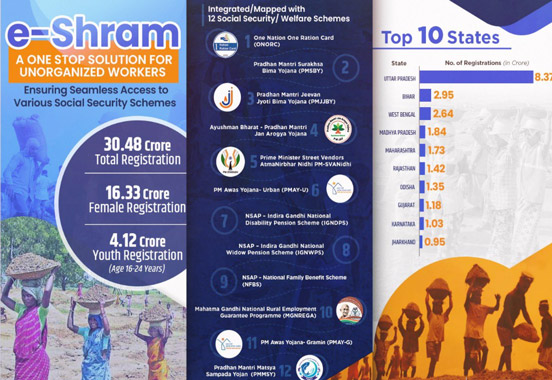
Launched in 2021, the e-Shram portal was intended to identify and register unorganized workers in India, registering over 290 million workers, including gig workers. While the portal includes gig workers, it does not yet recognize them as a separate entity under the broader category of informal workers, thus failing to address the uniqueness that is inherent in gig work. Not only does this absence of specific categorization conceal the existence of gig workers in policy-making circles, but it also bars the development of targeted interventions that can directly benefit them.
To overcome this deficiency, one of the solutions can be the introduction of a single "Gig ID". This single digital identifier could be duplicated across platforms, financial institutions, and government departments, and could act as an exhaustive repository of a worker's employment history, earnings, performance assessments, and involvement in skill development programs. With such well-organized and easily accessible information, gig workers would have easier access to formal financial services like loans up to a certain amount, insurance products, pension schemes, and career advancement opportunities. Further, the introduction of a separate Gig ID system could also play a crucial role in developing a robust and inclusive database, thus enabling more effective and evidence-based policymaking that can directly address the specific challenges of gig workers.
The creation of a universal Gig ID and the development of structured and accessible skill training programs is central to the empowerment of gig workers. TeamLease's 2023 report indicates that around 60% of gig workers are "skilling-ready", but they do not have formal entry points. While online skilling materials are available through platforms like Coursera and Udemy, the resources are expensive, poorly aligned to the needs of the gig economy, and rigid, linguistically inaccessible, and industry-unfocused, which are required for gig workers with non-traditional schedules. An intervention of specific intent would be the creation of a cost-effective, mobile-focused, multilingual skill development platform specifically for gig workers.
The platform would provide certified, modular micro-courses in drone operation, logistics, content creation, and artificial intelligence, hence being aligned to the needs of gig employment. Along with integration into the Gig ID system, the platform would allow tracking of skill acquisition and certification, enabling workers to build verifiable credentials. This integrated solution not only addresses the affordability and accessibility challenges inherent in existing skilling platforms but also empowers gig workers with concrete qualifications, hence enabling their economic mobility and ensuring the sustainability of their long-term careers.
The structural solutions already touched upon — eg, assuming a standard Gig ID and creating an accessible, specialist platform for skill-acquisition — can potentially make a big difference to the effectiveness and the inclusivity of the gig economy. But these solutions, taken in isolation, will not suffice to address the more fundamental issues at stake. Probably the most deeply embedded and systemic issue concerns gender inequality. Despite the flexible, remote, and task-based nature of gig work conditions that, in theory, should enable greater female participation-women make up only 19% of the gig economy in India. This underrepresentation is not merely statistically significant but also based on deeply embedded socio-cultural barriers that continue to deter women's economic participation.
Easing the greater participation of women in the gig economy is a concern that stretches beyond the domain of justice and transforms into an economic necessity. There are statistics to suggest that raising the participation of women in platform work has the potential to boost India's economy by up to $500 billion by the year 2025. To realize this potential, however, it is crucial to address some of the challenges facing women, such as safety issues, the absence of flexible and family-friendly working conditions, poor child care facilities, and poor access to or exposure to digital technology.
Thus, any attempt to scale and reform the gig economy will have to deliberately include gender-sensitive interventions, such as platform-level safety assurances, user-friendly interfaces, digital literacy programs, and social infrastructure for working mothers. Addressing these challenges with the same intensity and creativity applied to structural shifts could enable up to 10 million women in the gig economy, potentially delivering a meaningful contribution to GDP growth and catalyzing a wider transformation in education, healthcare, and social justice. In the end, filling this gender gap will take not just policy reforms but also a cultural reimagining of women's roles in the economy — a shift as fundamental as any technological or institutional innovation.
As India rides its digital revolution and changing labor markets, the gig economy appears not only as a temporary stopgap but as a fundamental change in the thinking and pursuit of work. Its power to increase access to work, diversify income streams, and spur economic advancement is beyond question. Yet, to achieve this potential requires a thoughtful and inclusive strategy encompassing structural, technological, and cultural dimensions.
Priorities are institutionalizing protections, implementing a universal Gig ID, creating skills development platforms, and addressing gender imbalances, all of which underscore the imperative of an overarching framework that acknowledges gig workers as full stakeholders, not fringe players, in India's economic narrative. If led with vision and compassion, this changing landscape can deliver a future of work that is flexible and secure, innovative and equitable - a model, not only for India, but for the world.
Agreima Tyagi, Sakshi Joshi are graduate students, and Aneesh K A is Assistant Professor, Department of Economics, CHRIST University, India.