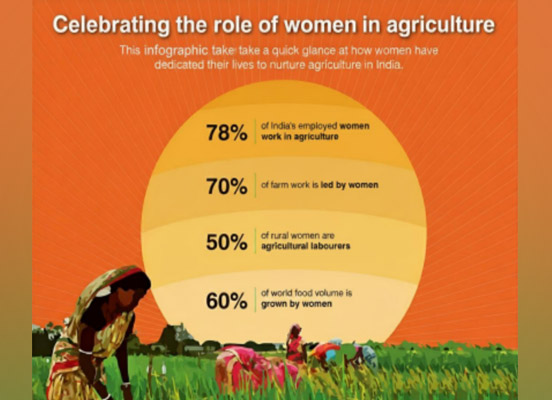
63% of rural women workers engage in agriculture, yet only 14% of landholdings are owned by women — underscoring a vast gap between participation and empowerment.
By Riya Thakur & Sayanton Mondal
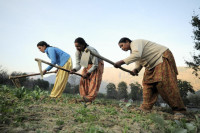
In rural India, the sight of women sowing seeds, harvesting crops, managing livestock, and even negotiating with traders is no longer unusual. According to MoSPI's Migration in India, 2020-21 report, 42.9% of men migrating to urban areas did so for better-paying work, either in search of employment (22.8%) or for jobs, business opportunities, or transfers (20.1%). Today, women form the backbone of the agricultural workforce — the Periodic Labour Force Survey (2022–23) reports that 63% of rural women are engaged in agriculture compared to 48% of rural men.
This stark gap between participation and control plays out daily in villages across the country. One such example of what genuine empowerment can look like comes from rural Bihar, where the Sahyog Women JEEViKA Agro Producer Company Limited has rewritten the rules of engagement for women farmers. This collective of more than 1,300 members not only grows paddy and pulses but also mills, packages, and sells branded products like sattu and besan in local markets. By pooling resources, securing credit, and controlling sales, these women have seized decision-making power over pricing, contracts, and profits — a rare reversal of the norm where women do the work, but men control the rewards.
Yet such examples remain the exception rather than the rule. The growing presence of women in agriculture too often translates into greater workloads without matching authority, income, or recognition. Much of this shift is concentrated in low-return, manual tasks, while higher-value activities, productive assets, and market control remain largely in male hands. Many women manage farms without owning the land, cultivate crops without deciding when or where to sell, and shoulder responsibility without gaining proportional influence over decisions. Change is taking place in two forms: a gradual increase in women’s participation in farming or non-farming work and enhanced power/influence in family decision-making. Truly, full autonomy is far from being achieved so far, but silent change is noticed regarding the degree of autonomy. Financial autonomy is far from being imaginable right now – what we can say is that the family dynamics, in a patriarchal economy, is tactically giving space to the women as a strategic move without even thinking of providing the leverage of financial autonomy.
The illusion of empowerment
This is why the rise in women’s participation can be misleading — an illusion of empowerment that masks persistent structural inequality. Women’s labor has increased, but the high-margin nodes of value chains — from ownership of mechanized equipment to negotiating input prices or final sales — remain dominated by men. Studies from India, Nepal, and Bangladesh (IFPRI, 2021) show that women handle sowing, weeding, harvesting, and even financial matters during men’s absence.
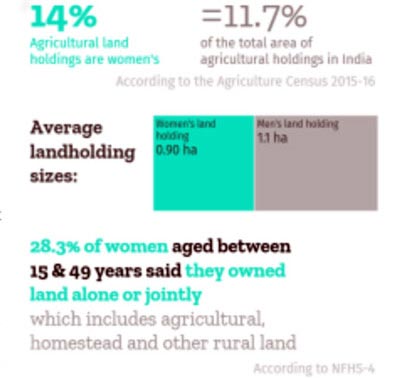
(Graphic courtesy of the authors)
However, the National Sample Survey Office (NSSO, 2019) reports that only 13.9% of women own agricultural land, compared to 86.1% of men. Without land titles, women-headed households are often excluded from schemes like the Kisan Credit Card, extension services, subsidies, and capital for small rural enterprises. Even when women lead daily tasks, key decisions — such as selling crops, investing in land improvements, or taking loans — are often deferred until the men return. This fragile and temporary autonomy upholds patriarchal hierarchies, where women bear the burden but lack control.
Barriers that undermine power
Several systemic barriers limit women’s capacity to transition from labourers to decision-makers. Social norms and mobility constraints hinder market engagement — an ILO (2022) study found that 68% of women farmers face mobility constraints, versus just 12% of men. The rural female literacy rate is 64.6% (Census 2011), compared to 80.9% for men, affecting women’s ability to understand contracts, navigate digital platforms, or apply for institutional credit.
The Time Use Survey (2024) shows that rural women spend five hours daily on unpaid domestic work, compared to 1.4 hours for men, in addition to farming work, which is largely invisible in policy discourse and agricultural data. In the Agricultural Census (2020–21), gender-specific contributions remain absent, masking both the scale and the significance of women’s work.
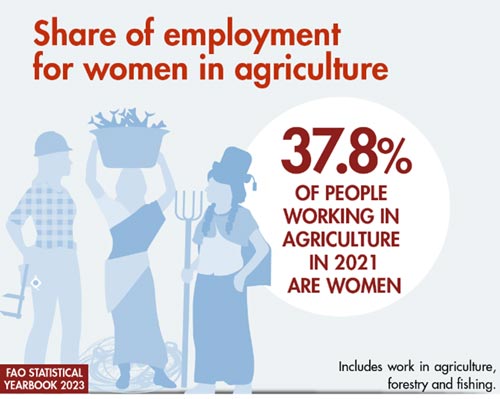
(Graphic courtesy of the author/UN)
Resilience in the face of invisibility
And yet, even in this constrained space, rural women display remarkable resilience — innovating, organizing, and ensuring household survival despite structural barriers. Across states like Maharashtra, Odisha, and Kerala, women have organized into Self-Help Groups (SHGs), Farmer Producer Organizations (FPOs), and informal seed and irrigation collectives to assert their agency.
In Maharashtra, the Mahila Arthik Vikas Mahamandal (MAVIM) has supported women’s cooperatives in adopting climate-resilient practices, leading to a 20% increase in crop yields (MAVIM, 2023). In Odisha, the Swayam Sampurna FPO has enabled thousands of women to adopt digital tools to secure livelihoods, enhance climate-smart crop production, and make data-driven decisions. The Mahila Kisan Sashaktikaran Pariyojana (MKSP) has reached 36 lakh women
across 24 states by 2024, offering training and market linkages.
Kudumbashree in Kerala has built a model where over 4.5 lakh women engage in collective farming and micro-enterprises, achieving high income levels. DAY-NRLM has mobilised over 10 crore women, strengthening farm and non-farm livelihoods, creating institutional and market linkages, and boosting incomes and resilience. Yet only 12% of FPOs are women-led, and they receive less than 5% of total agricultural funding (NABARD, 2023), while women account for just 7% of outstanding MSME credit — underscoring systemic neglect and exclusion.
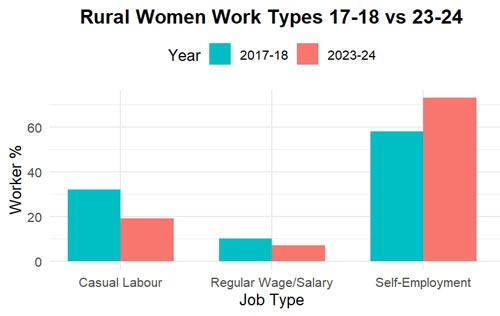
(Graphic courtesy of the authors)
From gaps to gains: A path forward
Resilience alone, however, cannot close the gender gap in agriculture. Structural interventions must transform survival skills into engines of growth and agency. This requires securing land and productive asset ownership for women, with incentives for asset transfer and joint titling in their names. Women must be guaranteed leadership positions within Farmer-Producer Organizations through mandatory quotas, backed by dedicated budgets for women-first extension services tailored to their schedules, literacy levels, and crop priorities.
Accessible, collateral-free financing — alongside micro-credit schemes — can expand their entrepreneurial capacity. At the same time, investment in tools and mechanization, designed to match women’s ergonomics and crop patterns, will ease labour burdens and boost productivity. Equally important is assured market access, which can be achieved through procurement set-asides for women-led enterprises and collectives. Tamil Nadu’s legal co-ownership policy has already shown the potential of such measures, increasing women’s land ownership by 8% between 2018 and 2023.
International experience reinforces this pathway: Rwanda’s recognized women’s cooperatives have raised incomes by 30%, while BRAC’s integrated microfinance and training model in Bangladesh enabled 70% of women participants to make more household and farm-related decisions. These models prove that empowerment is not just possible but transformative — provided it is grounded in legal rights, financial inclusion, and strong institutional support adapted to India’s diverse rural contexts.
Conclusion: From responsibility to real power
The shift in who does the work on India’s farms offers a once-in-a-generation opportunity. If structural reforms fail to accompany women’s rising participation, rural gender inequities will deepen. But with the right policies, the story can change — from women as invisible labourers to women as architects of India’s agricultural future.
International experience reinforces this pathway: Rwanda’s recognized women’s cooperatives have raised incomes by 30%, while BRAC’s integrated microfinance and training model in Bangladesh enabled 70% of women participants to make more household and farm-related decisions. These models prove that empowerment is not just possible but transformative — provided it is grounded in legal rights, financial inclusion, and strong institutional support adapted to India’s diverse rural contexts.
Conclusion: From responsibility to real power
The shift in who does the work on India’s farms offers a once-in-a-generation opportunity. If structural reforms fail to accompany women’s rising participation, rural gender inequities will deepen. But with the right policies, the story can change — from women as invisible labourers to women as architects of India’s agricultural future.
---------------------------------
(Dr Riya Thakur and Sayanton Mondal are Research Associates at Pahle India Foundation, a policy think-tank based in New Delhi. The views expressed are their own)