By Vandana Sehgal
India’s Consumer Price Index (CPI), the official measure of inflation, requires a complete overhaul to align with the evolving consumer spending behavior. Over the past decade, the economy and household consumption patterns have undergone a significant change, while the CPI basket continues to rely on the Household Consumption Expenditure Survey (HCES) 2011–12 data. This disconnection between the perceived consumption expenditure and the actual expenditure makes inflation estimates far from the ground reality.
Revising the CPI basket is no longer a statistical exercise; it is an economic and policy imperative. Understanding this gap, the Ministry of Statistics and Programme Implementation (MoSPI), Government of India, is set to release a new CPI with the updated base year of 2024. The new CPI series will be based on HCES 2023-24 data. The updated CPI series is expected to be released on February 12, 2026, marking one of the most significant reforms in India’s inflation measurement framework in over a decade. The revision of the CPI basket has become essential to represent the real cost of living of the common and typical Indian household.
Food vs services: A structural shift in household spending
Indian households’ lifestyle and spending habits have transformed to a large extent. Households now allocate a smaller share of their expenditure to basic food items and a larger share to non-food items across urban as well as rural India. However, the CPI basket continues to reflect the priorities of an older, goods-dominated economy.
The Household Consumption Expenditure Survey (HCES) 2023–24 provides clear evidence of this transformation. Expenditure on non-food items accounts for 52.96% of rural spending, while 60.32% of urban spending. The share of expenditure on services has increased tremendously, occupying a significant share of household budget allocation, such as:
>> Transport- 7.59% (rural) and 8.46% (urban)
>> Healthcare- 6.83% (rural) and 5.85%(urban)
>> Education- 3.24%(rural) and 5.97%(urban)
Further, expenditure on services like app-based cab services, mobile recharge, OTT subscriptions, DTH, internet data packs, quick commerce, online food ordering, and processed foods indicates a move away from basic subsistence consumption to a convenience-oriented lifestyle. These evolving expenditure trends make it essential to update the CPI basket, as an outdated basket may fail to capture the inflation people actually feel.
Weightage needs rationalization — especially housing, health, and education
Reweighting expenditure categories is a key policy priority. Weightage on housing expenditure needs reconsideration. Housing illustrates this shift clearly. House rent alone absorbs 6.58% of urban household budgets, yet earlier CPI series significantly underrepresented this burden. In response, the Expert Group recommended:
>> Extending the house rent index to rural areas,
>> Excluding employer-provided accommodation, and
>> Improving the rent index methodology to address anomalies observed in CPI 2012.
Similarly, the rising financial stress associated with healthcare and education justified their enhanced representation.
CPI 2024: A broader, more representative inflation measure
The revised CPI 2024 represents a decisive shift toward a more comprehensive and realistic measurement of inflation in India. Compared to CPI 2012, the new series significantly expands market coverage, item coverage, and service representation, reflecting the structural transformation of household consumption. At the all-India level, the number of rural markets have increased from 1181 to 1465, urban markets from 1,114 to 1,395, and online markets have been introduced for the first time (12 markets) to capture growing digital transactions.
The total number of weighted items has expanded from 299 to 358. Notably, the number of services has increased from 40 to 50, underlining the growing importance of services such as housing, transport, communication, education, healthcare, and digital services in household budgets.
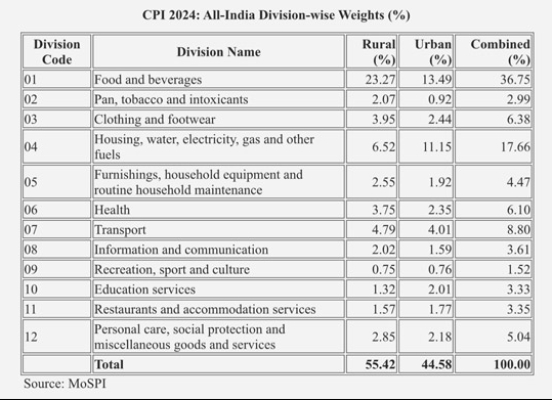
The CPI 2024 table clearly shows a declining dominance of food and a rising combined weight of services such as housing, transport, health, education, and communication, making inflation measurement more aligned with how Indian households actually spend today. Digital services, once considered discretionary, are now treated as essential consumption, warranting systematic inclusion and appropriate weightage.
Impact on RBI policy: Interest rates and borrowing costs
CPI inflation is the primary anchor for the Reserve Bank of India (RBI) monetary policy. If CPI does not reflect the household's actual cost burden, it may lead to misjudged interest rate decisions by the RBI. This not only affects the household home loans and EMIs burden but also the overall investment and business environment of the economy in a significant way. This statistical lag is no longer harmless; it risks misguiding Reserve Bank of India (RBI) policy, understating middle-class cost pressures, and weakening the credibility of inflation targeting.
Fiscal policy, welfare indexation, and middle-class pressures
Beyond monetary policy, CPI influences Dearness Allowance adjustments, pension indexation, and minimum wage revisions. If CPI does not fully capture rising service costs, government compensation mechanisms may lag behind actual cost-of-living increases. It may result in the redistribution of economic burden by under-compensating households facing rising service expenses.
A major concern expressed is the lower measured inflation due to the statistical effects of a high base year. This concern is valid. However, accuracy should not be sacrificed for continuity. The solution lies in transparent methodology and rational reweighting, not in delaying reform.
[Dr Vandana Sehgal is an Assistant Professor, Department of Humanities and Social Sciences, Jaypee Institute of Information Technology, Noida.]
The views expressed are not necessarily those of The South Asian Times