By Ananya Tiwari
A system at crossroads
“We can transform our students from being job seekers to job creators by building the proper ecosystem for imparting skill-based training in every higher educational institution.” - M Venkaiah Naidu, Vice President of India (2019)
For decades, India’s education system has been a linear path set in stone, of scoring your best in school, getting a degree from a renowned and reputed college, and that will ultimately help you land your dream job. However, the year 2025 poses new challenges as automation and AI reshape economies, making this model increasingly outdated; the traditional obsession with producing job seekers is no longer enough.
The National Education Policy (NEP 2020) pledged to reorient education from rote learning towards creativity, critical thinking, and entrepreneurship. Yet, even after five of its launch, the real question remains: has India’s education system truly changed direction, or does it still mass-produce job seekers?
The promise of policy and vision
NEP was launched with ambitious promises: “ By 2025, at least 50% of learners through the school and higher education system shall have exposure to vocational education.” This signalled a shift in the teaching approaches from rote memorization and exam scores to practical skills, creativity, and critical thinking. It emphasised “fundamental principles” such as flexibility, multidisciplinary learning, and an entrepreneurial mindset. Additionally, it called for universities to develop incubation centers, vocational labs, and apprenticeships to connect students with real-world problems.
Sharing his thoughts on education, then Vice President M Venkaiah Naidu said that an ideal educational institution must focus on making a student into a holistic individual by equipping him/her to face challenges of life with equanimity and stability. Moreover, his vision was reinforced in the Union Budget 2025-26 by announcing five National Centres of Excellence for Skilling and a rupees 500 crore Centre for AI in Education - proof that policymakers recognize the urgency of shifting towards innovation-driven education. On paper, India has shown a progressive vision. But the path from policy promises to societal transformation is a long journey.
Challenges - Why do we still produce job seekers?
Despite the bold goals, Indian classrooms and campuses remain stubbornly tied to the familiar older model. Let's examine why we are still stuck with the outdated formula of studying harder, getting good grades, earning a degree, and securing a stable job.
Firstly, there is the cultural mindset. Families, schools, and society as a whole still equate success with stability and security rather than skill and personal growth. At the end of the day, the question most parents ask their children is not “What problem will you solve?” but rather “Which company or job will you join?”
Secondly, the exam-driven system continues to dominate. Board exams leave little room for experimentation or risk-taking, yet they continue to dominate the chances of securing a job. Innovation thrives on failures, yet our system punishes it. Thirdly, there is a stigma of vocational education. Offbeat streams such as vocational and skill-based training are viewed as inferior to academic tracks. Despite the fact that students have options, these choices remain pseudo in nature as they don't pay well, even for earning a basic livelihood. Job recruitment still continues to place disproportionate weight on academic scores rather than growth, especially in Government jobs.
Fourth, unequal access remains a deep challenge. While IITs, IIMs, and private companies boast incubators and startup labs, we must remember that the vast majority of India’s state universities and rural colleges lack funding, mentors, and infrastructure to foster entrepreneurship.
Finally, the weak research base of India’s higher education limits innovation. India invests just 0.69% of its GDP in research and development. As a result, India has become a market for other countries to recruit talent rather than utilizing the youth for its own growth and development.
India, the largest market for recruiters
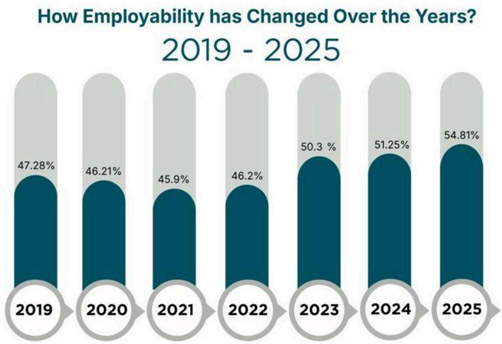
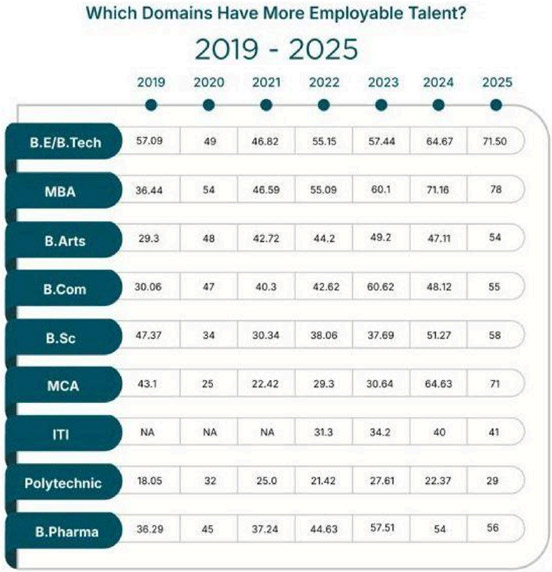
The India Skills Report 2025, based on the Wheebox Global Employability Test, offers a sobering picture. Overall, the employability across domains stands at 54.81%. Graduates in IT and Computer Sciences perform strongly with employability levels of 75-78%, reflecting alignment with industry demand. On the other hand, the picture is very different for vocational domains: ITI graduates score only 41%, and polytechnic graduates a mere 29%.
Geography also plays an important role. Maharashtra tops the employability index with 84%, while Gujarat lags at 62%. Pune 78.3% and Bengaluru 76.4% lead among cities, while Ahmedabad trails at just over 60%. This shows that while some hubs thrive as talent centers, others risk falling behind. Meanwhile, higher education is expanding rapidly. Enrollment reached 4.33crore in 2021-22, a 26.5% rise since 2014-15. Particularly in professional courses such as medicine and social sciences, female participation grew 32%. These are
hopeful signs that India is bringing more of its youth, especially women, into the knowledge economy. Although India is now the third-largest startup ecosystem in the world, student-led ventures remain concentrated in metros and elite campuses, rather than being spread across the country.
Alternative voices - industry and society
Industry leaders and entrepreneurs echoed these concerns time and again. Amit Gadgil, Project Manager at IBM, points out the paradox: despite the fact that India produces 1.5 million engineers annually, they lack industry-ready skills; for this reason, half of them are unemployable. He calls for “business-oriented education” that prioritizes skills, mentorship, and outcome-driven projects over degrees.
Additionally, Gagan Dhawan, Founder & CEO of the New Me, frames the mindset shift more directly: “Imagine a shift in mindset from ‘How can I get hired?’ to ‘How can I build something that hires others?’ That's the essence of entrepreneurship”. He reminds us that even modest ventures have ripple effects - building a single house engages over 300 industries, from cement and steel to transport and paint. Consequently, job creation multiplies opportunities far more effectively than job seeking.
Suggestions - what must change?
Today, India faces an uncomfortable paradox: millions of young graduates leave colleges every year, yet unemployment among the educated is at a record high. From the point of view of a policymaker, the way forward requires courage and imagination. We must change the perceived idea of success to celebrating innovators and risk-takers as much as toppers and IAS officers, thus also encouraging careers in vocational studies. We must expand incubation and funding beyond elite institutions to state universities and rural colleges.
Investment should be increased for teacher training, equipping educators to serve as mentors who guide projects and encourage experimentation, rather than just delivering lectures. Research and development should be promoted, making it closer to global benchmarks; without this, entrepreneurship will lead to imitation rather than innovation. We must not only focus on changes in the education system but also on its relevance in the job market. Finally, reimagining a new way that includes creativity and adaptability should be used for job recruitment.
Conclusion - aiming bigger
Regardless of the fact that the NEP 2020 laid the blueprint, and the Union Budget 2025-26 reinforced the vision with fresh investment, the hard truth remains: our schools and universities still largely prepare youth to seek jobs, not create them. As long as we continue down this path, India risks producing the world’s largest pool of degree holders without producing enough innovators. However, if we dare to reimagine success as achieving our dreams, we can also redefine the story of India’s growth. The question is no longer whether India can educate its youth; it is whether India can educate them to lead. And that is the choice that will decide whether we remain job seekers or job creators. The true measure of India’s growth will be when the youth dream to create and not just survive paycheck to paycheck.
REFERENCES
Ananya Tiwari is a student of Political Science and Economics at Christ (deemed to be) University, Delhi NCR
The views expressed are not necessarily those of The South Asian Times
[All graphics courtesy of the author]