By Rajat Singh Yadav & Ritika Gupta
India’s MSME and informal enterprise surge is not a footnote; it is the backbone of jobs and local economic resilience.
India’s economic story is often told through headline-grabbing indicators: GDP growth, foreign investment, and large-scale manufacturing. Yet the everyday engine of the economy hums elsewhere: in the neighbourhood kirana stores, home-based manufacturing, small workshops, street vendors, tiny service units, and local trade networks.
These enterprises are not marginal; they underpin jobs, incomes, and export-linked activity across districts and towns. The challenge is that the next phase of growth for Micro, Small, and Medium Enterprises (MSMEs) will depend on who can actually step onto the formal and digital rails. If formalization and digitalization are not designed around the realities of the last-mile entrepreneurs, especially women-led and informal micro businesses, they risk becoming new filters that widen gaps rather than pathways that close them.
Recent evidence reinforces both the scale and the stakes: the ASUSE 2023-24 (Annual Survey of Unincorporated Sector Enterprises) estimates that 73.4 million unincorporated enterprises contribute ₹17.97 trillion in GVA and generate 12 million jobs in a year, underscoring how much of India’s economic vitality rests on small, often informal businesses.
So why does the “MSME success story” still feel uneven for many entrepreneurs? The answer is partly structural: where value is created and which sectors capture it are highly uneven. Figure 1A highlights sharp
state-level divergence in MSME GVA per enterprise, with high performance concentrated in a few states and much lower outcomes across several others.
.jpg)
(Courtesy of the authors)
Figure 2 also shows sectoral concentration: wholesale and retail dominate MSME GVA, while manufacturing sub-sectors and several services account for relatively small shares. Together, these patterns suggest that enterprise growth is shaped as much by location and sector structure as by firm-level effort, making targeted, inclusion-first formalization and digitalization essential. However, the policy push toward formalization and digital adoption, while well-intentioned, has not yet translated into universal, meaningful participation, particularly for informal micro-units and women-led enterprises.
Formalization is rising, but not evenly
India’s formalization drive has gained momentum through platforms such as Udyam and the Udyam Assist Platform, and the unincorporated non-agricultural enterprise base has expanded sharply, often interpreted as
evidence of a stronger, more visible MSME ecosystem. ASUSE also indicates that employment and output in the unincorporated sector are not stagnant; they are growing. Employment rose strongly year-on-year, and GVA growth at current prices has been robust, signaling that micro and household enterprises remain significant labor absorbers and contributors to local demand.
However, a key measurement gap persists. India still lacks a comprehensive, publicly available dataset that cleanly captures the entire universe of incorporated MSMEs, particularly in services. Even a recent MoSPI pilot attempt to map incorporated service enterprises using GSTN faced limitations in representativeness, driven by sample-size and traceability constraints. The result is a mismatch between what can be counted and what can be assessed: India can track registrations far more easily than it can evaluate whether formalization is actually improving productivity.
Informality remains the default setting
India’s enterprise structure remains heavily skewed toward micro units, and the informal segment is still the “default economy” for a large share of workers and entrepreneurs. For many informal enterprises, the binding constraints are familiar: low documentation, limited collateral, irregular cash flows, and vulnerability to shocks. Informal businesses often operate largely in cash, maintain limited records, and have weak access to formal support schemes.
This is why a narrow focus on “more registrations” is not enough. Formalization must be evaluated by its outcomes: easier compliance, better credit terms, greater market reach, greater income stability, and improved ability to withstand downturns.
The digital leap is underway, but the divide persists
Digital tools can be a bridge for MSMEs, helping with payments, bookkeeping, supplier discovery, and customer reach. And yes, adoption is rising: ASUSE notes an increase in internet use for business purposes. Yet the divide is still significant, especially along rural-urban and gender lines. Internet penetration for business use remains far lower in rural areas than in urban areas, and women-led enterprises lag further behind, mainly in rural settings.
The gender gap is not a side issue-it is the core inclusion test. Women’s entrepreneurship is rising in visibility, but ownership and scale remain sharply constrained. Only about 22% of MSMEs are women-owned, and the share drops steeply among larger enterprises. The reasons are structural and cumulative: weaker collateral, limited mobility and networks, lower access to mentorship, and uneven digital readiness, factors that can prevent a promising micro-enterprise from scaling into a small or medium firm.
If digital formalization is designed as a “one-size-fits-all” shift, it risks turning digital capability into a new gatekeeper where the already-connected move faster and everyone else slips further behind. At the same time, targeted finance can move the needle. The Stand-Up India progress is an important signal: with institutional backing and product design aligned to constraints, women-led businesses can expand and formalise on better terms.
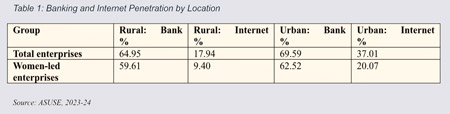
(Table courtesy of the authors)
What should change now?
India does not need to choose between formalization and informality; it requires a strategy that makes formality workable for the smallest enterprises and ensures digital systems become an on-ramp, not a wall. This starts with making formalization outcome-driven, easing compliance, reducing friction costs, and linking Udyam registration more directly to tangible benefits such as credit, insurance, skilling, market access, and social protection so that formalization genuinely feels worthwhile for micro-units.
In parallel, India should fund MSME “digital missions” where gaps are widest: state-specific efforts that combine subsidised tools (devices, connectivity support, payment rails) with hands-on training to help lagging districts and sectors translate digital adoption into productivity and market access.
A third priority is to place women-led enterprises at the centre of MSME growth by scaling targeted funding windows, institutionalizing mentorship networks, and designing market-linkage programmes, including export clusters, that intentionally help women move beyond the micro stage into higher-value activities. Finally, growth must be spatially broadened by building clusters beyond the usual hotspots.
A regional balancing approach that strengthens clusters, infrastructure, skilling, and market connectivity in underrepresented states can more evenly spread MSME opportunities and reduce the current concentration of value creation. India’s MSME and informal enterprise surge is not a footnote; it is the backbone of jobs and local economic resilience, but the next phase of growth will be judged by a more complex question: who gets included. If formalization becomes merely a registry exercise and digitalization becomes a capability filter, the inclusion gap will widen. Still, if both are redesigned as practical, low-friction pathways, especially for informal micro-units and women entrepreneurs, India can convert today’s MSME scale into tomorrow’s broad-based prosperity.
(Dr Rajat Singh Yadav is an economist and independent consultant, working on MSME policy, financial inclusion, and digital economy research in India. Ritika Gupta is an economist and is affiliated with New Delhi-based MicroSave Consulting. Views expressed are personal.)