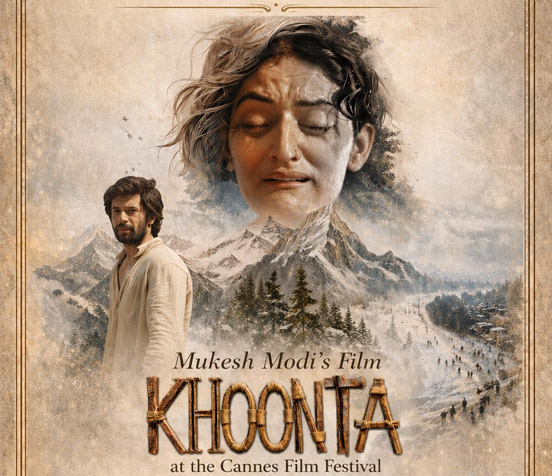
Amid a powerful rise of Indian independent cinema at Cannes 2026, New York-based filmmaker Mukesh Modi backed a culturally rooted Himachali story that reflected India’s growing global presence through regional narratives and authentic storytelling.
K S Tomar
India’s expanding presence at Cannes
The 2026 Cannes Film Festival marked a significant moment for Indian independent cinema as an unusually large number of Indian films — particularly short films and culturally rooted regional narratives — found space at the prestigious Cannes Film Market.
At a time when international audiences are increasingly seeking authentic local stories rather than formula-driven spectacle, India’s presence this year reflected a growing global appetite for cinematic voices emerging from beyond mainstream Bollywood.

New York-based filmmaker Mukesh Modi at the Cannes Film Festival. (Photo courtesy: Instagram@realmukeshmodi)
Among the Indian films that drew attention was 'Khoonta', a culturally layered short film rooted in the Himalayan landscape of Himachal Pradesh. The project stood out not merely because it emerged from a remote mountain region, but because it symbolized a wider transformation within Indian cinema — where stories shaped by local memory, folk spirituality and regional identity are beginning to reach international platforms without surrendering their authenticity.
Mukesh Modi’s unusual cinematic gamble
What made 'Khoonta' particularly remarkable was the role played by New York-based Indian-American producer and filmmaker Mukesh Modi, who chose to support a deeply local Himalayan story instead of pursuing a commercially safer cinematic formula.
Speaking to this writer from Cannes after the screening, Modi said the response from international producers and filmmakers exceeded expectations.
“The response was tremendous and the audience turnout of producers and directors from the USA and France was bigger than for many other films screened here,” he said.
Explaining his decision to support the project, Modi added that his own journey as an independent filmmaker in America made him deeply aware of the struggles faced by emerging storytellers in India.
“My decision to venture into an innovative cinematic idea stemmed from a desire to support independent filmmakers who face enormous hurdles in their careers — struggles that I myself experienced. I eventually overcame those barriers in 2015 when my first film was shot in America,” he said.
Discovering the spiritual soul of Himachal
Deeply influenced by the script’s cultural depth, Modi travelled extensively across Himachal Pradesh before production began in order to understand the region’s traditions, spiritual ethos and social realities.
Referring to 'Khoonta' — symbolizing an invisible binding force between people and their roots — he said the film was intentionally designed to introduce international audiences to a side of India rarely explored seriously in cinema.
“The film has been shot entirely against the backdrop of rivers, remote villages and untouched landscapes to showcase to the world how deeply people remain committed to preserving their faith, traditions and cultural identity despite the growing lure of modernism,” he said.
According to Modi, the project particularly focuses on the extraordinary devotion surrounding Mahasu Maharaj and the spiritual rhythms of Himalayan life — elements largely ignored in mainstream Indian cinema.
People associated with the project said Modi strongly believed the film should remain culturally honest rather than commercially diluted for wider markets. That decision may ultimately become one of the film’s greatest strengths.
From a remote Himalayan village to Cannes
Behind the Cannes screening lies an even more extraordinary personal journey. For 32-year-old filmmaker and actor Anushi Sharma, who comes from the remote and economically backward village of Dravil in Shillai area of Himachal Pradesh’s Sirmaur district, the road to Cannes was marked by hardship, uncertainty and relentless perseverance.
Her journey began quietly through theatre groups in Solan before moving into the fiercely competitive world of Mumbai’s television industry. Coming from a humble family background, she entered Mumbai without influence, financial backing, or industry connections.
For nearly five years, she struggled silently against rejection, instability and survival pressures. Yet the emotional connection with her homeland continued to shape her artistic imagination.
That emotional pull eventually became 'Khoonta'.
When the mountains found their own voice
The title itself symbolizes attachment, belonging and the invisible tether between individuals and their ancestral roots. Set in a Himalayan village devoted to Mahasu Maharaj, the story explores the quiet tension between modern transformation and fading traditions.
Rather than relying on cinematic spectacle, the film reportedly captures change through ordinary lives, rituals, silences, and emotional landscapes. Local dialects were preserved, costumes emerged from actual village homes and traditional rituals were recreated with cultural accuracy.
In many ways, 'Khoonta' appears less interested in presenting Himachal as a tourist postcard and more concerned with allowing the mountains to speak in their own voice.
When the film premiered at the Cannes Film Festival Market on May 16, 2026, it represented far more than an international screening for an independent short film. For Anushi Sharma, it marked the fulfilment of what once appeared an impossible dream.
More than a film
For Himachal Pradesh, the Cannes screening could mark the beginning of a new cinematic identity. For decades, the mountains of Himachal appeared in Indian cinema largely as scenic backdrops for songs and romantic sequences. Rarely did filmmakers explore the emotional world of the people living within those landscapes — their faith, folklore, loneliness and cultural memory.
That silence may now be breaking.
At a time when regional cultures across India are increasingly flattened into standardised entertainment formulas, 'Khoonta' attempts to preserve something fragile — memory, faith, language and belonging.
Whether the film ultimately achieves commercial success may matter less than what it has already accomplished symbolically. A young filmmaker from the remote hills of Shillai carried the emotional landscape of Himachal Pradesh to Cannes with the support of an Indian-American producer who believed that authentic Indian stories could resonate globally without losing their cultural soul.