By Basab Dasgupta
Various phases of my early life can be correlated with songs from Bollywood movies. Each song reminds me of a certain event or a place, or a person. If you grew up in India, you could not avoid these songs. They came blaring out of loudspeakers during religious festivals and social ceremonies, if not from neighbors’ radios.
The songs appealed to our younger generation because most were catchy tunes covering the entire gamut from Indian classical Ragas to Punjabi folk songs to blatant imitation of western songs; a more important reason was that we had nothing better to do; no TV in those days, no dating, no playground in the city to play cricket or soccer, no opportunities for engaging hobbies.
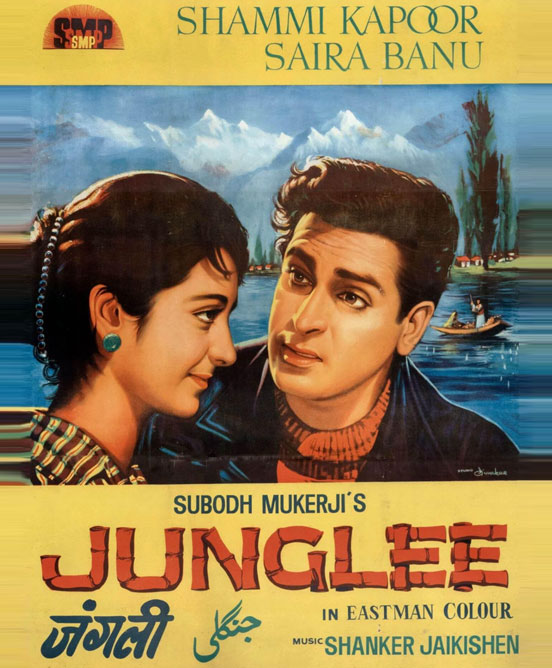
These songs were marketing arms for movies. If one liked the songs, one would probably want to see the movie. The release of the movie “Junglee” in 1961 was a milestone in many ways: the first Technicolor movie; the first movie to establish a standard plot of an Elvis Presley-style musical: boy meets girl, they fall in love, some villain causes problems, boy gets rid of the villain and marries the girl to live happily ever after!
The movie is punctuated by a generous supply of song and dance numbers. “Junglee” also showed that people would go to see the movie just for the songs. For millions of Indians, a temporary relief for a couple of hours from the cruel reality of their daily lives is irresistible. The songs themselves provided an attractive medium of entertainment. The appeal of the songs was multi-faceted: first was the variety. Then there was the instrumentation, starting from one-stringed instruments to sixty-piece orchestras.
Every music director developed his/her own recognizable style. The lyrics were simple and resonated with adolescent youth. The Bollywood music directors also copied from Western, Latin American, and Middle Eastern tunes. Finally, there was the voice: Lata, Rafi, Asha, Mukesh, Kishore, Manna Dey, Hemant Kumar, Talat Mahmood – everyone's voice had an inimitable, unique sound.
Most Bengali parents advocated avoiding watching Bollywood movies and listening to Hindi songs because of their absurdity and lewdness. Despite parental objections, Bollywood songs and movies made a huge impact on almost every person of my generation throughout our entire lives. The age at which we spent time watching these movies and listening to songs was also the most impressionable period of our lives.
As a result, and without any other influence, our beliefs and expectations in personal lives were mostly built around what we saw in these movies: concepts of romance and marriage, right versus wrong, patriotism, social justice, God and religion, responsibilities towards family members, foreign travel, and so on. Ironically, contrary to what our parents thought, almost all of these influences were positive.
After I came to the USA, I lost touch with Bollywood for several decades. Graduate studies, chores of a new marriage, and efforts to get adjusted to a new society took higher priorities. Opportunities to see Bollywood movies were limited in those days before the VCR and DVD. Although songs from recent movies were available, I always searched for songs from those bygone years to feel nostalgia.
Finally, there was YouTube.com, which gave me an opportunity to systematically track what was going on in the Bollywood world. However, it was a mammoth task. There were hundreds of movies made in the preceding forty years, with thousands of songs. Unlike the dominance by a handful of singers and music directors, there was a myriad of talents! I nearly gave up on catching up with Bollywood songs.
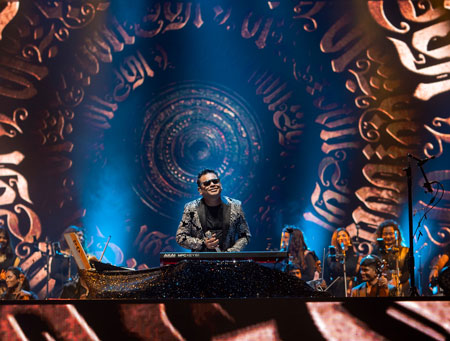
Music composer A R Rahman at a live concert. Many of his compositions are experimental in nature. (Photo courtesy: A R Rahman/Facebook)
The movie “Slumdog Millionaire” was released in 2008. While it was an interesting story, I felt that a foreign director focused on the negatives of the country – poverty, filth, corruption, violence, etc. It was a surprise to see the movie win the Oscar for best picture, and more significantly, A R Rahman (ARR) won the Oscar for best soundtrack.
I started to listen to ARR’s music. It seems that he has established a new genre in Bollywood music, and many music directors are emulating him. The characteristic of this genre is “Indianization” of Bollywood music. Most of the music was based on Indian folk songs, especially Punjabi and Tamil tunes, and some clever inter-mixing; no more imitation of Western beats.
Instrumentations were also very Indian and minimal. Many of his compositions were experimental in nature, where he was trying new ideas. I am sure many of his songs would have sounded even better if he had the luxury of having Lata, Rafi, or Mukesh in many of his songs. My friends pointed out Shreya Ghoshal as the new Lata Mangeshkar. I was intrigued because she is Bengali, and it is an incredible honor for her to be compared with incomparable Lata. I listened to some of her songs and liked her voice.
The fact that the emergence of a new style of music in Hindi movies roughly coincided with the economic prosperity in India may be an indication that the Indians have found out that THEY can create things of their own and attract international attention instead of emulating other countries.
I also started to watch recent movies, some on YouTube and some on the Z-TV channel. The movies also seemed to have outgrown that routine plot pioneered by 'Junglee' and now covered a whole array of subjects. A more significant and broader impact of Bollywood movies continues; they provide a unifying force in India! There is no stronger unifying force, except perhaps love of cricket.
I liked many recent songs for their fast tempo and the associated dance routines, but they did not touch my heart the way songs from my youth did. One day, about ten years ago, as I watched the movie “Guru”, I heard the song “Barso re megha megha” accompanied by a dance performance by actress Aishwarya Rai.
I fell in love with this song! What a composition, modulation of voice, and free spirit reflected in it. Sure enough, it was a composition by ARR, and the voice was that of Shreya Ghoshal. The song is about rain and water. The song made me realize that this was what India is all about: softness, emotions, bonding to the soil, fertile land yielding crops when rain comes; like Bankim Chandra’s description of his motherland as “Sujalang Sufalam” in “Vande Mataram”.
I felt for a minute that, deep down inside, I was still an Indian who never changed. I have spent hours listening to old Hindi songs and wished many times that I could go back to those innocent, carefree days. However, I always knew that what was gone was gone. This song was different. It really did not have much in common with those old songs. My feeling was not one of nostalgia; it was more about an identity crisis.
I started to wonder if my Americanization and detachment from India resulted from giving up Bollywood songs. In any case, I knew that I would have to start following Bollywood music once again.
-----------------------------------------

(California-based Basab Dasgupta has a doctorate in Physics from the University of Wisconsin and has worked with Sony as Vice President of an operating division)