By Bhuvan Lall
A reflection on predestination, eastern wisdom, and the inner journey on the passing of Professor Robert Thurman (May 3, 1941 – June 16, 2026)
There is a quiet teaching hidden within the architecture of time, that every encounter, every parting, every moment of grace arrives not by accident but by appointment. The ancient sages whispered this. The mystics wrote it in the margins of their illuminated manuscripts. And with each passing day, I find myself less inclined to argue with them.
One evening, I sent a message into the universe, or rather, into the inbox of one of its more eloquent interpreters. I wrote to my dear friend and teacher, Professor Robert Thurman, hoping to arrange a meeting, and to lay before him a question that had been quietly unsettling me all week, the kind of question that rises before dawn and refuses to be still.
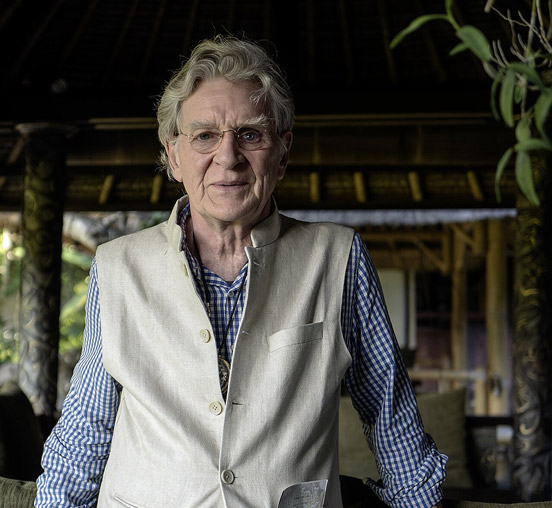
Professor Bob Thurman needed little introduction to those who walk the bridge between Eastern wisdom and Western thought. Born in New York City in 1941 to Elizabeth Dean Farrar, an actress, and Beverly Reid Thurman Jr, an Associated Press editor and United Nations translator, Thurman was steeped from childhood in the life of the mind and the power of language.
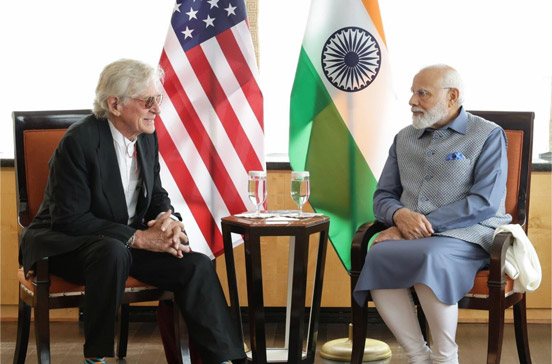
Robert Thurman with Prime Minister Narendra Modi in New York. PM Modi called Thurman "an eminent scholar of Buddhism, a distinguished teacher, and a lifelong friend of India". (File photo courtesy: X@narendramodi)
A restlessness, what he would later call “a deep dissatisfaction and questioning”, led him to abandon his studies at Harvard and set out on a pilgrimage to India. It was an act of radical surrender to the unknown, and it changed everything. In India, Thurman encountered Tibetan Buddhism with the full force of a man ready to be transformed.
In 1965, Robert Thurman became the first American to be ordained as a Tibetan Buddhist monk, with the Dalai Lama himself presiding over the ceremony. What began as a teacher-student relationship deepened, over six decades, into one of the great friendships of the spiritual world. Thurman claimed, “What I have learned from these people has forever changed my life. Their culture contains an inner science particularly relevant to the difficult time in which we live.”
A globally recognized authority on religion and philosophy, Asian history, and Tibetan Buddhism, he was that rare scholar who wore his learning lightly, a man who could illuminate the most profound metaphysical terrain with the ease and warmth of a fireside conversation. Time magazine named him one of America's 25 most influential people. The New York Times and People had both sought to capture him in words.
He had spoken at TED. He had lectured in the great halls of Columbia and Amherst. His scholarly output was as formidable as it was varied and resulted in twenty-three books. However, scholarship alone could not contain Thurman’s sense of obligation. In 1987, at the Dalai Lama’s personal request, he joined with his wife Nena, actor Richard Gere, and composer Philip Glass to set up Tibet House in New York, a nonprofit dedicated to the preservation and transmission of Tibetan civilization. As president of its board, Thurman shepherded the organization for nearly four decades, ensuring that a culture under siege might survive, and even flourish, far from its mountain homeland.
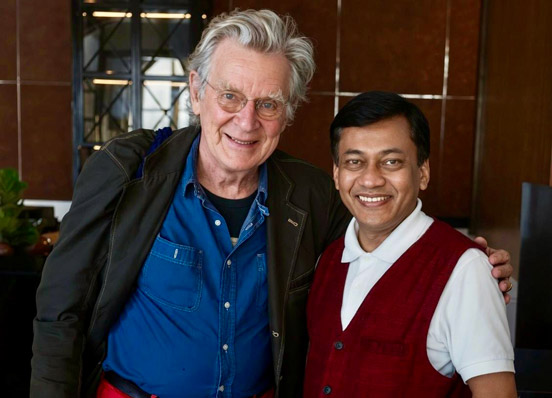
Author with Robert Thurman. (Photo courtesy: Bhuvan Lall)
And yes, for those for whom this opens a particular door of recognition, he was Uma Thurman’s father.
That evening, I had hoped we might meet soon, perhaps in some distant corner of the world where our respective journeys might intersect. The universe, however, had already made other arrangements. He was in my neighborhood - a stone's throw from my door.
The next morning, I drove to his hotel through the familiar chaos of the city, and what followed were three of the most quietly educational hours I have spent in recent memory. We talked about the great conversation I return to again and again: Eastern Spirituality and Western Science and Philosophy, the two rivers that have been flowing toward each other for centuries, each carrying what the other lacks. Between us sat glasses of mango lassi, cool and golden, the perfect earthly accompaniment to unworldly ideas.
I had carried my question carefully, like something fragile. What, I asked him, is enlightenment?
He did not reach for complexity. He reached for clarity, which is, perhaps, the same thing, only further along the road. He offered, “To become enlightened is not just to slip into some disconnected euphoria, an oceanic feeling of mystic oneness apart from ordinary reality. It is not even to come up with a solution, a sort of formula to control reality. Rather, it is an experience of release from all compulsions and sufferings, combined with a precise awareness of any relevant subject of knowledge. Having attained enlightenment, one knows everything that matters, and the precise nature of all that is.”
Release. Precision. Awareness. I turned these words over slowly, like stones in a river, feeling their weight and their smoothness. He also spoke of reincarnation with the matter-of-fact ease of someone describing the weather, not naively, not fancifully, but with the calm confidence of a deep and rigorous thinker who had simply followed the evidence of his own inquiry to its natural conclusion.
There was something quietly arresting about hearing such things spoken in that register. It did not demand one's belief. It simply expanded the room. What made Robert Thurman singular was the quality of his presence: the sense, rare and unmistakable, that here was a man who had genuinely looked, and genuinely seen. And then, gently, almost in passing, he offered this, “Those caught in the cycle of self-concern suffer helplessly, while the compassionate are more free and, implicitly, more happy.”
Toward the end of our morning together, the conversation turned towards spiritual elevation, as the best conversations sometimes do, and towards the concept of levitation during meditation. I confessed to him one of the singular experiences of my life: sitting in stillness at an ashram deep in the Himalayas, watching yogis in profound meditation rise and descend in the lotus position, gravity apparently having received and accepted its notice. Professor Thurman smiled.
He had not witnessed this himself, he said. Being fortunate enough to spend time in the orbit of his thoughts, one began to understand that the wonders of the outer world are merely reflections of the wonders within. His mind moved across the sweep of history, through the subtleties of the inner science of the psyche, and into what he beautifully called the life of the heart. It took you with it, whether you planned to go or not. Shrouds of confusion fell away. The present grew vivid and spacious. The future felt, somehow, possible.
Driving home through the afternoon light, the city hummed its eternal hum around me, I was reminded once again of the teaching that never quite left me alone: The real voyage is the inner journey. Everything else, the traffic, the meetings, the mango lassi, the questions carried, and the answers were the beautiful, improbable scenery along the way.
On June 16, 2026, the dharma lost one of its most eloquent Western voices with the passing of Robert Thurman. Gentle, radiant, relentlessly positive, who never let negativity take root, death, he would remind us, is merely a comma.
---------------------------------
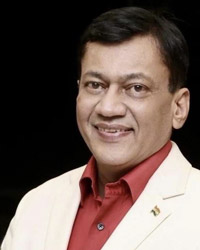
Bhuvan Lall is the biographer of Subhas Bose, Har Dayal, and Vallabhbhai Patel. He is the author of Namaste Cannes, India on the World Stage and Delhi in the Era of Revolutionaries. He can be reached at [email protected]