By Bhuvan Lall
From Swami Vivekananda’s first words to Amma’s last embrace of the day — one truth echoes across the century and Southern California — the longest and deepest journey in one’s life is the inner journey.
A nondescript house situated on Monterey Street in South Pasadena, on the outskirts of Los Angeles in Southern California, became the staging ground for one of the great spiritual experiments in modern history. In January and February 1900, a young Indian monk, Swami Vivekananda, stayed here for six weeks.
As he lectured and meditated in Southern California, America’s westernmost edge, the perennially searching populace did not merely appreciate his talks; it went on to embrace Eastern philosophy. It absorbed, amplified, and in many ways transformed ancient Indian wisdom, sending yoga, meditative practice, and Vedic thought right across the nation and the world. Marked as a historical landmark, this building is now known as the Vivekananda House.
The amazing story of over a century-long conversation between two distinct civilizations began in Chicago. In 1893, Vivekananda addressed the World’s Parliament of Religions and electrified Western audiences with his opening words: “Sisters and brothers of America.”
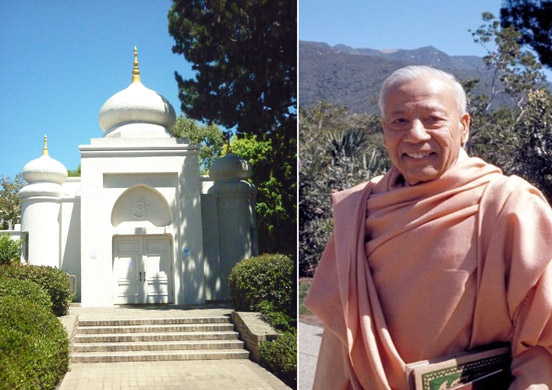
Swami Prabhavananda, a monk of the Ramakrishna Order, founded the Vedanta Society of Southern California in 1930. (Photos courtesy: Wikimedia Commons)
His subsequent tour of America planted the first sustained seeds of Vedanta in Western soil. By 1900, Vivekananda had established the Vedanta Society in San Francisco. His insistence that all religions lead to the same divine truth, that the Self is sacred, that God-realization is a science, proved irresistible on the shores of the Pacific.
Swami Prabhavananda, a monk of the Ramakrishna Order, came to Los Angeles in December 1929 to build on the work started by Vivekananda. He founded the Vedanta Society of Southern California the following year. The Hollywood Vedanta Temple became a genuine crucible of cross-cultural spiritual exchange, drawing many Californian intellectuals like Aldous Huxley and Christopher Isherwood into its orbit. Here, humanity’s ancient inner science dramatically met the world’s most restless culture. Since then, Southern California’s spiritual receptivity has been a phenomenal success.
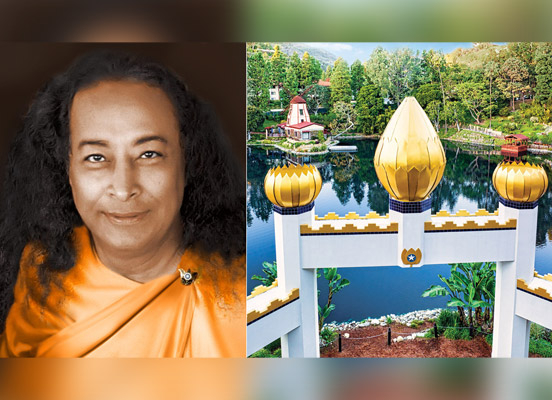
If Vivekananda cast the seed, Paramahansa Yogananda cultivated the garden. Arriving in Los Angeles in December 1924, Yogananda initially gave his first lectures at the Biltmore Hotel. Subsequently, he established the Self-Realization Fellowship (SRF) on the shores of Lake Shrine in Pacific Palisades, and it remains one of the most serene spiritual spaces on the American continent.
His book, Autobiography of a Yogi, published in 1946, became one of the most widely read spiritual books, famously inspiring Steve Jobs. SRF continues to draw devotees from across the world to its Los Angeles headquarters, teaching Kriya Yoga as a precise, systematic path to communion with the Divine. More than any single institution, SRF established Southern California as a place where Eastern contemplative practice was not an exotic novelty but a living tradition.
No account of yoga in Southern California would be complete without Indra Devi, born Eugenie Peterson in Latvia in 1899. Devi, the former actor of silent Indian films, studied directly under the legendary yogi T Krishnamacharya in Mysore, making her one of the first women to be admitted to his school.
She opened her yoga studio on 8806 Sunset Boulevard in West Hollywood in 1947, and her students were not ashram devotees but movie stars: Gloria Swanson, Jennifer Jones, and Greta Garbo. Devi did not compromise the philosophy; she translated it. She understood that yoga, as a physical and spiritual practice, could enter American culture through the body, and in doing so, she laid the groundwork for the modern-day billion-dollar wellness industry. She lived to 102, perhaps the most compelling testimony a yoga teacher could offer.
In 1966, A C Bhaktivedanta Swami Prabhupada brought the International Society for Krishna Consciousness (ISKCON) to the West, and it found an eager home in the counterculture of Los Angeles. The chanting of many spiritual followers of the Hare Krishna movement on street corners and their temples on Watseka Avenue in Culver City became landmarks of a Los Angeles spiritual landscape that was rapidly expanding.
Maharishi Mahesh Yogi arrived in Los Angeles in the 1960s, with a technique, not a theology - Transcendental Meditation. Maharishi’s intent in framing meditation as a scientifically verifiable technology of consciousness resonated deeply with Californians already comfortable with self-optimization.
The Beatles’ famous pilgrimage to Rishikesh in 1968 turned the world’s attention toward Maharishi’s method, and Southern California became a major center for TM training. Practitioners reported measurable reductions in stress, blood pressure, and anxiety. TM’s legacy is visible in corporate mindfulness programs in Silicon Valley today.
Osho Rajneesh’s movement established significant roots in Hollywood in the 1970s as he spoke of a frank embrace of desire rather than its suppression. He took Eastern mysticism, Zen, Tantra, Sufism, Vedanta, and threw it against Western psychology, Nietzsche. The movement attracted Francoise Ruddy, the wife of Albert Ruddy, the Oscar-winning producer of 'The Godfather,' to its fold. Francoise became Osho’s personal secretary, Ma Prem Hasya, and opened the Osho center in Los Angeles. Her home had a special rock, with the engraving: “Remember”. This denoted the essence of the teachings of her master. Osho’s thousands of discourses, now widely available, continue to attract new generations of followers worldwide.
From the 1980’s onwards, Southern California has served as one of the most important Western homes for Buddhist thought, in no small part due to the visits of His Holiness the Dalai Lama and the Vietnamese Zen master Thich Nhat Hanh. The Dalai Lama’s talks in Los Angeles have drawn tens of thousands, and his Institute for Buddhist Dialectics and its California affiliates have made Tibetan Buddhism intellectually serious in Western academic life.
Thich Nhat Hanh’s concept of interbeing and practice of mindful living gave Buddhism a language perfectly suited to Western anxieties. His Deer Park monastery near San Diego attracted an enormous following in Southern California.
On June 1, 2002, the Wadsworth Theatre in Brentwood, Los Angeles, welcomed a quiet phenomenon. Satya Narain Goenka, the 79-year-old Indian meditation master, had attained rock-star reverence among his followers. His ten-day Vipassana retreat remains a path to personal peace that naturally banishes fear and anxiety from the heart. He illuminated it as a pure science of mind and matter and gently urged his admiring disciples, “Be happy”.
In the twenty-first century, India’s spiritual tradition renews itself with quiet power. Sri Sri Ravi Shankar’s Art of Living Foundation, with its strong Southern California presence and fan following, offers Sudarshan Kriya as solace to veterans, prisoners, and the traumatized. The discourses of Sadhguru Jaggi Vasudev, meanwhile, blend Inner Engineering, wry humor, and ecological urgency. His Isha Foundation events regularly fill large venues in Los Angeles, drawing thousands of disciples weary of dogma and superficial wellness.
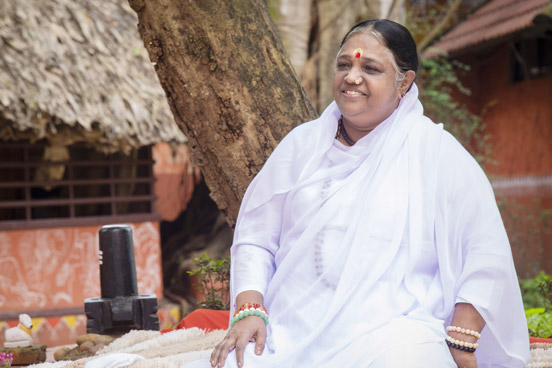
Mata Amritanandamayi, or Amma, has visited Southern California regularly, drawing thousands to marathon darshan events in Los Angeles. (Photo courtesy: Wikimedia Commons)
Among the most viscerally powerful presences to emerge from India’s spiritual tradition is Mata Amritanandamayi, known simply as Amma, whose teaching is not a discourse or a technique but an act: the hug. Since her first world tour in 1987, Amma has visited Southern California regularly, drawing thousands to marathon darshan events in Los Angeles, where she embraces each person individually. In a culture saturated with teachings, she offers something almost disarmingly. An embrace is a wordless communication of unconditional love that cuts through intellectual resistance in a way that no lecture can.
(Bhuvan Lall is the biographer of Subhas Chandra Bose, Har Dayal, and Vallabhbhai Patel. He is also the author of Namaste Cannes, India on the World Stage, and Delhi in the Era of Revolutionaries. He can be reached at [email protected].)