By Neha Saini, Preety Shoran & Manjula Shanbhog
(When we think about air pollution, we usually picture traffic jams, smoke-filled skies, and breathing problems. But scientists are uncovering another side of the story-one that begins long before a child takes its first breath.
Growing evidence suggests that the air an expectant mother breathes may influence her baby's health, making clean air not just an environmental concern but one of the earliest foundations of life itself.)
Every parent wants the same thing-a healthy child. The moment a pregnancy is confirmed, life begins to change. Mothers become more careful about what they eat, how much they rest, and the medicines they take.
Families celebrate every ultrasound, count every passing week, and eagerly wait for the day they can finally welcome the newest member of the family.
Every decision, whether it is choosing healthier food or keeping up with regular medical check-ups, is made with one hope in mind: giving the child the best possible start in life.
Yet there is one important question that rarely enters these conversations.
What about the air an expectant mother breathes?
Most of us think of air pollution as something that affects our lungs. We notice it when cities disappear behind a blanket of smog, when our eyes begin to sting during the morning commute, or when the Air Quality Index flashes red on our mobile phones.
We associate polluted air with asthma, coughing, and breathing difficulties. We worry about children playing outside and older adults struggling with respiratory illnesses.
Rarely do we stop to ask whether polluted air can affect a child even before birth.
For many years, pregnancy was considered a naturally protected stage of life. The womb was seen as a safe place where a baby could grow, shielded from most of the dangers of the outside world.
Doctors rightly focused on nutrition, vaccinations, regular health check-ups, and avoiding habits such as smoking or alcohol. Environmental factors, especially air quality, received far less attention.
Today, that understanding is changing.
Researchers across the world are discovering that the environment surrounding an expectant mother may quietly influence the environment inside her body.
The child growing inside the womb depends entirely on its mother for oxygen, nourishment and protection. Every breath she takes supports the remarkable process of building a new life.
This changes the way we think about air pollution. It is no longer only an environmental issue. It is also a matter of maternal health, child health and the future well-being of society.
The World Health Organization describes air pollution as one of the greatest environmental risks to human health. Almost everyone on the planet breathes air that exceeds its recommended guideline levels.
While polluted air affects people of every age, pregnant women, newborns and young children are among those most vulnerable because their bodies are still developing.
In India, this concern is impossible to ignore.
Every winter, many cities disappear behind a layer of haze. Air Quality Index updates become part of daily conversations. News reports highlight traffic emissions, construction dust, industrial pollution, crop residue burning, and smoke from waste burning.
Hospitals often see more patients with respiratory illnesses, while schools sometimes reduce outdoor activities to protect children.
These images have become familiar. But there is another group living through the same polluted air that rarely becomes part of these headlines.
The children who have not yet been born.
Unlike the rest of us, they cannot wear a mask or avoid a polluted street. Their world is much smaller. Everything they need comes from one person-their mother.
The womb is often described as the safest place a child will ever know.
It is where the first heartbeat begins.
Where tiny fingers and toes take shape.
Where the brain develops at an astonishing pace.
Where the lungs quietly prepare for the very first breath after birth.
For nearly nine months, this is the baby's entire world.
The growing child cannot breathe on its own. Oxygen reaches the baby through the mother's blood. Every nutrient needed for healthy growth also comes through her body.
This extraordinary partnership is made possible by the placenta, an organ that acts like a lifeline between mother and child. Because of this close connection, the mother's health directly influences the baby's well-being.
If she is healthy and well nourished, the child usually receives everything needed for healthy development. But if her body is constantly under stress-whether because of illness, poor nutrition or prolonged exposure to polluted air-scientists believe the baby's surroundings may also be affected.
Air pollution is not made up only of smoke that we can see. Some of its most harmful components are microscopic particles, far too small to be noticed with the naked eye.
Released by vehicles, industries, construction activities, and other everyday sources, these tiny particles can travel deep into the lungs after they are inhaled.
Researchers are still working to understand every detail of how this affects pregnancy. However, there is growing evidence that long-term exposure to polluted air can place additional stress on the mother's body and may interfere with the healthy environment needed for a developing baby.
This does not mean that every pregnancy exposed to pollution will face complications. Pregnancy is influenced by many factors, including nutrition, genetics, healthcare and overall maternal health.
But one message is becoming increasingly clear.
Clean air should be considered as important as good nutrition, regular medical care and a healthy lifestyle during pregnancy.
Perhaps the most powerful way to understand this is through one simple thought.
Long before a child opens its eyes to the world, the world has already begun shaping that child.
The first environment every child experiences is not the world outside. It is the air their mother breathes.
Once we begin to see pregnancy through this lens, air pollution becomes much more than an environmental challenge. It becomes a story about the beginning of life itself.
And that is exactly what scientists around the world are now trying to understand.
What we are learning
The growing concern about air pollution and pregnancy is not based on a single study or one isolated finding. It comes from years of research carried out in different countries, where scientists have followed mothers and children over time to better understand how the environment influences health.
Every pregnancy is unique. Genetics, nutrition, access to healthcare, existing medical conditions and lifestyle all play an important role in determining a baby's health.
Air pollution is only one part of this much larger picture. Yet researchers are finding that it is a part we can no longer afford to ignore.
One of the earliest concerns was whether polluted air could increase the chances of babies being born too soon.
A full-term pregnancy gives a child valuable time to grow inside the womb. During those final weeks, the lungs continue to mature, the brain develops rapidly and the immune system prepares for life outside.
When a baby is born too early, these organs may still need time to develop, often requiring specialised medical care.
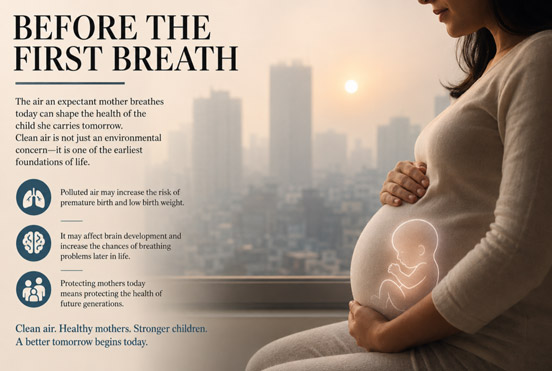
Growing evidence suggests that prolonged exposure to polluted air during pregnancy may increase the risk of premature birth.
Air pollution is certainly not the only cause, but researchers believe it may be one of several factors that contribute to pregnancy complications.
Scientists have also been studying birth weight. According to the World Health Organization, babies born with a low birth weight are more vulnerable to infections and other health challenges during infancy.
Several studies have suggested that mothers who are exposed to higher levels of air pollution during pregnancy are more likely to have babies who weigh less than expected at birth.
Another area receiving increasing attention is brain development.
Long before a child speaks its first word or takes its first step, the brain is already growing at an extraordinary pace.
Millions of new connections are formed every day, creating the foundation for learning, memory, behaviour and emotional development.
Researchers are now exploring whether long-term exposure to polluted air during pregnancy may influence this delicate process.
While scientists continue to investigate these links, the findings reinforce a simple message: a healthy environment during pregnancy supports healthy development.
The lungs tell a similar story.
Although a newborn takes its first breath only after birth, the lungs begin developing months earlier.
Researchers believe that cleaner air during pregnancy and early childhood can contribute to healthier lung development, while repeated exposure to polluted air may increase the likelihood of breathing problems later in life.
The first 1,000 days of life-from conception to a child's second birthday-are widely recognized by UNICEF and public health experts as one of the most important periods of human development.
During this time, the foundations of physical growth, brain development and lifelong health are established. The quality of nutrition, healthcare, emotional care and the surrounding environment all matter.
That is why protecting expectant mothers is about much more than protecting one individual. It is about protecting an entire generation.
The latest State of Global Air report estimates that air pollution contributed to around 8.1 million deaths worldwide in 2021, including more than 700,000 deaths among children under the age of five.
These numbers remind us that clean air is not simply an environmental aspiration; it is essential for public health.
Looking beyond the headlines
In India, conversations about air pollution often begin with winter smog and end with discussions about traffic, industries, or crop-residue burning. These are important issues, but they are only part of a much larger story.
Air pollution is also about the woman travelling to work through heavy traffic during pregnancy. It is about a family living near a busy road or an industrial area.
It is about a child quietly growing inside the womb, completely dependent on the mother's body for every breath of oxygen and every drop of nourishment.
The good news is that this is one environmental challenge where action can make a real difference.
Governments can strengthen pollution-control measures, improve public transport, encourage cleaner energy, regulate construction dust and support better urban planning.
Healthcare professionals can include environmental awareness as part of routine antenatal care, helping families understand practical ways to reduce unnecessary exposure during periods of severe pollution.
Families can also take simple but meaningful precautions. Keeping track of local air-quality updates, avoiding unnecessary outdoor exposure during severe pollution episodes where possible, reducing indoor smoke from tobacco or other sources, and following medical advice throughout pregnancy are sensible steps that may help lower exposure.
These actions cannot eliminate pollution, but they can reduce avoidable risks while broader solutions continue to evolve.
At the same time, it is important not to place the burden entirely on expectant mothers. No woman chooses the quality of the air she breathes while travelling to work, visiting a hospital or walking through her neighborhood.
Clean air is a shared responsibility. It depends on thoughtful policies, responsible industries, cleaner technology and communities that recognize the importance of protecting the environment—not only for themselves but also for the generations that will inherit it.
A future worth protecting
Every generation dreams of giving its children a better future. We save for their education, celebrate their achievements and hope they will grow into healthy, happy adults.
We build schools, hospitals and playgrounds because we believe children deserve the very best opportunities.
Yet perhaps the first gift we can offer does not begin in a classroom or a playground. It begins much earlier.
Long before a child learns to walk, speak, or dream, that child depends entirely on the world we have created. The quality of our air is not simply an environmental issue.
It is one of the earliest promises we make to the next generation. Because long before a baby opens its eyes to the world, the world has already begun shaping that child.
The first environment every child experiences is not the world outside. It is the air their mother breathes. Perhaps that is where protecting our future should begin.
(Neha Saini, Dr Preety Shoran and Dr Manjula Shanbhog are Assistant Professors at the School of Sciences, Christ (deemed to be) University in Delhi NCR, India.)