
By Basab Dasgupta
Who would have thought that, of all people, I would end up being a prolific writer and that even in English? The medium of instruction in my high school was Bengali, and the English teachers never spoke English outside of their classrooms. I did not read ANY book in English outside the required curriculum and had no access to libraries like the USIS library in Kolkata. I entered a different world when I enrolled in the physics department of Presidency College. I hung out with students from the best schools of Kolkata who were all well-read with great command of English. I used to get bored by their frequent discussions in the coffee house about books by Sartre, Kafka, and Camus.
Fortunately, English was not a required subject in college. I did well in physics exams and came to the USA for PhD studies. Here I had to read, write, and speak English 24 hours a day. I got my first taste in writing through writing term papers, thesis, and technical papers in physics journals. This experience taught me how to analyze a given situation, organize my thoughts, and write up a report with a definite objective, background, observations, and conclusions.
My involvement in reading and writing English in a literary sense came much later in life. Motivation came from an American woman I became fond of after my divorce. She was intelligent and well-read. I started to read books just to discuss them with her; I wrote poems serenading her, and learned how to write spontaneously by letting all my thoughts out. I articulated my personal opinions to impress her. She inspired me with her compliments.
The “watershed moment” in my writing career came when my college friend Kamal from New Jersey solicited a contribution for an upcoming puja magazine; he was on the editorial board. I wrote a story based on a personal experience, which was well-received. I enjoyed writing the piece so much that a few years later, I drafted an autobiography. Although no one read it, the exercise was a wonderful therapy.
My education led me to write about unusual aspects of physics, generating lively exchanges with my ex-classmates. These motivated me to write, not only about physics but also about philosophical and social issues, autobiographical episodes, and commentaries on current topics. Bengali organizations in various US cities gave me avenues to publish my works through their newsletters and magazines.
At the suggestion of a friend, I was brave enough to send two manuscripts to the editor of the Statesman, a respected Indian newspaper. He wrote back, “You write well,” and agreed to publish both pieces. This was the final spark needed for an explosion of fuel for my writings.
I wanted to be a “columnist”. Someone said, “You cannot be a columnist because you do not have a column. Perhaps you can call yourself an essayist”. Thus, an essayist was born. I felt that my strength lies in my simple, direct, and sincere tone with a touch of humor and controversy. Writing essays also has the advantage over writing fiction because, unlike fiction, there is no shortage of topics.
Recently, I tried to persuade Kamal to start writing. His command of English is much better than mine, thanks to his schooling at La Martiniere in Kolkata. I was telling him how wonderful it is to spend time writing during our retired life, and unlike playing golf (his favorite pastime), there is an end-product to show when one is done. I was encouraging him to write at an abstract, profound level, going above politics and events from our daily grind, using his mastery of the language.
I lamented the hyper-partisanship in the political world, which has made it difficult to publish an essay unless it conforms to the ideological stance of a newspaper. Furthermore, I reminded him that Indian newspapers naturally emphasize news and events happening in India. I encouraged him to submit to the South Asian Times because they are more in tune with the lives and issues of Indian Americans like ourselves. I expressed my confidence in his ability to go beyond superficial aspects and write something intriguing to every reader.
Sadly, Kamal was not moved by my inspiring comments. He told me that he feels no need to read any opinion piece or similar analytical or informative essay on any topic, political or otherwise, anymore. He subscribes to a ChatGPT app, which gives him a rather wide variety of information in great detail in a matter of seconds on any subject. To prove his point, he asked his Chatbot app about Sonam Bajwa’s origin while we were on the phone; the answer came back instantly. The answer not only mentioned that she is a Punjabi and Sikh, but it also provided a detailed account of her background, including where she was born, where she went to school, and the names of her relatives.
This was not too surprising to me. A celebrity like Sonam Bajwa probably has all her personal and professional information already available on the internet. ChatGPT is simply accessing all that information at lightning speed. Later, I accessed a different AI-driven chatbot and asked, "Does God exist?” I got a somewhat long and comprehensive response, covering arguments both for and against the existence of God. With a little elaboration, this could easily be an excellent opinion piece or analytical essay in some magazine or newspaper.
Although not all chatbots are the same in terms of technology at the present time, as far as the extent of information they can access or their speed is concerned, I am sure these capabilities are going to improve rapidly, and eventually, all chatbots will be equally efficient.
I was both intrigued and discouraged. I knew that Kamal’s assertion was true, and soon, no one would feel the need to read opinion columns or analytical essays in any newspaper. I already feel that many authors derive the content of their essays from websites on the internet, such as Wikipedia. Listening to the ChatGPT robot is the logical extension of that. Also, since these robots are supposed to be unbiased and apolitical, chances are that they would deliver the most objective narrative compared to any opinion piece written by a human being and even “mainstream” news editors. From the reader’s point of view, this is certainly preferable; who cares about how an author personally feels about any given topic?
Ever since that conversation with Kamal, my enthusiasm for writing has dampened considerably. I realized that my career as an essayist about current events and personalities might be coming to an end. However, I am not ready to give up yet. I will continue to write about my heartfelt emotions, unusual intuitions, and passionate convictions; AI robots still have a long way to go before they can catch up with me in these regards.
-------------------------------------
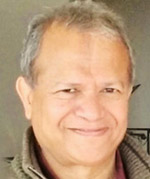
(California-based Basab Dasgupta has a doctorate in Physics from the University of Wisconsin and has worked with Sony as Vice President of an operating division. The views expressed are his own.)