By Murli Menon
Nestled in the limestone hills of Gombak, Selangor, just 13 km north of Kuala Lumpur, Batu Caves offer a serene escape into heritage and nature. Known locally as Pathu Malai or “Ten Hills”, this sacred site is the spiritual heart of Malaysia’s Tamil Hindu community. My long stay in Kuala Lumpur provided a deep insight into Tamil culture and Malaysian hospitality, as Batu Caves remains one of the most iconic Hindu pilgrimage destinations outside India.
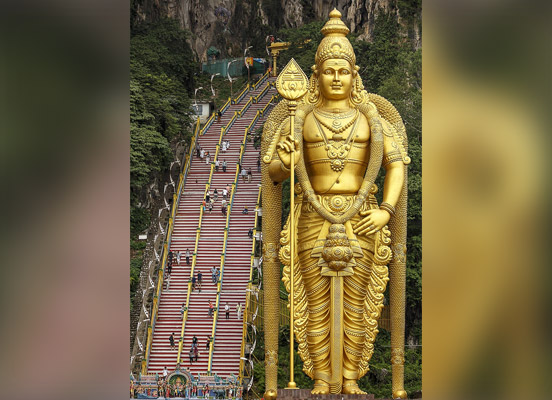
Rising 325 meters above sea level, the caves are a geological marvel formed over 400 million years ago. The towering 43-meter golden statue of Lord Murugan, completed in 2006, greets pilgrims and visitors alike. The climb of 272 vibrantly painted steps, leading to the Temple Cave, is both a physical and spiritual ascent.
The journey begins with the colorful staircase, guarded by mischievous macaques. As one ascends, the limestone cliffs reveal stalactites and stalagmites, whispering the primordial divine energy of the site. Inside the temple cave, shrines dedicated to Lord Murugan and other deities bask in the glow of oil lamps, while murals narrate episodes from Hindu mythology.
Nearby, the Ramayana Cave offers a visual retelling of the epic, with statues of Lord Rama, Hanuman, and Ravana carved into the cavern walls. The cave’s atmosphere, lit by neon hues, contrasts with the solemn sanctity of the temple cave, yet together they form a tapestry of devotion and storytelling.
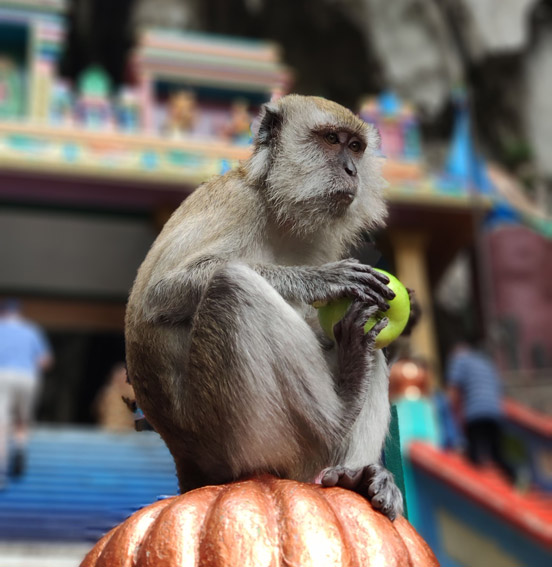
The hills near the temple cave are home to diverse wildlife, including monkeys and fruit bats. (Photo courtesy: Pexels)
The surrounding hills are home to diverse wildlife, including fruit bats, swifts, and monkeys, while the caves themselves echo with chants during festivals. For the adventurous, the Dark Cave offers guided eco-tours showcasing rare spiders and limestone cave ecosystems.
According to the ancient Tamil scriptures, Murugan, also known as Kartikeya (Skanda in the Bhagavad Gita), son of Shiva and Parvati, was gifted the divine spear (Vel) to vanquish the demon Surapadman. Seeking a place of power to establish his shrine, Murugan chose Batu Caves, its ten hills symbolizing the ten aspects of dharma. The caves became a sanctified abode where devotees could seek courage, virtue, and youth.
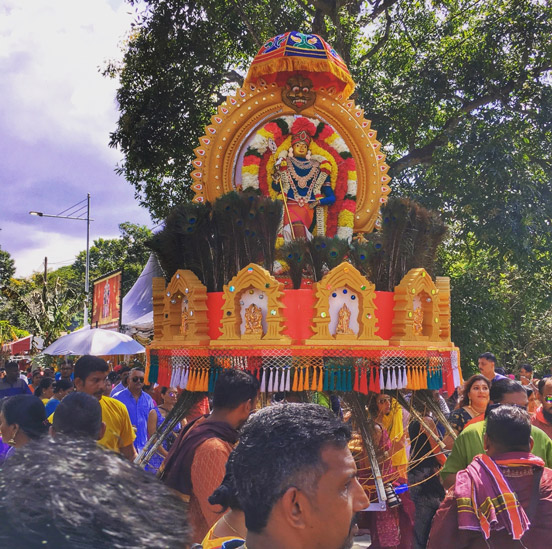
The Thaipusam festival is celebrated in Malaysia to commemorate the victory of Lord Murugan over the demon Surapadman. (Photo courtesy: Wikimedia Commons)
The annual Thaipusam festival, celebrated since 1892, commemorates this victory. Thousands of devotees undertake vows, carry kavadi (ornate offerings), and pierce their bodies as acts of devotion. The sight of saffron-clad pilgrims ascending the 272 steps with earthen pots and kavadi is a living enactment of the puranic tale.
At the base of Batu Caves, Tamil vegetarian fare is served at roadside eateries. Banana leaf meals with sambar, rasam, and poriyal are staples, while fresh coconut water and lime juice provide respite after the climb. During Thaipusam, stalls line the approach road, offering free food (annadanam) to pilgrims, including rice, curries, and sweets prepared by volunteers.
Kuala Lumpur offers a range of stays from budget hostels near Sentral Station to luxury hotels like the Cititel Hotel, Kuala Lumpur. For pilgrims, guest-houses near Batu Caves provide proximity to the temple complex.
I personally did a day trip driving to Batu Caves from Penang and stayed at boutique hotels in Penang, including Cititel, Penang and City Bayview Hotel, Penang and Gurney Hotel.
|
>> How to get there By train: KTM Komuter connects Kuala Lumpur Sentral to Batu Caves in 30 minutes. By road: A 20-minute drive from the KL city center, with taxis and ride-hailing apps readily available. From Penang: The 350 km drive from Penang to Batu Caves takes four hours. >> Nearby attractions Batu Cave Villa & Art Gallery, showcasing Hindu art and culture, trekking into limestone ecosystems, and into the evergreen rainforests of Taman Negara in Penang. |
.jpg)
Murli Menon is the author of ZeNLP books and conducts storytelling workshops based on his works on eschatology. He can be reached at [email protected]