By Vipul Tamhane
The quest for peace is still on, but it has been made known by 2025 that the road ahead will be neither easy nor guaranteed anymore.
With the closing of 2025, the globe has to deal with an entirely revolutionized geopolitical map, which is characterized by the increase in wars, international norms becoming less and less powerful, and a clear shift towards a multipolar world. It was a year when the old order could no longer handle the pressure of rivalry among states, thus giving rise to weak truce agreements and disputes that had not been settled as the inheritance of the period.
The return of transactional diplomacy
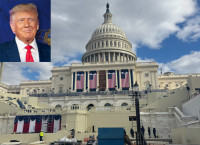
On January 20, 2025, Donald Trump took office as the 47th president of the United States, marking a shift toward policy turbulence. Instead of broad cooperation, his revived "America First" stance brought wide-ranging import taxes, reaching 10 per cent generally, yet spiking to 50 per cent for nations such as China and India.
Pulling out of the Paris Climate Agreement and exiting the World Health Organization became key moves. At the same time, shrinking financial support for the United Nations highlighted a deeper disengagement from global partnerships, an approach felt across continents.
Security support under Trump often came with strings attached, tied directly to financial or resource-related demands. When Kyiv discovered arms shipments depended on granting mining privileges, it exposed how leverage shaped policy.
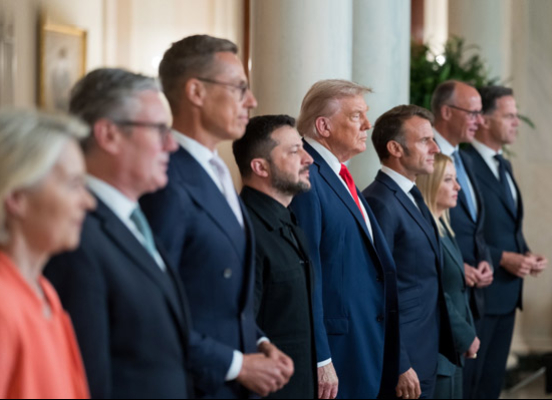
European nations, long used to steady partnerships, faced sudden shifts, forcing them to rethink their reliance on Washington. This uncertainty fueled bigger budgets for armed forces across the region while governments explored using immobilized Russian funds to back Ukraine’s ongoing fight.
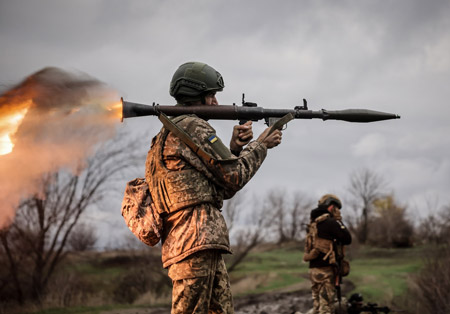
A Ukrainian soldier fires at a Russian position. (Photo courtesy: Volodymyr Zelenskyy/Facebook)
Persistent wars and fragile truces
A third year unfolded without an end appearing likely. Even though Russian forces held about one-fifth of Ukraine’s land, their advance slowed sharply, gaining under one per cent more by 2025. Kyiv responded with new tactics, surprising observers when drones struck far inside Russia during what insiders called Operation Spiderweb. Meanwhile, peace efforts led by Washington stumbled; meetings between Trump and Vladimir Putin in Alaska, followed by discussions in Miami, failed because Moscow would not withdraw. Progress stayed out of reach.
The Middle East experienced a wave of unrest that was rocking the whole region and never seen before. The Israeli military conducted major operations in Lebanon, Yemen, Syria, and even Iran. In June, these operations escalated into a conflict that lasted for 12 days and was marked by the joint attacks of the US and Israel on the nuclear sites in Iran. The operation was called "Midnight Hammer", which, with its intensified violence, further moved the region's instability, which was already suffering from the Gaza conflict.
A shaky truce slowly settled over Gaza, allowing prisoners to be freed while aid began reaching civilians, yet breaches continued, leaving what comes next unclear. By contrast, late 2024 saw Assad's rule collapse in Syria, triggering shifts across the region; entering 2025, Ahmed al-Sharaa stepped into power, seeking early contact with Europe and the US to ease sanctions and related penalties.
Flashpoints beyond the headlines
While the world was watching Ukraine and the Middle East, less visible but equally critical situations were becoming worse in the background. In Sudan, conflicts arose among the military groups, which led to a humanitarian emergency with millions of people being displaced. The United Nations identified it as the worst aid emergency in the world today. Over twelve million people escaped, a large portion being subjected to starving conditions so bad that it is endangering their lives.
The most recent incident in South Asia was quite fierce, and it was the most serious moment in the region for years. It was the militant attack in April that targeted an area of Kashmir controlled by India. This led to a short but very fierce period of fighting between India and Pakistan during May, which lasted exactly four days, and emphasized the fact that the conflict can escalate very fast when the nuclear powers are involved. Communication between armed forces at operational levels helped pull tensions back from the edge. What unfolded served as a stark instance of brinkmanship among neighbors with atomic arsenals.
Myanmar's internal conflicts escalated despite the government's assertion that elections would be a means to renew politics. A little later, Bangladesh plunged into its deepest political crisis since the beginning of the 2010s. The conflict between Pakistan and Afghanistan turned up a notch quickly through the borders after the air attacks from one side and the retaliatory strikes from the Taliban on the other.
Meanwhile, extremist-related violence in the Sahel grew massively, and the disorder got hold not only of Mali but also the surrounding countries like Benin, Togo, and Nigeria. In a different part of the world, armed gangs were gradually taking full control of the capital city of Haiti, thereby pushing the fragile state closer to collapse.
Economic warfare and technological competition
A shift in world economics took center stage this year as countries pulled apart economically. When Trump introduced sweeping tariffs labeled as “Liberation Day,” international supply networks wavered under strain. Reactions followed swiftly, pushing governments to explore new trading partners instead of relying on old ties. In one pivotal moment, China slowed shipments of rare earth elements to the United States after tax measures were imposed. That pause led Washington to soften part of its stance while revealing how fragile essential material flows truly are.
The artificial intelligence race between Washington and Beijing intensified; nowhere is the rivalry more visible than in how chips shape global influence. Power shifts follow who leads in machine learning tools. One side restricts hardware flows; the other accelerates domestic production. Technology edges once shared now face barriers. Breakthroughs in gene editing, next-gen computers, or green tech matter less for profit than for leverage. Whoever sets standards gains an advantage. Progress ties tightly to national agendas. Control over components decides broader reach. Influence spreads through innovation networks. Silent contests unfold in labs and factories. Outcomes hinge on access, secrecy, and talent.
Climate, protests, and shifting power dynamics
The year saw a sharp rise in heat, standing out as notably high within recorded climate data. What made it very clear were the increasing global temperatures, which put the time among the hottest ever recorded. The European continent had wildfires that were raging in the forests, and the cause was a long period of dryness. On the other hand, the Asian areas were suffering from heavy rains that lasted for weeks, and they were changing the climate quicker than expected. These changes did not occur by themselves but were influenced by, and at the same time influencing, the existing stress factors, thus changing the ecological balances and the social stability. The subsequent geopolitical changes became very unpredictable. In this context, COP30 unfolded in Brazil, drawing global attention. America appeared less certain in its role, stepping back gradually. Meanwhile, China stepped forward, not loudly, yet unmistakably present in climate discussions. Heat lingered, not just in the atmosphere but in political tensions too.
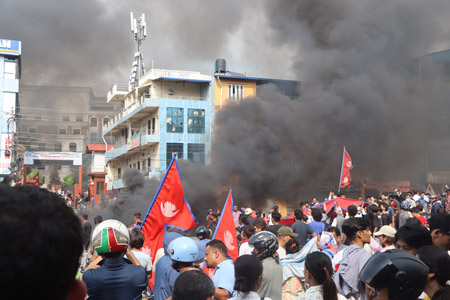
Nepal’s youth hit the streets in unprecedented protests, following a sweeping government ban on social media platforms. (Photo courtesy: Wikimedia Commons)
A wave of youth-driven protests targeting graft and favoritism shook regimes in Nepal, Madagascar, yet also elsewhere, a proof that the younger generations can shift real political ground. Elsewhere, extremist factions gained strength in West Africa while filling weak spots left by failing administrations in parts of the Middle East, along with South Asia.
There were major shifts in the power dynamics of the regions. The rising partnership between China, Russia, and North Korea was a clear indication of the West's influence reaching a limit in a united front. Conversely, the Gulf Cooperation Council began to drift apart with the differing Saudi-UAE tactics towards Yemen, exposing the rifts of the once-unified bloc.
A world redrawn
As the year 2025 comes to an end, power across nations feels more fragmented, shaped less by consensus, more by competition, than it has been in years. Rules that once held weight globally now weaken under repeated strain. Trade ties, meant to bind countries together, instead get used as tools of pressure. Conflicts simmering in different regions pile up, shaking long-held beliefs about how world politics should work.
Still, openings appear even within disorder. A deal reached between Armenia and Azerbaijan, backed by US involvement, broke through decades of deadlock where talks had failed before. What happens next depends on choices made under pressure.
Europe stood by Ukraine, showing alignment matters when crises hit. Rising powers grow bolder, turning to groups such as BRICS to shift influence away from old Western-led institutions.
The year ahead will challenge the global society to either stop these separating trends or recognize 2025 as the year of the consolidation of the multipolarity into fixed rival blocs. At the moment, the planet goes through an uncertain changeover, one in which dialogue contends with coercion, cooperation with competition, and shared difficulties against the backdrop of shrinking national interests. The quest for peace is still on, but it has been made known by 2025 that the road ahead will be neither easy nor guaranteed anymore.
----------------------------------------------------
.jpg)
(Vipul Tamhane is a counter-terrorism expert and governance consultant)