By Kuntala Karkun & Jyoti Yadav
Closing India’s gender gap in finance and labour participation is not only a social goal, it is an economic imperative.
India’s financial inclusion journey is rightly celebrated as a global benchmark. Over the last decade, the Jan Dhan–Aadhaar–UPI trinity has connected 55 crore citizens to the formal financial system. Fifty-six per cent of the Jan Dhan account holders are women, and 66% of these, or two in every three women, are in rural and semi-urban India, a sign of deep penetration.
Yet, this revolution has stalled halfway. Around 23% of all Jan Dhan accounts, around 130 million, are inactive (as of July-2025, per Ministry of Finance figures). Financial inclusion has reached the doorstep, but economic inclusion has yet to enter the household. The next frontier of reform must move from access to activation: from accounts that exist to accounts that empower.
A success story with incomplete dividends
The gender gap in formal account ownership has nearly closed. The World Bank Global Findex 2023 shows that 78% of Indian women now own a financial account, compared to just 43% in 2014. However, usage remains limited. Government data indicate that nearly 49 million inactive Jan Dhan accounts belong to women, and women receive only 7% of total formal business loans (Ministry of Finance, RBI).
A recent report by Pahle India Foundation, Enhancing Female Entrepreneurship & Employment in the MSME Sector, finds only 14% of India’s MSMEs are women-owned, with most operating informally and outside formal credit networks. Further, women-led enterprises face a 35-40% higher credit rejection rate than men-led firms and often rely on personal savings or informal borrowing. Among urban self-employed women, 65% have never accessed a formal business loan. This gap between inclusion on paper and empowerment in practice defines the unfinished agenda of India’s financial inclusion story.
The financing fault line: Beyond collateral
The problem runs deeper than the lack of collateral, it stems from a mix of structural and behavioral barriers. On the supply side, lenders often perceive women-led enterprises as riskier because of their informal business profiles, smaller loan sizes, and limited credit histories. On the demand side, women face low financial literacy, fear of debt, and banking processes that are time-consuming and incompatible with domestic responsibilities. As a result, India’s women entrepreneurs face a staggering $1.4-1.7 trillion financing gap (IFC).
Pahle India Foundation’s analysis of ~350 MSMEs across six states (Chhattisgarh, Gujarat, Maharashtra, Odisha, Tamil Nadu, and Uttar Pradesh) shows that lack of collateral and formal credit records remains the most significant obstacles to institutional finance.
At the same time, digital adoption is proving to be a decisive differentiator; women-owned enterprises using UPI or digital payments recorded 17% higher revenue growth and 22?tter credit access compared to their offline peers. Yet, fewer than 20% women-led MSMEs currently use digital bookkeeping or invoicing tools, keeping them invisible to lenders. The message is clear: digital inclusion must now form the bedrock of financial deepening and empowerment.
A policy shift on the horizon
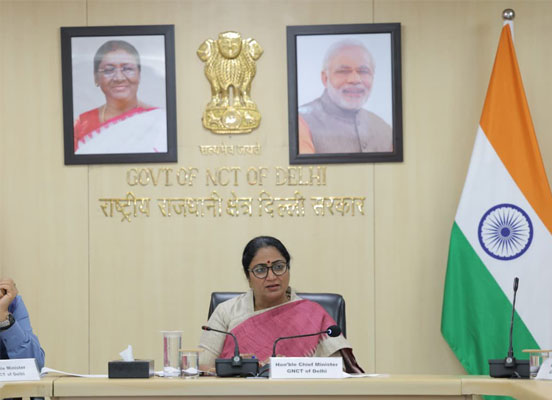
At the launch event of the Report, Delhi Chief Minister Rekha Gupta announced a ₹10 crore collateral-free loan scheme for women entrepreneurs, a first-of-its-kind initiative for the national capital. The scheme aims to provide zero-collateral working capital and expansion loans through a government-backed guarantee mechanism, targeting 10,000 women-led micro and small businesses in its pilot phase.
This initiative is significant for two reasons. First, it signals state-level ownership of gendered financial inclusion, which until now has been largely centralised under national missions. Second, by providing collateral-free lending within an urban ecosystem, it could serve as a testbed for scalable models in other states.
However, as the Report cautions, credit access without complementary capacity-building and market linkages risks limited impact. Without integrating financial literacy, digital onboarding, and supply-chain participation, such schemes may add breadth but not depth to inclusion.
From access to activation: What must change
To convert financial access into economic empowerment, three structural shifts are necessary:
Fintech as a gender equalizer
Fintechs and payment banks can play a catalytic role in narrowing the usage gap. Initiatives like PayNearby Saathi, which trains women as rural banking correspondents, show how digital models can simultaneously create employment and expand financial reach.
Policymakers can accelerate this momentum by mandating gender-disaggregated fintech data, creating regulatory sandboxes for women-focused financial products, and including women’s digital credit participation as a Priority Sector Lending (PSL) sub-target.
From welfare to growth: Inclusion as a strategy
Closing India’s gender gap in finance and labour participation is not only a social goal, it is an economic imperative. McKinsey Global Institute (2023) estimates that achieving gender parity could boost India’s GDP by 27%, or ₹46 lakh crore. The Report suggests that if even half of inactive women’s accounts were reactivated and channelled toward income-generating activities, India could unlock nearly ₹2.5 lakh crore in additional household credit flow annually.
Women’s current contribution to GDP, just 17-18% underscores how much potential remains untapped. The gains from deepening inclusion are not incremental, they are transformative.
The road ahead
Ten years ago, India ensured that every household had a bank account. The next decade must ensure that every woman uses hers; to build a business, a livelihood, and a future. This demands state-driven credit innovation, digital-first inclusion, and institutional accountability for women’s economic activation. The momentum from Delhi’s collateral-free loan scheme, UP’s Bank Sakhee, Odisha’s SHG-linked credit, and Kerala’s enterprise networks must now converge into a national framework. Turning financial inclusion into economic power is not just about closing gender gaps, it is about opening growth frontiers. The women of Bharat hold the key to its most inclusive decade yet.
(Kuntala Karkun is a Senior Fellow and Jyoti Yadav is a Fellow at Pahle India Foundation, a policy think-tank based in New Delhi.)
The views expressed are not necessarily those of The South Asian Times