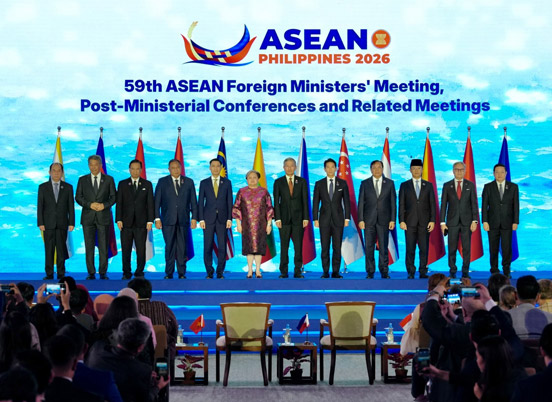
Southeast Asia's top diplomats began three days of talks in Manila this week, with the conflict in the Middle East escalating and tensions in the South China Sea building up. The meeting opened against the backdrop of the resurging war involving Iran and a violent skirmish in disputed waters.
Foreign ministers of the Association of Southeast Asian Nations (ASEAN) met behind closed doors before issuing a joint statement calling for an immediate halt to fighting in the Middle East and the full and safe reopening of the Strait of Hormuz.
"We expressed serious concern over the rapidly evolving situation in the Middle East, particularly the renewed hostilities involving the United States of America and the Islamic Republic of Iran," the ASEAN ministers said.
"We are deeply concerned that these developments severely undermine the ongoing efforts of key mediators and diminish the prospects for a peaceful resolution through dialogue and diplomacy," they added.
The ministers also said they reaffirmed the obligations of states to peacefully resolve their differences and respect national sovereignty and territorial integrity. Southeast Asia, a region of more than 680 million people, relies heavily on Middle East oil and gas and has been hit hard by the global supply and price shocks triggered by the Iran war.
Starting this week, Philippine and Chinese sailors clashed at the Second Thomas Shoal in the South China Sea in what was the first serious seaborne encounter in months. Manila said China Coast Guard personnel had assaulted Filipino sailors.
The clash has highlighted the urgency of the proposed non-aggression pact, which has been under negotiation for about two decades, with both sides aiming to conclude talks within the year. Beijing claims sovereignty over almost the entire South China Sea, a vital global trade route, despite an international ruling that its claims have no legal basis.