Washington, D.C.: The Gupta-Klinsky India Institute (GKII) at Johns Hopkins University, in partnership with Indiaspora, convened the Hopkins India Conference 2026 at the Johns Hopkins University Bloomberg Center in Washington, D.C., bringing together leaders from government, academia, industry, and civil society to examine the future of the India–U.S. relationship in a rapidly changing global environment.
At a time of increasing geopolitical and economic fragmentation, the conference positioned the India–U.S. partnership as a central pillar of alignment across trade, technology, energy, and security.
The conference, now in its second year, focused on “Ideas, Innovation, and Impact for a Shared Future,” with discussions spanning geopolitics, economic strategy, artificial intelligence, climate, public health, and philanthropy.
-Atul-Keshap,-President,-U_S.jpg)
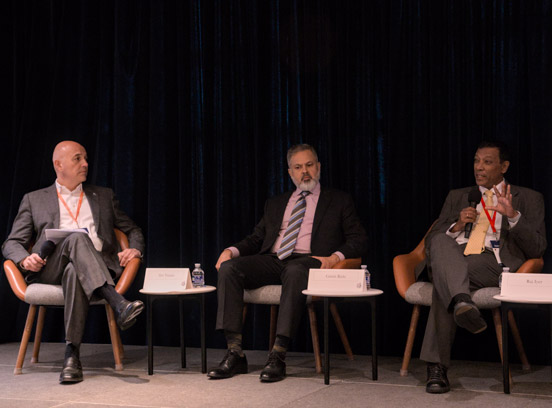
Ambassador (Retd.) Atul Keshap, President, U.S.-India Business Council and Vivek Lall, Chief Executive, General Atomics on the impact of West Asia Conflict on energy security
The conference featured a distinguished lineup of speakers, including Ambassador Namgya C. Khampa; Ambassador (Rtd.) Atul Keshap, Sunil Wadhwani, Managing Partner, SWAT Capital, President, Wadhwani AI; Lisa Curtis, Senior Fellow and Director, Indo-Pacific Security Program, Center for a New American Security; Rick Rossow, Senior Adviser and Chair, India and Emerging Asia Economics, Center for Strategic and International Studies; Anshu Gupta, Founder, Goonj; and other leaders across sectors shaping the India–U.S. corridor.
“This year, the conference convened a diverse audience to explore critical themes such as U.S.–India relations, the fast-evolving AI landscape, India’s DeepTech momentum, and reimagining systems in the climate era,” said Neetisha Besra, Director–India, Gupta-Klinsky India Institute. “The book discussion with Megha Majumdar was a particular highlight for many participants.”
In a recorded message, Union Minister Jayant Chaudhary emphasized the role of people-to-people ties, noting that talent mobility, including over 300,000 Indian students in the United States, continues to strengthen the foundation of the bilateral relationship. He said, “One of our strongest bridges is our people. With over 300,000 Indian students in the US, alongside a dynamic flow of researchers and professionals in both directions, we are seeing a powerful exchange of knowledge and skills. This movement of talent is not incidental.”

Amb. Namgya C. Khampa, Deputy Chief of Mission, Embassy of India, gives keynote address on India-U.S. relations at Hopkins India Conference 2026
Ambassador Namgya Khampa, deputy chief of mission for the Embassy of India, described the Indian-origin community in the U.S. as a force multiplier that few bilateral relationships can match, and a reservoir of strength and goodwill for building the bilateral partnership between India and the United States. “What was once careful, sometimes hesitant engagement has evolved into a partnership that is now central to how both countries envision the world around them—driven by intersecting interests: economic, strategic, security, and technological,” she said. “And this transformation is not sudden. It has been built steadily over years—across governments and through sustained effort on both sides.”
Throughout the day, the conference hosted a series of high-level panels examining critical global and bilateral priorities. A panel on India in a fragmenting global economy, chaired by Shuchita Sonalika, Director and Head of Confederation of Indian Industries (CII) explored how India is navigating shifting trade dynamics, technological competition, and strategic autonomy in an increasingly complex geopolitical environment.
A session on building India’s deep-tech engine, chaired by Dean Alex Triantis of Carey Business School, brought together leaders from academia, industry, and venture capital to examine how India can scale innovation through stronger linkages between research institutions, startups, and capital, with a particular focus on enabling adoption and demand for emerging technologies. Seema Chaturvedi, Founder & Managing Partner, Achieving Women Equity Funds, particularly emphasized the need for investing more in women founders.
A climate-focused panel on reimagining systems for dignity and agency highlighted the need to center communities in climate responses, emphasizing resilience, equity, and the integration of health, environmental systems, and policy. Sweta Chakraborty, CEO – North America, We Don’t Have Time, highlighted the critical role of strategic communication in shaping human behavior and driving climate action.

Video Address by Shri Jayant Chaudhary, Minister of State with Independent charge for Skill Development and Entrepreneurship of India
The conference also examined evolving global challenges through a fireside conversation between Amb (Rtd.) Atul Keshap of the U.S.-India Business Council and Dr. Vivek Lall of General Atomics on West Asia, analyzing the implications of regional conflict on global energy systems, geopolitical alignments, and economic stability.
A keynote by Sunil Wadhwani highlighted the transformative role of artificial intelligence in accelerating societal development. He said, "AI-based solutions are improving development outcomes in health, education, and agriculture, and for its impact to be equitably scaled, we need to be collaborating with governments.”
A panel on philanthropy in a world of shrinking global funds explored how philanthropic capital has become a force for good driving research excellence, community development and frontier-tech innovation. The panel reflected on nurturing the next generation of diaspora to feel connected to giving causes and sustain long-term impact, with a focus on collaboration, efficiency, and new approaches to mobilizing capital for development.
In addition to public sessions, Day 2 convened invite-only roundtables focused on priority areas such as public health, women’s leadership in research, higher education, mental health, climate disasters, and training AI workforce, enabling deeper engagement among partners and stakeholders.
“The Conference brought together a diverse audience to explore critical themes shaping the India-U.S. corridor, from geopolitics and AI to climate and public health,” Kunal Pal, Executive Director, Gupta-Klinsky India Institute, said. “The roundtables in particular enabled solutions-focused dialogue with key partners and stakeholders on how to translate ideas into action.
(All photos courtesy: Johns Hopkins University)